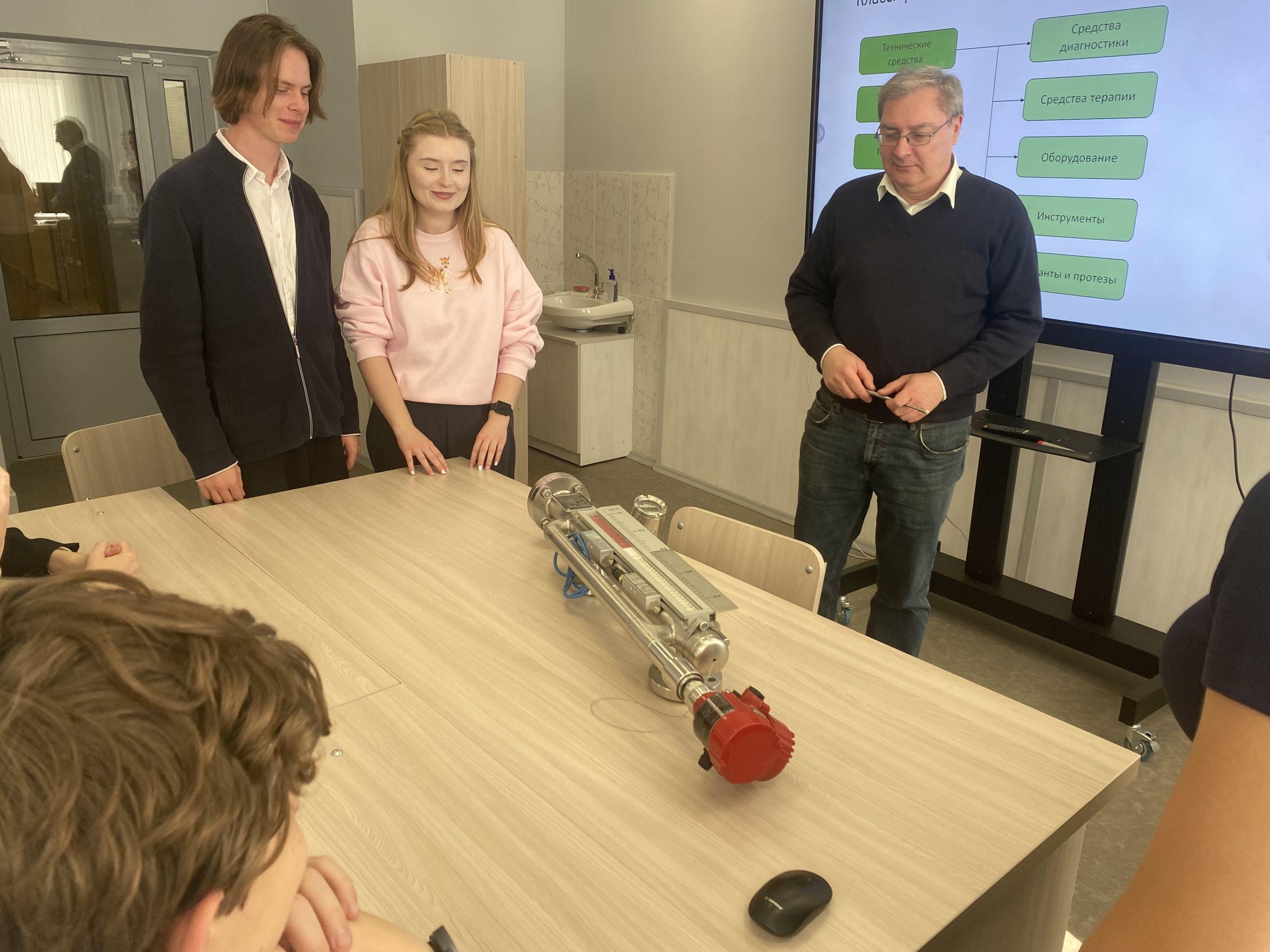
On September 30, 2026, the Instrument-Making Faculty of BNTU hosted students of the engineering class of Secondary School No. 108 in Minsk. The visit became another step in the faculty's systematic career guidance work with schools in the capital and continued a series of meetings aimed at immersing schoolchildren in the world of modern engineering at an early stage.
For the guests, a lecture session was organized in the laboratories of Building 17 on the topic "Modern Biomedical Technology, Its Modeling and Production. Implants. Endoprostheses." The session was conducted by Andrey Savchenko, Head of the Department of "Design and Production of Instruments."
During the lecture, the students learned how achievements in instrument-making find application in medicine — one of the most dynamically developing and socially significant fields. Particular attention was paid to the modeling and production of implants and endoprostheses: from engineering calculation and computer-aided design to the selection of materials and modern manufacturing technologies. The students became acquainted with how products are created whose quality directly affects human health and quality of life.
The lecture was accompanied by a demonstration of the capabilities of the department's laboratory facilities, which allowed the students not only to hear theoretical material but also to see how engineering ideas are translated into real products. The students showed keen interest in examples of the practical application of biomedical technologies and in issues related to the prospects for the development of this field.
Such meetings are an important part of PSF's cooperation with institutions of general secondary education. They help high school students take a conscious approach to choosing their future profession and also form a holistic understanding of what a modern instrument-making engineer does. The Instrument-Making Faculty of BNTU continues to open its doors to schoolchildren interested in engineering creativity and scientific and technological progress.
