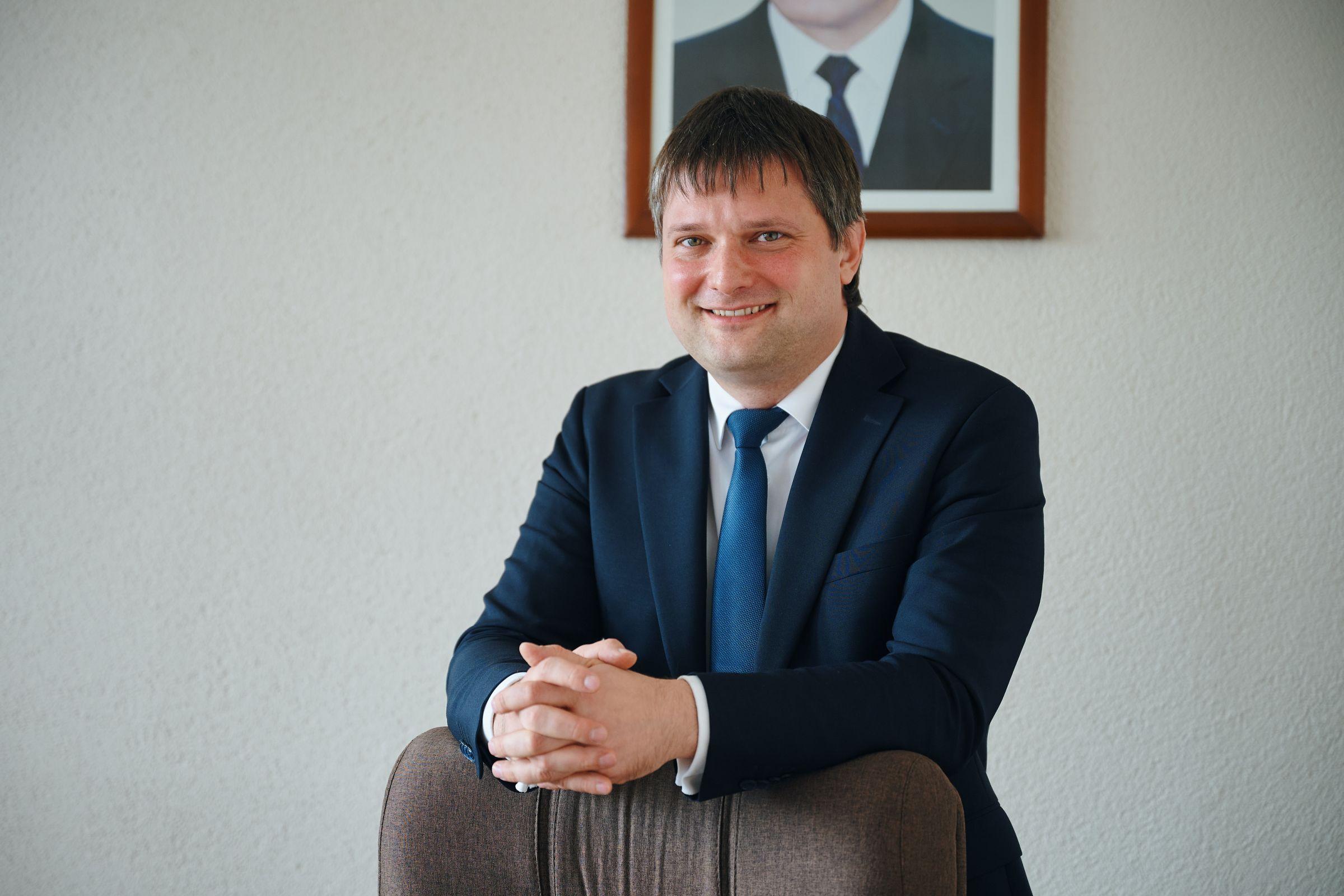
Today, on October 1, the Faculty of Energy Engineering (FES) celebrates its 40th anniversary. It was on this day in 1986 that the faculty officially began its work at the Belarusian Polytechnic Institute to train highly qualified specialists. Since then, its history has been inextricably linked with the development of energy and water management in Belarus. Today, the faculty is a modern engineering school that trains specialists without whom it is impossible to imagine the life of cities and industrial enterprises.
Dean of the Faculty of Energy and Water Management Dmitry Livansky admitted that the anniversary is not just a date for him, but an occasion to look back at the history of the faculty.
— For me, the 40th anniversary of the faculty is, first and foremost, an occasion to look back with pride at the path it has taken and to remember with gratitude all those who created it. Officially, we celebrate the founding of the faculty in 1986, but its roots run much deeper, going back to the very founding of the Belarusian National Technical University in 1920, when the first departments specializing in hydraulic engineering and hydraulic reclamation were established. Therefore, forty years is not the beginning of the story, but a stage of its maturity, when disparate but related areas united into a single, powerful faculty. For me, as the dean, this is also a great responsibility: over these years, the faculty has accumulated vast experience, reputation, and traditions, and my task is not to lose them, but to develop them further in line with the demands of the time.
Maintaining the traditions of continuity, the faculty was successively headed by Nikolai Sinitsyn from 1986 to 1998, then for almost twenty years, from 1998 to 2017, by Pyotr Bogoslavchik, and from 2017 to 2022 by Vladimir Ivashechkin. Each head created new areas of focus, strengthened the material and technical base, and developed scientific schools. Separately, Dmitry Livansky highlighted the formation of a system of departmental branches at enterprises such as RUP “Belnipieenergoprom” and UE “Mingaz,” which fundamentally changed the approach to practical training. According to him, the continuous expansion and updating of specialties and profiles allows the faculty to remain modern and in demand.
— Initially, the faculty combined areas related to hydraulic engineering, heat and gas supply, and water supply—that is, the core specialties for the energy and water management sectors. Over the course of forty years, the training structure has evolved significantly. Today, we are conducting training in four specialties and six specializations: “water transport vehicles” (specialization “shipbuilding and technical operation of water transport”), “engineering economics” (specialization “utilities and water management”), “engineering networks, equipment of buildings and structures” (specializations “heat and gas supply, ventilation and air basin protection” and “water supply, wastewater disposal and protection of water resources”), as well as “construction of buildings and structures” (specializations “hydraulic engineering construction” and “construction of buildings and structures in thermal and nuclear power”).
— Which areas of training do you consider the most promising and in demand at the moment?
— I would single out several areas at once. First, the construction of thermal and nuclear power facilities — this is an area with enormous potential, given that Belarus is developing its own nuclear power industry and modernizing thermal generation. Second, heat and gas supply and ventilation — this is an area that is becoming increasingly technological, given the focus on energy efficiency and the introduction of smart building management systems. Thirdly, water supply and wastewater management — there is a growing demand for specialists capable of working with modern treatment technologies and sustainable water use. I would like to highlight hydraulic engineering construction — a traditional field that is acquiring new significance in the context of the development of small‑scale and hybrid hydropower.
Dmitry Livansky emphasized that a close connection with the real sector of the economy is built not on one‑off contacts, but on systematic and long‑term work with industry enterprises. Cooperation is built through joint educational programs, practical training, the placement of graduates, and, most importantly, through the establishment of department branches directly at enterprises. This format allows students to immerse themselves in real production even during their studies, and enables enterprises to train personnel tailored to their needs, knowing the level of their training.
The faculty’s partner network covered all areas of training — from design institutes to operational organizations.
— The main employers of the graduates from the Faculty of Energy Construction today are the unitary enterprise “Mingaz,” which has established a special training center that annually provides internships for about 78 full‑time students; the unitary enterprise “Minskvodokanal” and other organizations responsible for the operation of water supply and wastewater systems; and the RUE “Belnipyenergoprom” — the leading design and survey institute in the field of energy, on the basis of which the faculty operates.
— What, for you as the dean, is the main indicator of the faculty’s successful work?
— For me, the main indicator is the demand for and success of our graduates. When I see that former students are working at key facilities in the country’s energy and water management sectors, growing professionally, and taking up leadership positions at partner companies, it’s the best confirmation that the faculty is fulfilling its mission properly. The second important indicator is the stable interest of applicants in our specialties and fields of study, which speaks to the trust in the quality of education. And thirdly, the atmosphere at the faculty, where students, teachers, and staff feel like part of one big team, are ready to contribute to the common cause, and are proud of their faculty — this is perhaps the most valuable, albeit not directly measurable, indicator of success.
Celebrating its 40th anniversary, the faculty did not rest on its laurels. The dean shaped his vision for the coming decade taking into account the challenges facing the country.
— Among the strategic tasks, I would highlight the further development of the construction of nuclear and thermal power facilities in line with the objectives of the national energy strategy, the expansion of competencies in the field of hydropower and hybrid renewable energy systems, as well as a more profound digitalization of the educational process — the introduction of BIM design and elements of artificial intelligence into engineering calculations. An equally important task is to strengthen and expand the network of departmental branches at enterprises so that practical training becomes increasingly comprehensive.
Thinking about the future of the faculty, Dmitry Livansky could not help but recall those who created it and continue to do so today. He addressed his congratulations to them.
— Dear colleagues, graduates, and students! Forty years is a story written by each of you. To the teachers and staff, I want to say a sincere thank you for your many years of work, your loyalty to the faculty, and the fact that you continue to teach with the same dedication with which the faculty began its journey in 1986. To the graduates — thank you for honourably upholding the status of graduates of the Faculty of Energy Construction at enterprises across the country, confirming the quality of our training with your professionalism. To the students, I want to say that you are the ones who will continue this story. Preserve the traditions that previous generations passed on to you, but don’t be afraid to introduce something new — that’s how the faculty has remained vibrant and relevant for forty years. Happy holiday to all of us, dear Faculty of Energy Construction!
Congratulations to the Faculty of Energy Construction on its 40th anniversary! Over this time, the faculty has become not just a place where students are taught, but an engineering school whose specialists ensure that there is light, heat, and water in homes. May there be many more significant projects and achievements ahead, and may the work bring joy and pride!
