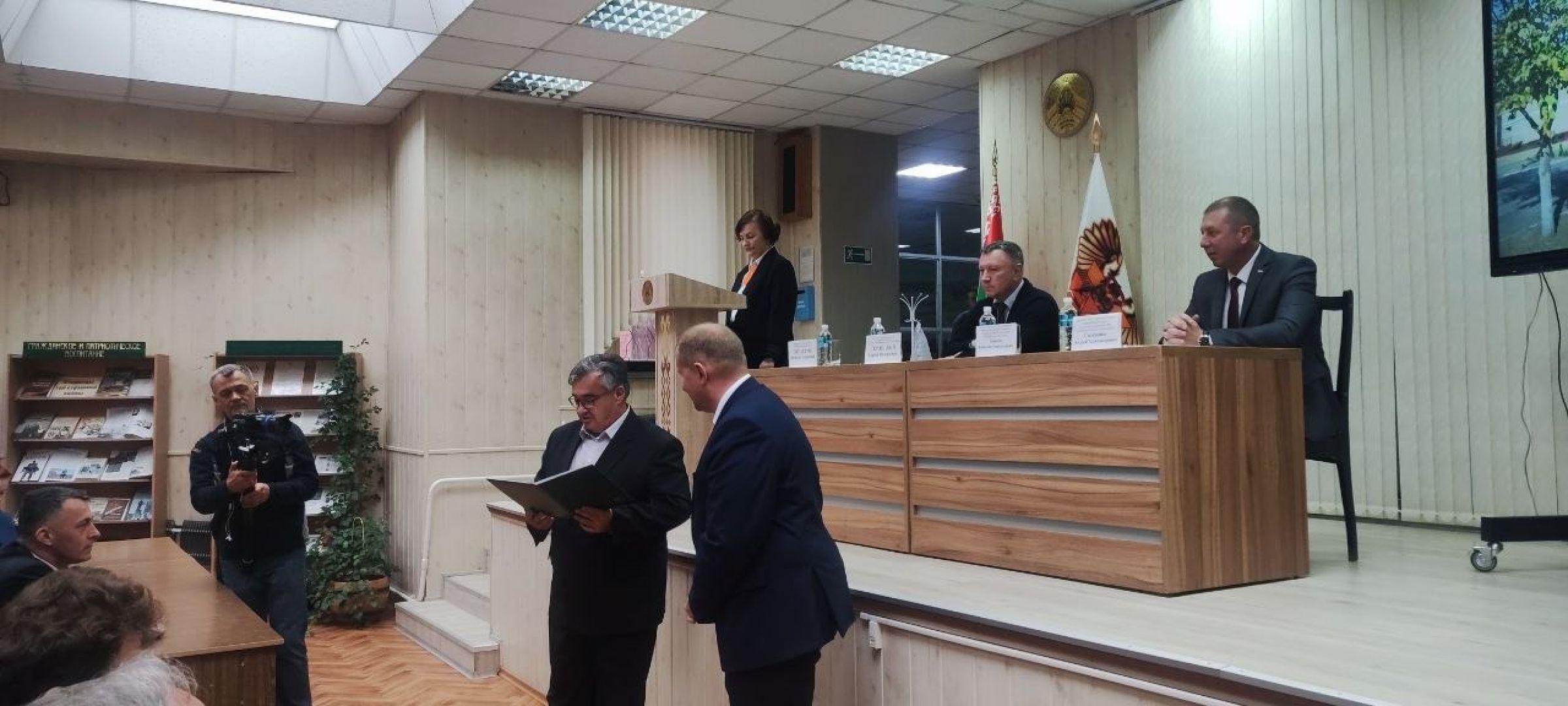
On September 23, 2026, a delegation of the Belarusian National Technical University visited the Zhlobin Metallurgical College. The reason for the visit was the 30th anniversary of the founding of the educational institution. The delegation included Deputy Dean of the Faculty of Mechanics and Technology Alexei Bely and Head of the Department of Machines and Technology for Metal Forming, Faculty of Mechanics and Technology Vyacheslav Tomilo.
On behalf of the rector of the Belarusian National Technical University Sergei Vasilyevich Kharitonchik, a congratulatory address was sent to the staff of the Zhlobin Metallurgical College. It emphasizes the many years of fruitful cooperation between the two educational institutions, the college's significant contribution to training for the industrial sector and the special role of the educational institution in shaping the country's engineering potential. The rector of BNTU wished the teachers and staff of the college further success, new achievements and preservation of the best traditions of vocational education.
Zhlobin Metallurgical College was founded in 1996 on the basis of a decision of the Ministry of Industry of the Republic of Belarus as Zhlobin Metallurgical College. Its creation was dictated by the need for highly qualified personnel for OJSC BMZ - the management company of the BMK holding. Over three decades, the institution of education has trained more than 3,000 qualified graduates for the industrial industry. In the period from 2023 to 2026 alone, the college graduated 496 young professionals, of which 319 were for BMZ. More than 177 specialists, 25 of whom have the qualification of "technician-technologist," were trained for the largest enterprises of the Ministry of Industry of the Republic of Belarus. These figures clearly demonstrate the role of the college as one of the key suppliers of personnel for domestic metallurgy and mechanical engineering.
The program of the anniversary celebrations was eventful and began with a meeting of guests, which gave an opportunity for representatives of various educational institutions and enterprises to exchange their first impressions. Then the grand opening of the "Laboratory of Instrumentation and Automation" took place. This facility is equipped with modern equipment that will allow students to master work with measuring instruments and automated control systems - skills critical to metallurgical production. The next item of the program was the opening of a multifunctional computer science cabinet. The new space is intended for classes in programming, working with databases and digital technologies, which meets modern requirements for the training of technical specialists.
The central event of the day was the scientific and practical seminar "Training for the industrial industry: challenges and prospects," which was held with international participation. Representatives of BNTU acted as listeners. During the seminar, the priorities of training young specialists in demanded professions, as well as opportunities for advanced training of existing personnel were discussed. Special attention was paid to the development of cooperation between educational institutions and enterprises of the Ministry of Industry of the Republic of Belarus for the period 2031-2035. The seminar participants noted that effective training of engineering personnel is impossible without close integration of education, science and the real sector of the economy. It is this approach that allows you to train specialists who not only have theoretical knowledge, but are also able to immediately get involved in production processes.
In the afternoon, a dialogue platform was held with college graduates on the topic "From student bench to professionalism, my career growth." Graduates of different years shared stories of their professional path, talked about how the knowledge gained in college helped them find their place in the profession. For students, this was an opportunity to see real career paths and make sure that quality education is a reliable basis for further development.
Immediately after the completion of the dialogue platform, BNTU representatives held a career guidance conversation with future college graduates. Students were told about the rules for admission to the Belarusian National Technical University in 2027, including the possibility of admission to integrated (abbreviated) specialties. The format of the live dialogue made it possible to answer questions regarding the conditions of study, the deadlines for submitting documents, the features of the entrance campaign and the prospects for employment after graduation. Such meetings are important not only for applicants, but also for the university itself: they help build continuity between secondary specialized and higher education, as well as attract motivated students who already have practical skills to BNTU.
The participation of the BNTU delegation in the anniversary events was a continuation of many years of cooperation between the two educational institutions. Such meetings strengthen the connection between university science and the system of environments.
Students were told about the rules for admission to the Belarusian National Technical University in 2027, including the possibility of admission to integrated (abbreviated) specialties. The format of the live dialogue made it possible to answer questions regarding the conditions of study, the deadlines for submitting documents, the features of the entrance campaign and the prospects for employment after graduation. Such meetings are important not only for applicants, but also for the university itself: they help build continuity between secondary specialized and higher education, as well as attract motivated students who already have practical skills to BNTU.
The participation of the BNTU delegation in the anniversary events was a continuation of many years of cooperation between the two educational institutions. Such meetings strengthen the connection between university science and the secondary specialized education system, open up new opportunities for training engineers for industry and contribute to the formation of a single educational space focused on the needs of the real sector of the economy.
