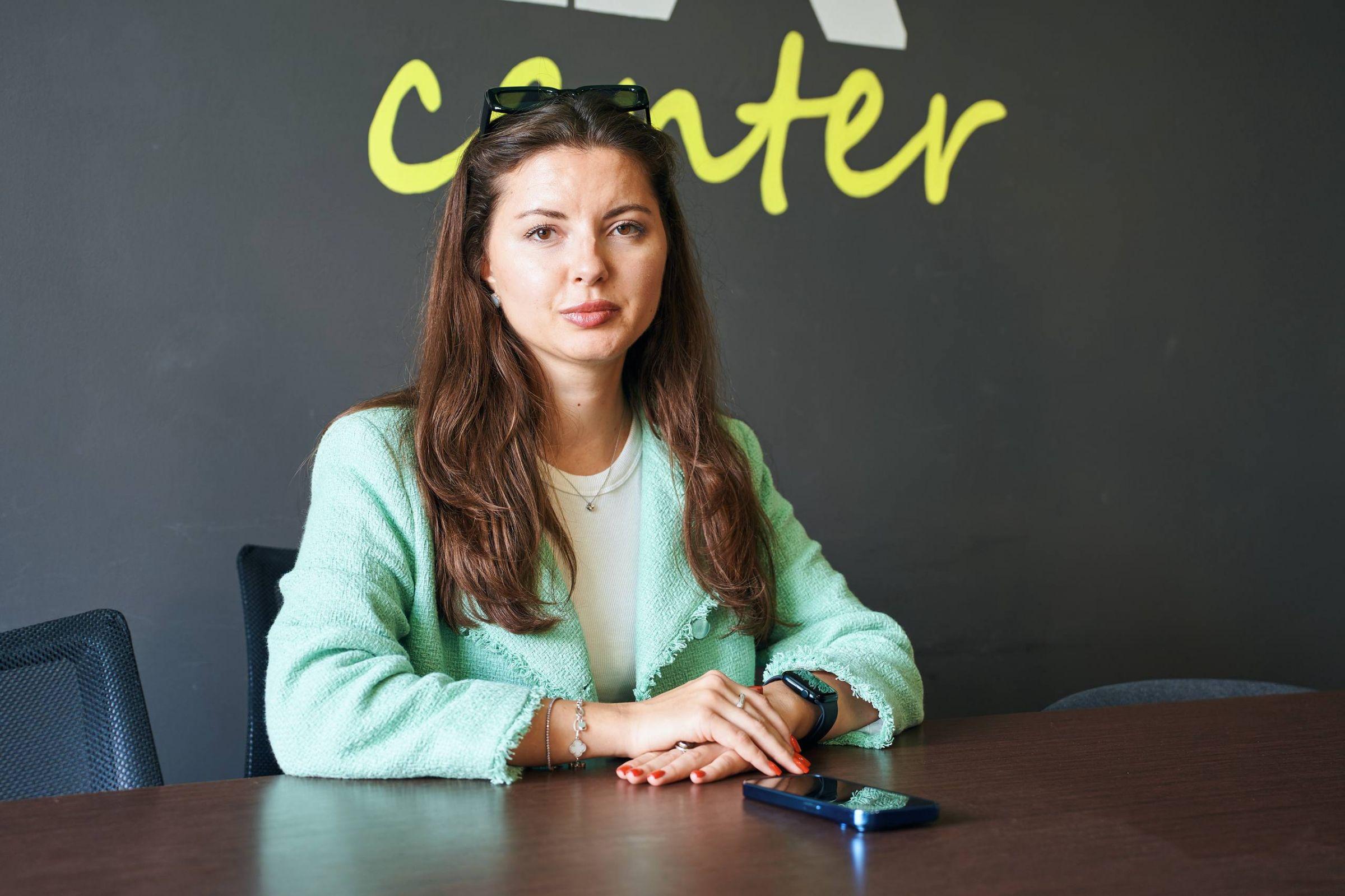
We continue to introduce girls in engineering. In this new piece, we talk about Yulia Medvedeva, an associate professor at the Department of Hydraulic and Energy Construction, Water Transport and Hydraulics, Faculty of Energy Construction. The young woman shared how her professional path unfolded and why engineering has long ceased to be a “non‑female field.”
As a child, Yulia Medvedeva was more interested in technical sciences, and her favorite subject at school was mathematics. Her love for the exact sciences laid a solid foundation for her university studies, but the final choice of her life path turned out to be a matter not only of personal preferences but also of family tradition.
– I graduated from the Faculty of Energy Construction with a specialization in water management construction, earning the qualification of a civil engineer. My parents helped me choose this field, as they themselves had graduated from this faculty in their time.
The student years became a time of active professional development and going beyond the standard curriculum for the future associate professor.
– During my studies, I actively participated in various scientific conferences held both at our university and abroad, for example, at the Mining University in St. Petersburg.
Interestingly, this confident scientific trajectory originally concealed a completely different plan, and the engineering path was not an unconditional choice from the very beginning.
– How did your career develop? Which stages do you consider the most important?
– My career development has been gradual and measured. Having been assigned to the department, I simultaneously studied at the master's and postgraduate programs of the BNTU, having worked my way up from a trainee teacher to an associate professor of the department.
This gradual academic growth allowed Yulia Medvedeva to delve deeply into the specifics of her work and take responsibility for the key, most complex disciplines of the faculty.
– My main subjects are specialized courses in my field, such as “Hydraulic Structures,” “Hydroelectric Power Plants,” “Water Transport Structures,” as well as “Automated Design in Construction.” Teaching such subjects requires not only in‑depth technical knowledge but also a special plan, which I clearly understand and implement every day.
– What does it mean to you to work at a technical university?
– Working at a technical university is, first and foremost, an opportunity to see how yesterday’s schoolchildren turn into real professionals. Engineering education is a solid foundation, and I enjoy being part of this important process. This mission is especially evident against the backdrop of the changing realities of the industry, where gender stereotypes are gradually but surely giving way to professionalism and competence.
The world is evolving, and in recent years, the number of girls in engineering has been growing. This interest is noticeable even at the admission stage: if earlier there were no more than 2–3 girls in a study group, now they may make up more than half of the group. However, the growing number of female students does not negate the fact that the path of an engineer always involves challenging tasks.
– When you encounter a professional or scientific difficulty now, how do you motivate yourself?
– In the scientific field or in teaching, the main thing is to remember that a mistake is not a dead end, but a part of the journey. I am motivated by curiosity and the understanding that every challenge overcome makes me stronger as a teacher and researcher. This attitude towards mistakes helps not only in personal research but also in building a harmonious balance between the two main pillars of academic life.
For an associate professor, science and teaching go hand in hand. According to Yulia Medvedeva, science provides the content, while teaching provides feedback.
– I try to integrate these two areas: for example, I include my research in classes and involve students in scientific work. However, time management is not only about work processes. The ability to switch on time is a key skill for maintaining productivity, energy, and personal happiness.
The girl highlighted the successes and achievements of her students as her source of inspiration for work and new achievements.
– I am always pleased to learn about the professional destinies of my students. For me, this is the main indicator that teaching at a university gives real results. It’s especially valuable when I receive feedback from production managers and learn that students have proven themselves to be good specialists not only at enterprises in our country but also abroad.
– How do you balance such a demanding career with family and personal hobbies? Do you have a hobby that helps you switch gears?
– For me, family and career are complementary parts of life. Family provides support and energy, while work gives meaning and growth. For me now, hobbies are more of a way to recover. For example, swimming, reading books, listening to my favorite music or chatting with loved ones – all this gives me back energy.
Based on this rich experience and seeing the real results of her work, Yulia Medvedeva addresses those who are just on the verge of choosing their life path with simple but very important words.
""I would advise all schoolgirls not to divide the engineering profession into "female" and "non–female." Engineering is about interest, thinking and perseverance, not about gender. Fear can be overcome if you start small: clubs, courses, Olympiads – nowadays, many different events are held in schools and cities across our country. If you’re interested, give it a try; don’t let stereotypes make decisions for you. The world needs your ideas!
Yulia Medvedeva is a shining example of how family traditions can lead to professional harmony, inspiring the new generation of engineers not to be afraid of challenging tasks and to confidently build their future. We thank the young woman for the interview and wish everyone endless energy and inspiration.
