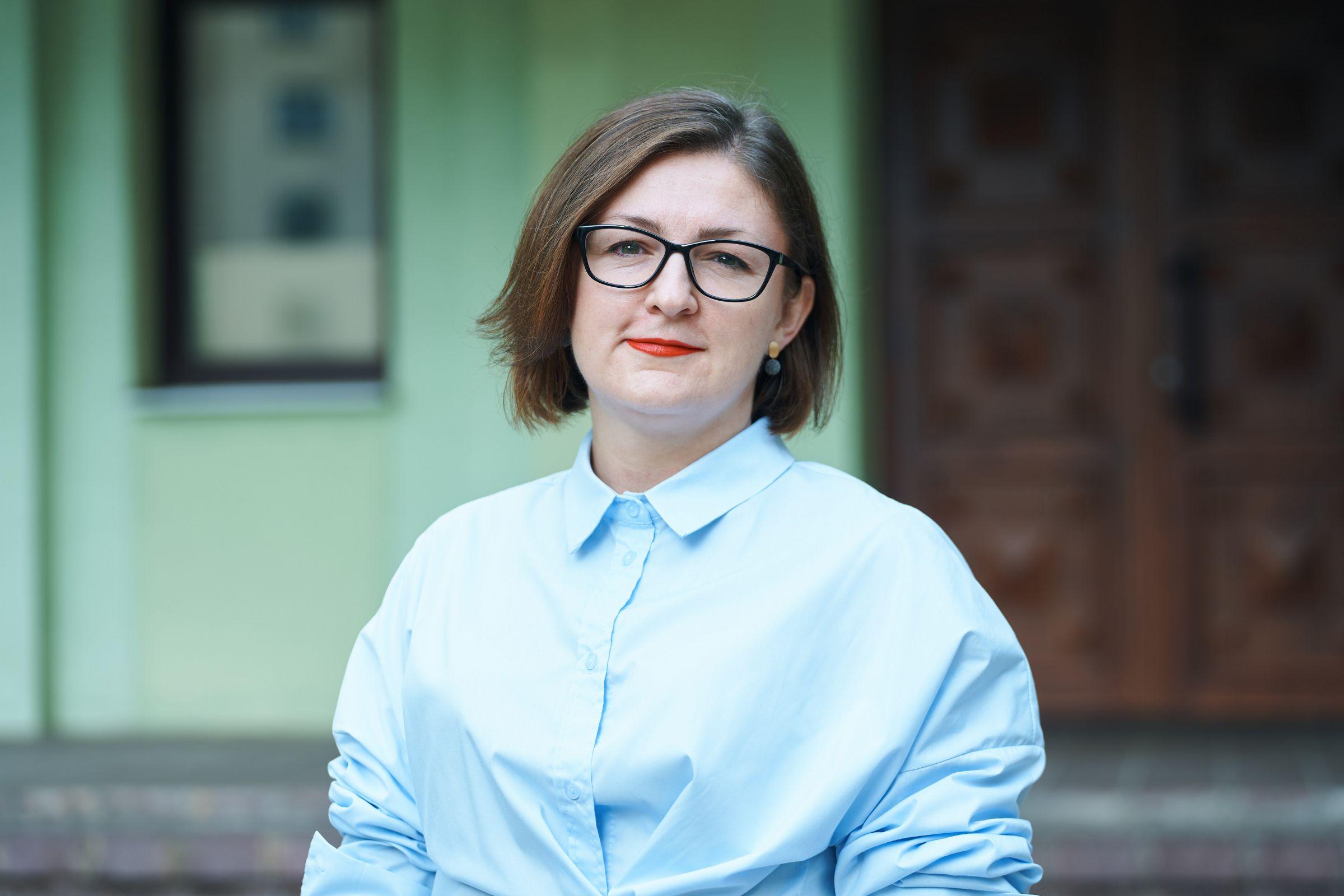
Olga Yatskevich—a professor in the Department of Technological Equipment, Candidate of Technical Sciences, and Associate Professor—discusses why engineers need to be lifelong learners and offers advice to young women who are unsure about choosing a technical field.
Olga Yatskevich describes her entry into the engineering profession as a series of chance events that nonetheless led her along a logical path.
"It probably happens by chance for everyone, yet many different life paths lead you to that moment. I finished the ninth grade with honors. I didn't want to stay in school; I wanted to go to college. My hometown had many educational institutions, including a medical college where I really wanted to go to pursue a career in medicine. But when I collected my documents from school and took them to the college, it turned out they weren't accepting students after the ninth grade that year—only after the eleventh. So, I was left with nothing but my documents in hand. My mom suggested going back to school, but I had firmly decided that I wanted to learn a trade. We weighed the options available in the city and decided to try another college, but my first impression there wasn't good. That left us with only the polytechnic college. We went there, and they offered exclusively technical majors. The admissions staff were so happy to see prospective students that the overall impression was positive and had a magical effect on me. I decided I wanted to study there. On one hand, it was a chance choice; on the other, I’ve never regretted it. I love my profession so much; I enjoy what I do. I am convinced that you should never resist the chance occurrences or inexplicable things that happen in your life—you should simply follow the path the Universe chooses for you."
Her first steps in the profession were not easy; the specialized subjects at the college seemed difficult and confusing at first. However, the challenges didn’t scare Olga Konstantinovna off; on the contrary, they helped her get to grips with complex concepts and deepened her interest in her chosen field.
— Once I was actually in the profession—when we started studying specialized subjects at the technical college—it came as a shock to learn how steel is produced, how cast iron is poured, and how the foundry industry works overall. I wasn't prepared for it, and at first, I was upset because the material seemed so complex and baffling. But I wasn't tackling it alone; I was part of a group of peers—young and inexperienced just like me. Gradually, we began to get the hang of it and understand the subject matter. If you have the desire and the aptitude to learn, you can master anything. From there, things just unfolded naturally. After college, I chose to pursue the same specialization at university, enrolling in the Faculty of Mechanical Engineering. After graduating—back then, the program took five years—I went on to a master’s program and then a PhD program; it was a very natural progression, without any abrupt life changes.
— What inspires you most about the profession? Is it those moments when a student finally "clicks" with a difficult topic, or is it scientific discoveries that reshape our understanding of technology?
— In scientific research, the most important thing isn't the result itself, but the process and constant development. For instance, a result achieved ten years ago might have been considered cutting-edge at the time, but today it’s outdated; there are new technologies that have surpassed it, enabling results far superior to what was possible five or ten years ago. That’s the most interesting and inspiring part—the fact that the evolution of engineering and technology brings new data and possibilities every day.
But science isn't just about technology and experiments. It’s also about the people who work alongside you every day, supporting one another and moving forward together. In this regard, Olga Yatskevich observes that women play a special role: they possess superior social intelligence and demonstrate greater perseverance and tenacity. When men’s patience wears thin, women serve as an emotional anchor for the team—a dynamic she witnesses firsthand within her department, the laboratory, and the faculty as a whole.
"The leadership of our faculty is a prime example—it is entirely female. Take, for instance, Anastasia Arabey, the Dean of the Faculty of Mechanical Engineering; she took on a challenging faculty, yet she is managing the role with great success."
For this reason, the professor has never encountered the prejudice that mechanical engineering is not a field for women. In her view, what truly matters is qualifications and professionalism—nothing else.
— If you are a professional—regardless of whether you are a man or a woman—you must be deeply knowledgeable, well-educated, and capable of grasping complex concepts. When you demonstrate this, you are accepted as a specialist. While some might appreciate seeing an attractive woman in that role, it in no way lowers the standards expected of a woman as a professional. It may be more challenging for us, but there are many women with a technical mindset and a mathematical approach to their work; indeed, they feel right at home in the fields of engineering and mechanical manufacturing.
— You have extensive teaching experience. Do you use any original methods or techniques to help students better grasp complex material?
— I try to adopt the best examples from my own teachers—from the way we were taught. I have vivid memories of the professors and associate professors who taught me right here in this department—how knowledgeable and competent they were in the field of mechanical engineering, and how engagingly they presented the material to us students. Those impressions have stayed with me for years. When I lecture or conduct classes, I prioritize highlighting the most interesting aspects of the subject and the logical connections between technical details, while demonstrating the importance and necessity of learning the material. If students grasp this and buy into the concept, I believe it becomes easier for them to master complex topics.
Olga Yatskevich believes that a modern instructor of technical subjects needs to stay current and keep up with the latest developments. This demands physical, mental, and emotional energy, but the ability to remain up-to-date always appeals to young people.
— Instructors with broad horizons—those who can share interesting insights beyond the immediate curriculum, touching on the broader technical field or innovations—always attract young people. Students always gravitate toward such instructors and seek to collaborate with them on research. This kind of dynamic interaction—along with a desire to set an example for students while simultaneously learning modern technologies from them and mastering those tools just as fluently—represents a vital set of qualities for an educator. Take platforms like TikTok or YouTube, for instance; one can find a wealth of professionally relevant content there, and instructors who embrace this approach truly become student favorites. When we were students ourselves, we looked up to professors who made the learning experience genuinely engaging.
For a long time, technical fields were considered the domain of men, but the landscape is gradually shifting: more and more young women are choosing engineering. According to Olga Yatskevich, this trend stems not only from societal evolution but also from the character of today’s young women, who are unafraid of tackling complex challenges.
"We live in a technology-driven society, so it would be odd not to be involved with technology. As a civilization, we chose this path of development; consequently, the scope for applying technical knowledge is expanding, and technologies are becoming more sophisticated. Naturally, this leads to a larger number of people entering the engineering sector. It is hardly surprising that the number of women in this field is rising, too. In my view, women aren't afraid of complexity; there is no gender-based difference in the capacity to learn—whether it’s mastering physics and mathematics in school or grappling with advanced university-level concepts. They aren't intimidated by the challenge. Women often gravitate toward demanding areas. They also recognize where the need lies—where there is a shortage of highly qualified personnel and a high demand for technical specialists—and they step up to support that field."
What inspires Olga Yatskevich most in her profession are the people around her—those with whom she shares positive energy every day.
"For anyone, the most pleasant thing is arriving at a place where you are welcomed, greeted with smiles, and supported." Thanks to this, you go to work happily and, standing shoulder to shoulder with your colleagues, battle through and overcome various challenges and problems. People are what matter most, and they are the greatest source of inspiration in my work.
— What advice would you give to a young woman considering university who is afraid to enroll in the Faculty of Mechanical Engineering because of stereotypes?
"I recommend attending an open house to chat with people and get a look at the faculty. Our professors are always happy to explain things to prospective students. They always strive to give engaging presentations on both academic and extracurricular activities, as students in our faculty are deeply involved in all aspects of life at BNTU. I also suggest coming to experience that sense of community—being surrounded by like-minded, active individuals who want to make a positive impact and grow in their chosen fields. When school students and applicants visit, we try to present information from that perspective; when they sense how genuinely excited we are to welcome them to the faculty, they often decide to join us. It is always a pleasure to see students in September whom we had previously shown around our labs and classrooms and introduced to our degree programs."
Today, Olga Yatskevich is a professor in the department, but she was once a student herself—one who found technical subjects difficult and confusing. She persevered, completing her journey and staying on at the university to help others. In her work, she values competence, curiosity, and a willingness to learn over impressive titles. She is convinced that engineering doesn't end with a diploma—it is a lifelong pursuit.
