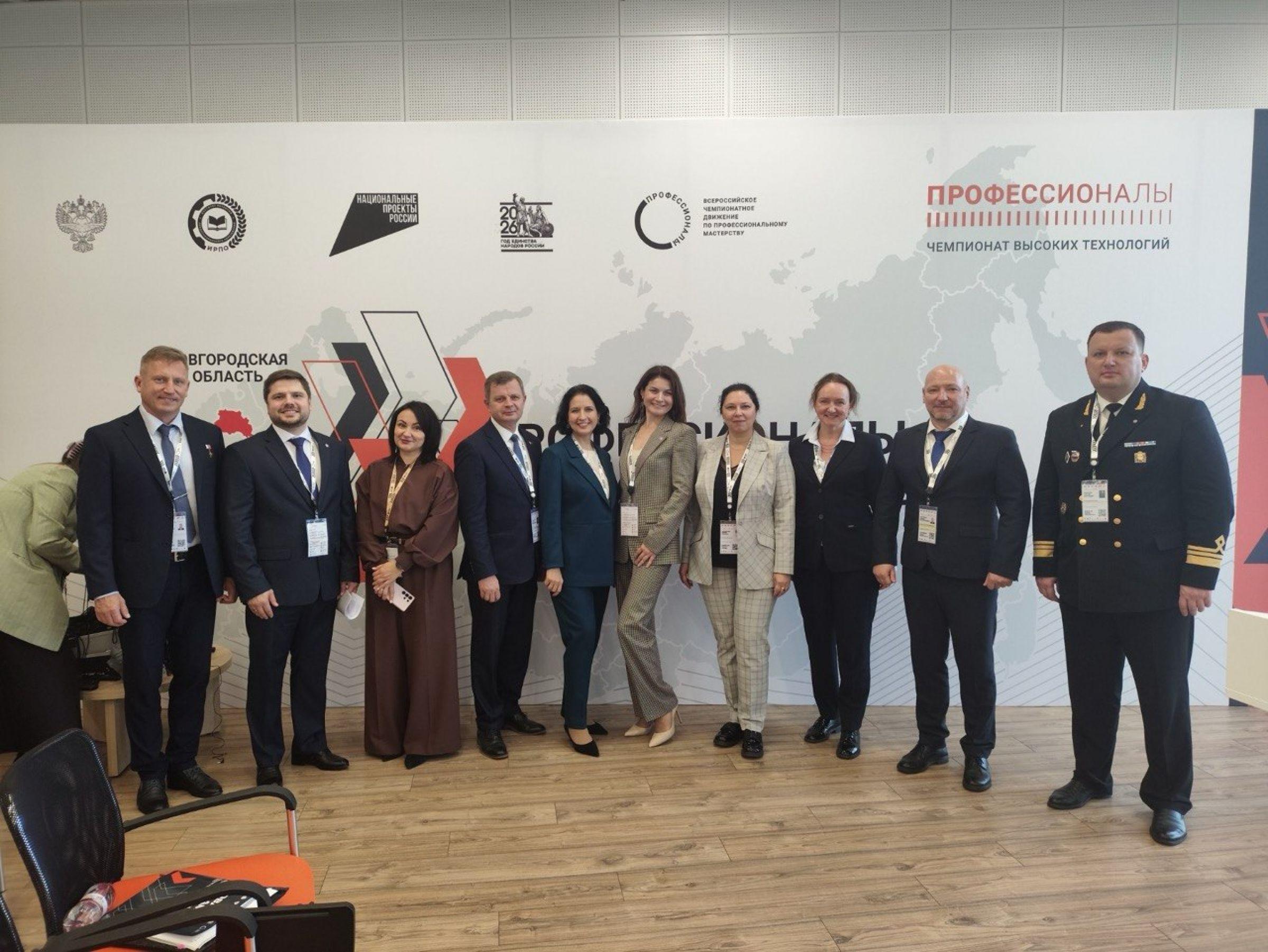
The finals of the 4th High-Tech Championship (HTC-2026) took place in Veliky Novgorod from September 14 to 18. The "Intelligent Electronics – Valdai" Innovation Science and Technology Center served as the venue for the competitions and business meetings. The Belarusian National Technical University (BNTU) was represented at the event by Vice-Rector for Research Ksenia Yakushenko and Dean of the Automotive and Tractor Faculty Sergey Skirkovsky.
Background: The High-Tech Championship is a professional skills competition based on competencies shaped by the emerging needs of high-tech enterprises. Organizers describe it as an experimental platform where training standards and curricula are developed for specialties that are just beginning to be introduced into the education system. The championship is overseen by Yaroslav-the-Wise Novgorod State University (NovSU). The event was held for the first time in September 2023. In 2026, the HTC finals brought together 15,000 participants from Russian regions and 30 other countries.
The transport industry was the central theme of this year's championship. Competitions were held in 20 categories developed in collaboration with industrial companies. Contestants worked with driver assistance systems (ADAS), autonomous road construction machinery, warehouse robots, unmanned aerial vehicles (UAVs), and components for high-speed transport corridors.
BNTU representatives took an active part in the championship's business program. On September 16, Sergey Skirkovsky spoke at the international discussion titled "Human Capital of the New Era: Medicine, Transport, and Technology – An International Dialogue on Workforce Sovereignty." His presentation focused on international educational pathways and the training of specialists for the transport sector.
In his address, the Dean of the Automotive and Tractor Faculty (ATF) emphasized that a high-quality educational pathway transcends border and customs controls. He illustrated this point by citing the successful experience of the Belarusian National Technical University (BNTU) in implementing joint educational programs. Currently, the university is actively developing partnerships with Bauman Moscow State Technical University, Hefei University of Technology, Tashkent State Transport University, and the Joint Belarusian-Uzbek Intersectoral Institute of Applied Technical Qualifications.
To further enhance this cooperation, the speaker outlined specific steps to overcome barriers in international education, including the harmonization of standards, the creation of a unified digital platform, and the development of targeted student support. When asked how successfully graduates with dual degrees integrate into various national transport systems, Sergey Skirkovsky gave a straightforward answer:
"Despite their differences, transport systems share common features. Joint programs allow students to study the specifics of their own national transport sectors while also gaining insight into Belarus's experience. Of course, integration is never entirely seamless; young professionals always require an adjustment period when entering the actual workplace. At BNTU, we strive to minimize this time through intensive, practice-oriented training. Internships at leading enterprises and the acquisition of vocational skills during practical training enable future engineers to immerse themselves in production processes and gain essential experience beforehand."
The following day, September 17, Ksenia Yakushenko spoke at a panel discussion titled "The Role of Youth Policy in Building the Talent Pool for the International Transport Ecosystem of the Future." In her presentation, she linked youth policy objectives with the university's approaches to project-based learning.
During her speech, she highlighted the university's integrated system of project-based education. As the vice-rector noted, BNTU currently coordinates specialized engineering classes across the country, with an enrollment of over 8,000 schoolchildren. Approximately 77% of graduates go on to pursue technical majors; this year alone, 392 graduates from these engineering classes and the National Children's Technopark enrolled at the university. Ksenia Yakushenko described the approach to this initiative as follows:
"We are building a comprehensive system of project-based education that spans every level, from school to postgraduate training. I sometimes joke that the only thing missing is a kindergarten, but in reality, introducing children to the professions of the future needs to start at a very early age. This foundation is what eventually leads students into our scientific community and guides them onto one of two tracks: industrial or academic."
To systematically monitor talent development across these tracks, the university employs a unified electronic database. This system tracks an individual's entire body of research activity leading up to their entry into a doctoral program. The report also highlighted a new format for engineering training: student design bureaus (SDBs). As the speaker explained, BNTU was the first institution in the country to formalize this practice and launch an SDB focused on "Advanced Vehicle Designs." This model—featuring official staff roles and a five-year work plan—is now backed by the Ministry of Education and is being implemented at other universities across the country.
During the visit, BNTU representatives also toured the championship exhibition area, viewing equipment, simulators, and solutions presented by partners from the transport sector. Additionally, Ksenia Yakushenko held talks with Anastasia Novikova, Vice-Rector for External Relations and International Affairs at NovSU. The meeting focused primarily on fostering educational and research collaboration between BNTU and NovSU.
The championship concluded with a formal closing ceremony. Such visits enable the university to familiarize itself with the industry's latest technical requirements, exchange best practices, and leverage these insights to advance engineering education.
