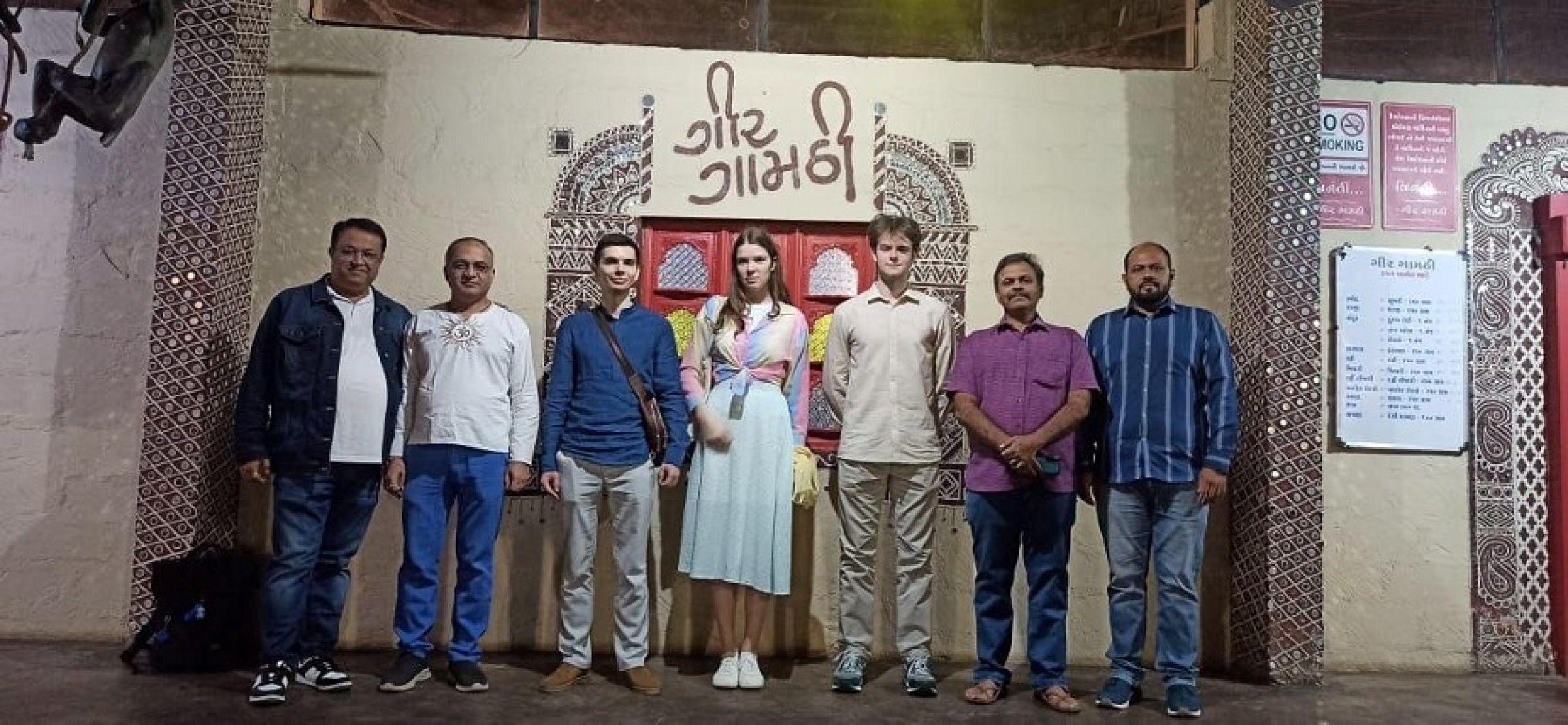
From December 2023, teacher of the Department of Robotic Systems Pavel Viktorovich Kholod, students Alina Savchik and Yahor Siamizhon participated in an educational program at Marwadi University (Rajkot, India). The training was held on the topic “Use of computer-aided design and development of technological processes to optimize time and financial costs for preparation for product release.”
Marwadi University is a leading Indian private university located in Rajkot , Gujarat . The university has 10 faculties, more than five thousand students, taught by 1,289 faculty.
During the educational program, interaction was carried out with such departments as Mechanical Engineering Department and Information and Communication Technology ( IcT Department ) of Faculty of Engineering.
Upon arrival, participants were met by an associate professor of the Mechanical Engineering Department Nikhil Chotai and then accommodated in the hotel.
This was followed by a gala dinner of traditional Gujarat cuisine with Marwadi staff including Head of International Relations Associate Professor Nilesh Advani , heads of the above mentioned departments and their teachers. During the meeting, the educational program, ways of its implementation and expected results were discussed.
The next day, a detailed excursion of the two departments and the campus was conducted.
The excursion began with a visit to the Innovation Development department. At Marwadi University, a pronounced emphasis is placed on students developing their own product and, in the future, creating their own production, their own company, based on it. In other words, the university focuses on practical training of engineers with the transformation of developments into profit. If a student shows his project to the faculty, then the faculty can make various modifications, guide it, help with patent registration, and with the economic component of implementing the development. If the project is assessed as promising, then the student can get a small office in this department in which they can work on the project. Students from different specialties can unite in groups for project work. When engaged in project activities, depending on its results, a student can receive a different number of credits “automatically”.
Also, the best projects can receive funding from Marwadi University, including the purchase of equipment and components at the expense of the university. If students need to produce various components for a project, they can be produced by students from other specialties and departments. For example, casting and forging parts, turning and milling parts, 3D printing and sheet metal parts. The projects focus on import substitution and recycling of resources.
At the same time, tasks are also taken from representatives of Indian industry. The department practices round tables with a team of students gathered for the project and industry representatives who pose the problem.
Then there was a tour of Mechanical Engineering Department , during which were shown: a foundry laboratory, which has capabilities for sand casting and centrifugal casting, as well as equipment for studying the characteristics of the resulting castings; materials research laboratory, which houses a device that recognizes grade and chemical composition upon contact with metal, forging and stamping presses. Then remote launch of the stand and regulation of engine rotation speed using virtual reality technology were shown. After this, castings from metals, plastics and silicone, made by students, were shown.
Afterwards were shown: a laboratory for working with fuel engines; sensor research laboratory; a laboratory for working with programmable logic controllers (PLC), provided by Bosch, a stand for programming CNC machines; an automation laboratory containing stands simulating an assembly line; laboratory of hydraulics and pneumatics, which presents stands of basic hydraulic and pneumatic components that can be assembled into various circuits, including those controlled by electrical signals.
Next, there was a tour of the student workshop, where first-year students learn to perform various technological operations. There are classic lathes, drilling machines, bending machines, CNC lathes and milling machines. The university's approach to practical training in this area is that at the initial stage, students must fully learn the mechanism of a lathe using the actual mechanisms of a completely disassembled machine. Next, when they finish learning it, they must assemble it, and only after that they begin to do work with lathes. For safety reasons, students primarily work with plastic parts.
Next, buggies that completely designed and assembled by students and taking part in Indian races were demonstrated.
Further there was a tour of IcT Department. First, some student developments were shown. For example, automatic seeding machine, a software analogue of ChatGPT , a program for creating a text description from an image and converting text to speech with adjustable speed and voice type, a program for recognizing gestures. Next, we were introduced to the laboratories of electronics and signal transmission. After excursions to two departments, a meeting with Provost Rajendrasinh Jadeja was held, where each internship participant were given an opportunity to choose a direction of study.
The next day, training began in the chosen direction. Kholod Pavel and Siamizhon Yahor spent the next few days working at Mechanical Engineering Department. They started their work on the assembly and control of pneumatic circuits, their modeling and design in the FluidSIM computer-aided design system, and then the development of automated systems based on Bosch PLC using development environment Rexroth IndraWorks .
It is especially worth mentioning the work of Associate Professor Nikhil Chotai to present new knowledge in the form of in-depth presentations, which consistently show the principles of control in systems based on pneumatic and electronic components. The slides have maximum detail, such that when switching them you can see step by step the movement of air flows and electrical signals, switching the state of each component.
Savchik Alina chose IcT Department and direction of machine learning in Python, where she was engaged in the design and development of systems and software based on machine learning, studying algorithms used in the field of machine learning. New skills were also acquired in the design and development of Web applications using JavaScipt , HTML , CSS .
The university has an original principle for checking student works. If students complete assignments on paper sheets, then these sheets are scanned in a special department, converted into electronic format and uploaded to the website and mobile application, where teachers can give a grade and write comments or recommendations. Next, the student can go to the website or application and view the results of checking their work. This was done to reduce the work of dragging paper from one place to another.
On the sixth day, in addition to the main work, there was a tour of one of the largest enterprises in the region, JYOTI CNC Automation , which is engaged in almost the full cycle of production of CNC machines. We visited: a foundry shop, a sheet metal workshop, a workshop for preparing body parts, a component sub-assembly shop , and a final assembly shop for machine tools.
On the seventh day, in addition to the main curriculum, there was a tour of the university library, which is included in the Guinness Book of Records for the number of readers on a particular day. The library has a self-service system, with which you can go to the touch screen, enter the author or title of a book and get information about which section it is in. Moreover, if the book is in electronic form, then it can be immediately opened on the screen. The library has a widely implemented statistics mechanism: it analyzes which books are in greatest demand, and, based on this, more books from one area are ordered, and fewer from another. An analysis of student activities is also carried out: class attendance for the entire period of study, visits to the library, frequency of receiving books, etc. The number of books ordered also depends on this data. In addition, this data is used to assess the student's level and engagement in learning. In addition, MU magazine was shown as part of the library tour Global , which talks about the university’s international interactions and the successes of foreign students. The latest issue included information about the March visit to the university of the BNTU delegation, headed by rector Sergei Kharytonchyk.
Next, the PhD work was shown, which consisted of converting three projections from an engineering graphics textbook into a 3D model with the ability to rotate and select views when pointing the smartphone camera at the textbook page. This application is intended for students who have difficulty understanding the engineering graphics course.
Highlighting the features of the implementation of the educational process, it is worth noting the deep feedback system with graduates and industry representatives. Surveys of graduates and the companies they work for are regularly conducted, on the basis of which adjustments are made to curricula and discipline curricula, and these adjustments are made quite simply, without the need for a large number of approvals. At the end of the educational program, BNTU teachers and students were also invited to participate in quality improvement by completing surveys assessing various aspects of the training provided.
The university pays attention to issues of subsequent employment of students. For this purpose, there is a special department, which, in addition to administrative premises, has several rooms for conducting interviews.
In general, the educational program brought significant benefits to both the teacher and the students.
For the teacher, in addition to just language practice, studying in English at a foreign university allowed him to better understand his own foreign students studying at BNTU, what difficulties they may encounter, and what should be given more attention to; how to present new knowledge as accessible as possible. Some individual techniques of foreign teachers were learned. Some features of the content of identical and related disciplines are emphasized, which can subsequently be used in the educational process when studying at the Department of Robotic Systems. New knowledge was obtained and existing knowledge in the field of internship was expanded. Methodological materials have been received that will be processed and used in teaching students at the home university. An exchange of contacts has been carried out, which will allow for joint research, exchange of experience, knowledge, skills and educational and scientific materials.
For students, this educational program improved their skills in the practical use of English and simplified the use of foreign materials in training and engineering activities. A large amount of new information in the field of internship was studied, practical skills and abilities were obtained that will be useful both when completing course projects and when working on a diploma project. The areas of activity and research of students of similar and related specialties at Marwadi University were studied , contacts were exchanged for further interaction and joint projects.
All participants in the educational program throughout the entire training period showed themselves with dignity, actively and diligently demonstrated themselves in their studies, showed the skills and knowledge previously acquired within the walls of BNTU and as part of internships at Belarusian enterprises.
At the end of the educational program, a final meeting was held with the Provost of Marwadi University, the head of the international department, heads of departments and all the faculty who took part in the implementation of this program. Further cooperation, the possibility of continuing education in an online format, and the possibility of joint research were discussed. All participants in the educational program were awarded certificates of successful completion of training.
