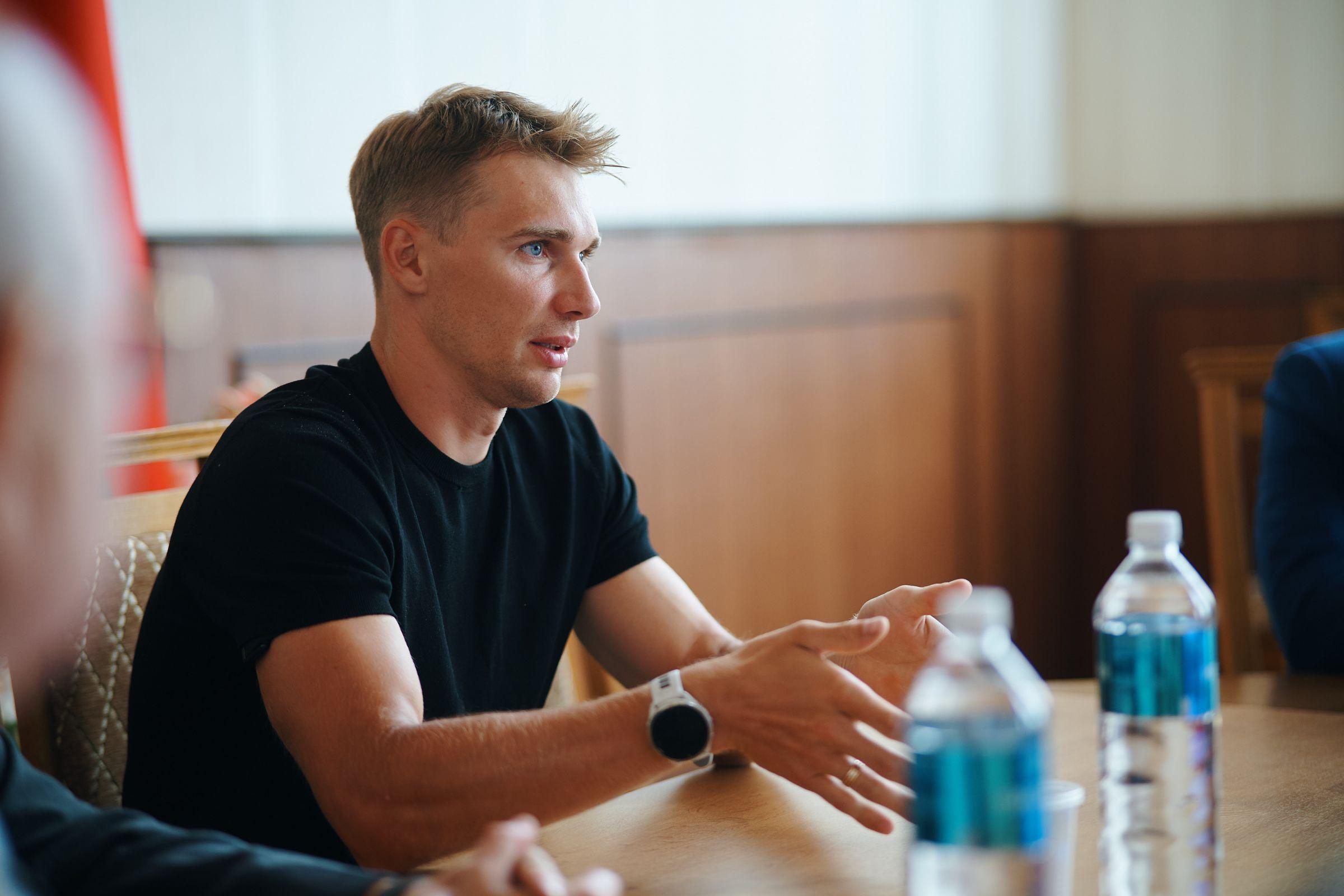
Today, on June 24, Anton Smolsky, a master's student from the Faculty of Instrument Engineering, the world's strongest biathlete, a recipient of the President of the Republic of Belarus's special award "Belarusian Sports Olympus," a multiple winner and medalist of World Cup stages, a multiple winner of the overall Commonwealth Cup, and a silver medalist of the Olympic Games in Beijing, as well as an Honored Master of Sports of the Republic of Belarus, met with students from the Faculty of Automotive Engineering, the Faculty of Management and Humanitarian Sciences, the Faculty of Instrument Engineering, and the Faculty of Sports and Technology. The event was also attended by Oleg Gusev, Vice-Rector for Academic Affairs, Alexander Svistun, Dean of the Faculty of Instrument Engineering, Yaroslav Potachits, Dean of the Faculty of Sports and Technology, and other faculty members.
Oleg Gusev began the event with a welcoming speech.
"I'm here to tell you that a great athlete and a great person has come to our meeting. Imagine, each of you is going to an exam, and you're worried. As a teacher and a parent, I'm also worried. When Anton Andreevich shoots on the track, not only are 10 million Belarusians worried about him, but several billion people are watching on TV. Everyone sees it: friends, foes, enemies, and allies. Just imagine that. How can a person do this? How can a person prepare for a race?
Anton Smolsky, in turn, shared his observations that the younger generation has made significant progress over the years, and the density of results in regional competitions has increased dramatically, providing a sense of security for the future. He also emphasized the importance of trust within the team and the need to find opportunities for growth, even in the most challenging circumstances.
After the biathlete's speech, the audience actively engaged in asking questions. Oleg Gusev was the first to raise a question. He inquired about the athlete's ability to excel in sports, education, and research.
— I came to Minsk for the second or third time, and my mother and I applied to the university. For me, this was a step into adulthood. At some point, I realized that I needed to try to combine my studies and sports. I didn't want to give up on either. From then on, I started planning my activities. Today, multitasking is a normal part of my life, but at 18, it was challenging to handle two or three tasks per day. Today, I have a lot of tasks, and I can write them down, keep them in my head, and know what awaits me. This has all come from my training and years of living this way. I don't have a single minute that goes unproductively. Even during my training sessions, I don't have any sessions that just pass by. Every day brings its own level of productivity and value.
Nadezhda Mishenkaya, a senior lecturer at the Department of Physical Education, asked Anton Smolsky how he decided to pursue a career in professional skiing.
— The first thing I started doing was the Winter Defender of the Fatherland military competition. At the same time, I was participating in track and field and volleyball competitions. Biathlon was a separate activity, as there were only two or three competitions in the summer and five in the winter. It was mostly at the track and field level or in school competitions. Almost 90% of the school's students participated in the ski club. Why is that? My first coach, he was an enthusiast and he was passionate about his work: he wouldn't let anyone pass, and everyone had to join his ski club and practice biathlon. He's still working, and it's still functioning, with many people being transferred to the reserve, and let's just say that the school is renowned for its biathlon skills. I enjoyed participating in sports. Why? Because I was used to physical labor since childhood. I was active, and I needed to release that energy. Then, over time, I became interested in biathlon for some reason. Perhaps it was my love for the combination of shooting and skiing. I was drawn to the challenge of this sport. I wanted to excel in it. However, there were many difficult situations in my life.
Next, Evgeny Vasilevich, a third-year student at the Faculty of Automotive Engineering, asked, "What is it like to perform better than one of the greatest biathletes in history? When you were preparing for the Olympic Games, did it feel like a dream or a fantasy? Did you visualize it?"
"I was already being noticed by the top stars of biathlon. When I competed in France during the World Cup, I didn't achieve the highest place, but I was very close to the podium. And Martin Fourcade came up to me and said, "You have very good potential for the Olympic Games, don't miss it." That's what he said.: "I see fire and desire in you." It was very interesting to talk to him and understand that people of this level are not afraid of communication. There were races when I was ahead at the mass start, but then I lost positions, and I didn't even understand what was going on. And the day after the race, we met with Alexander Loginov, and he asked: "When was the last time a Belarusian man won an Olympic medal?" And he answered himself: "It was 12 years ago, when Sergei Mironovich won one in Vancouver." And he added: "It's an achievement that you should probably repeat today." But I didn't feel any pressure or negativity. I remember that all the competitors were friendly, and there was no difficult interaction with the teams. Everyone was always positive. But the situation at the Olympics is certainly exciting, and I think we have everything we need for a good performance. However, the day before my race, the women's medal race took place. At that time, Dinara Smolskaya was not in optimal condition. She missed one shot on the last shooting stage. I couldn't approach her because I was on the far lap myself. She was going for a medal, but she lost the podium due to her miss. When she came out of the shooting range, I could see that she didn't want to talk to anyone. It was a big blow to her morale. I understand her frustration; she was fighting for an Olympic gold medal and lost just 11 meters away from victory. She had 10 good shots, but the last one was a miss. And the next day was my race. When we went to bed, she said to me, "Do everything so that you don't regret it like I did today, don't regret the consequences when everything was so good, just feel satisfied with the work you've done." With these thoughts in mind, I went into the race knowing that I needed to do everything right to avoid repeating her mistake. That race taught me the importance of taking my time, adjusting my mindset, and staying focused on the task at hand. And now, something similar is happening.
During the dialogue, Anton Smolsky also touched upon the topic of psychological resilience, discussing seasonal challenges, recovering from setbacks, and the importance of proper nutrition and routine for achieving results. The conversation also delved into international eligibility requirements and differences in competition levels, but the focus was primarily on practical aspects of a biathlete's life, such as managing stress during training sessions, finding solutions to various situations, and utilizing opportunities for personal growth.
Undoubtedly, there will always be a way out and a solution. So just believe in yourself and look for ways to solve the problem. Combine your studies with your sports life. This is the most important thing," Anton Andreevich summed up.
The meeting showed that the main value for a future specialist is not only professional skills, but also the ability to allocate resources competently, while remaining open to new challenges and mass sports.
