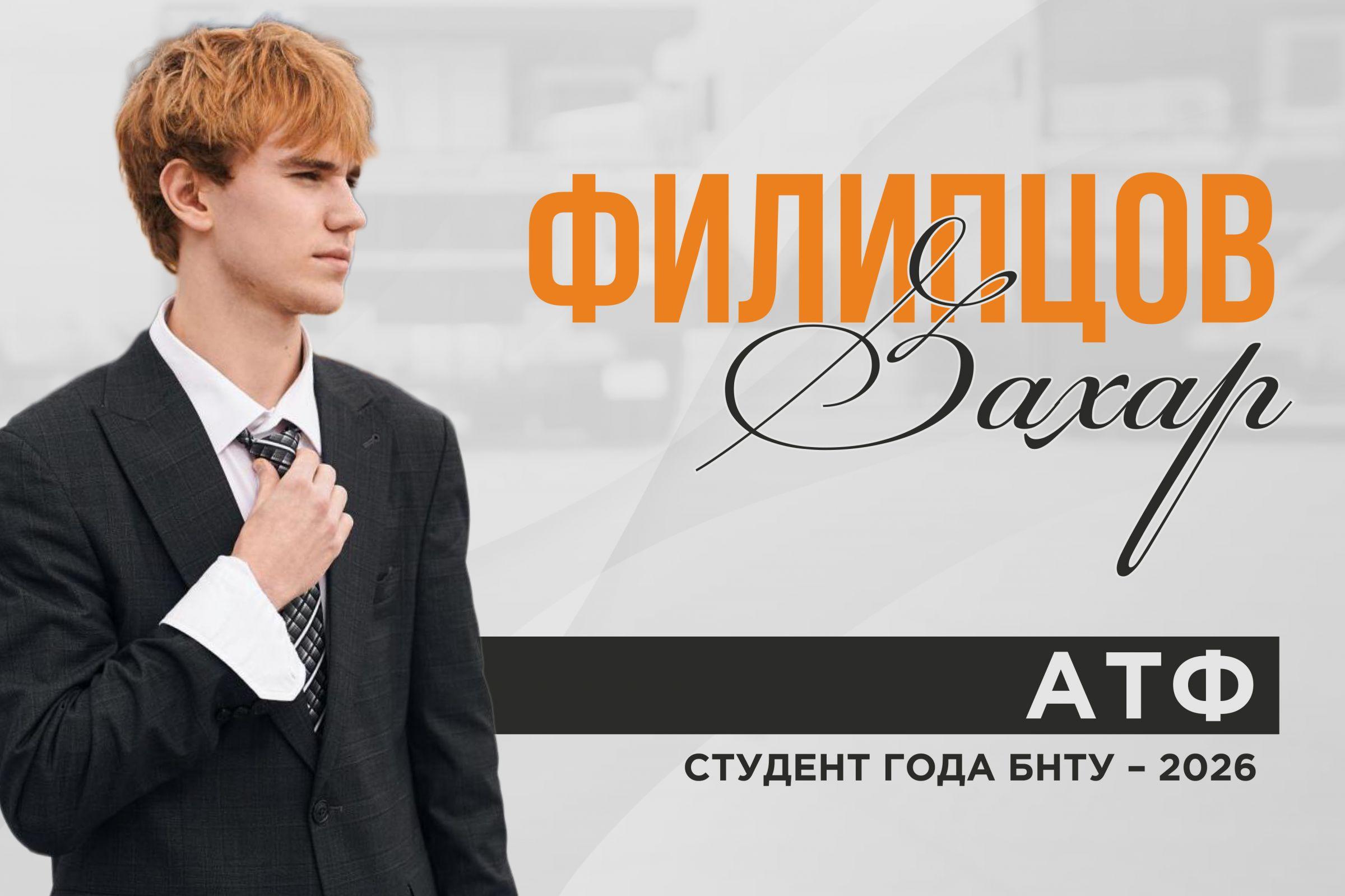
Monday morning starts completely differently for every student. Some people rush to finish their coffee before the first class, others repeat their notes, others just wake up when the alarm clock rings. For a student of the Automotive and Tractor Faculty (ATF) Zakhar Filiptsov, every day of the week begins with a clear understanding of his goals. There are no free minutes in his schedule, because preparing for the “BNTU Student of the Year – 2026” competition requires a lot of concentration.
You can strive for years to achieve a certain result, and then find that you still can’t put the “done” mark next to it. There is always something left that you want to do better, more accurately, more interesting. Perhaps this is why the idea of “measuring success to hundredths” resonates especially well with Zakhar, because he is not so much trying to find the ideal value as he is accustomed to moving towards it, realizing that such a movement may not have an end point.
– At the casting, what became the “hundredth” was not big words and titles, but honesty in the details. It is in them, in my opinion, that the real result is manifested,” the student admitted.
It is impossible to measure such a “hundredth” in ordinary units. And Zakhar himself is not one of those who are used to regularly checking a table of his own achievements. His way of tracking changes is much simpler and more subjective.
– To be honest, I don’t have any special instruments or tables. I don’t keep diaries or check off any achievements. But I still feel my progress, I just measure it differently. For me, the main marker is the feeling that what previously seemed difficult has become ordinary and familiar over time.
– When you have to make a decision, what usually turns out to be stronger – the first internal feeling or what is confirmed by facts?
– Usually, first I turn on intuition as a generator of random ideas, and then logic as a filter. However, if the facts contradict my instinct, I will always choose them, because an engineer cannot afford to build routes at random.
This approach is especially well tested where intuition alone is really not enough. So, speaking about the main achievement, the young man remembers not only the moment itself, but also what preceded it:
– For me, the most important achievement of recent years has been entering the university in a specialty that I have been striving for for several years. This was a goal that I had been working towards for more than one month and more than one academic year. Behind it are hundreds of hours of preparation, a huge amount of material covered, attempts to figure out what didn’t work the first time, and constant work on oneself. At some point, I realized that the result does not depend on one successful day, but on how much effort you are willing to put into it every day. Therefore, when I managed to enroll in exactly the specialty that I had chosen for myself, I took it not just as the fact of admission, but as confirmation that all these efforts were not in vain. This is probably why I especially appreciate this achievement.
At the same time, Zakhar himself would hardly agree with the image of a person who exists exclusively within numbers, formulas and pre-calculated decisions. In his view, a good student must have a quality that is difficult to fit into technical documentation.
– I think that this would be a very complex mechanism, and it should combine several qualities at once. First of all, he should not break under the pressure of the crowd - it is important to be able to maintain his own position, even when the majority thinks differently. At the same time, such a student must quickly relearn and adapt, because it is impossible to gain knowledge once and assume that it will be enough for a lifetime. I would still make the creative module the most important element. After all, you can know a huge amount of information, understand formulas and remember a lot of facts, but if you don’t know how to combine this knowledge in a new way, look for non-standard solutions and generate your own ideas, then in the end we will just get an encyclopedia that knows a lot, but is not able to create anything new,” said the finalist.
For Zakhar, engineering thinking and creativity are not on opposite sides of a conventional border. Rather, these are two ways of looking at the same problem, and he has to switch between these approaches in very different situations:
“In me, the engineer defines the form, while the artist defines the content. The engineer says: ‘It must be reliable, safe, well-thought-out, and within budget.’ The artist suggests: ‘That’s not enough—it needs to be beautiful, expressive, and evoke emotion.’ These two sides don’t conflict; on the contrary, they complement each other. On stage, I apply an engineering mindset even to creative elements: I calculate timing, monitor my breathing, control the range of movement, and understand exactly where to hold a pause or, conversely, inject more energy. This helps me stay grounded during a performance and grasp how the entire composition functions as a whole. In my scientific work, the process is reversed: I tap into my artistic side when I need to present material in an unconventional way, find an engaging explanation, and capture the audience's interest.”
When the conversation turns to perfect precision, the question of possessing a truly flawless skill arises. It turns out he is rather cautious about such labels:
“I wouldn’t call any of my skills flawless, because there’s always that final fraction—that last ‘hundredth’—remaining. Achieving a perfect result is impossible, yet striving for it remains the ultimate goal.”
“Is it even possible to be precise in a creative field where so much depends on improvisation?”
“I simply can’t step onto the stage without a clear plan of action. I always have backup options and room to maneuver. In engineering, this is called ‘tolerance’; in the arts, it’s ‘variability.’ I write a script but leave ten percent of the time open for the audience's reaction. The plan serves as my foundation, while improvisation acts as the architectural ornamentation—something I allow myself to add right there on the spot.”
This approach to preparation speaks volumes about the readiness of the final creative act. Yet, Zakhar prefers to keep the suspense alive until the very end, skillfully attributing this air of mystery to the principles of his profession. “I’m not ready to reveal all the details just yet; such secrecy is a crucial part of the engineering approach. A good project is never put up for discussion before the final assembly stage, due to the immense risk of being misunderstood when taken out of context. I chose this specific act because it’s entirely about me—though not in a literal sense. The script doesn’t recount my biography to the audience; instead, it vividly demonstrates my actual thought process. Within the performance, a clear structure boldly borders on risk, while precise calculations are organically complemented by elements that defy strict formulas.”
Any specialist who usually relies on a backup plan eventually has to let go of total control. In the final seconds before stepping out to the audience, there is no longer time to adjust the timing or rewrite the script; to achieve the right mindset, the finalist completely switches off his analytical side:
“Before I go out, I close my eyes and sit like that for exactly a minute. I deliberately avoid running through the script, rehearsing the lines, or counting out the timing in my head. In those moments, it’s important for me simply to breathe deeply and calm down. It’s as if a switch flips inside me, leaving all past events far behind the door. Any thoughts about the future are also set aside for later, because right now, nothing exists but me and my appearance before the audience.”
At the final of the “BNTU Student of the Year 2026” competition, Zakhar Filipptsov will have just a few minutes to showcase the results of all his hard work. Judging by his words, the most interesting part will unfold precisely when it is no longer possible to calculate anything in advance.
