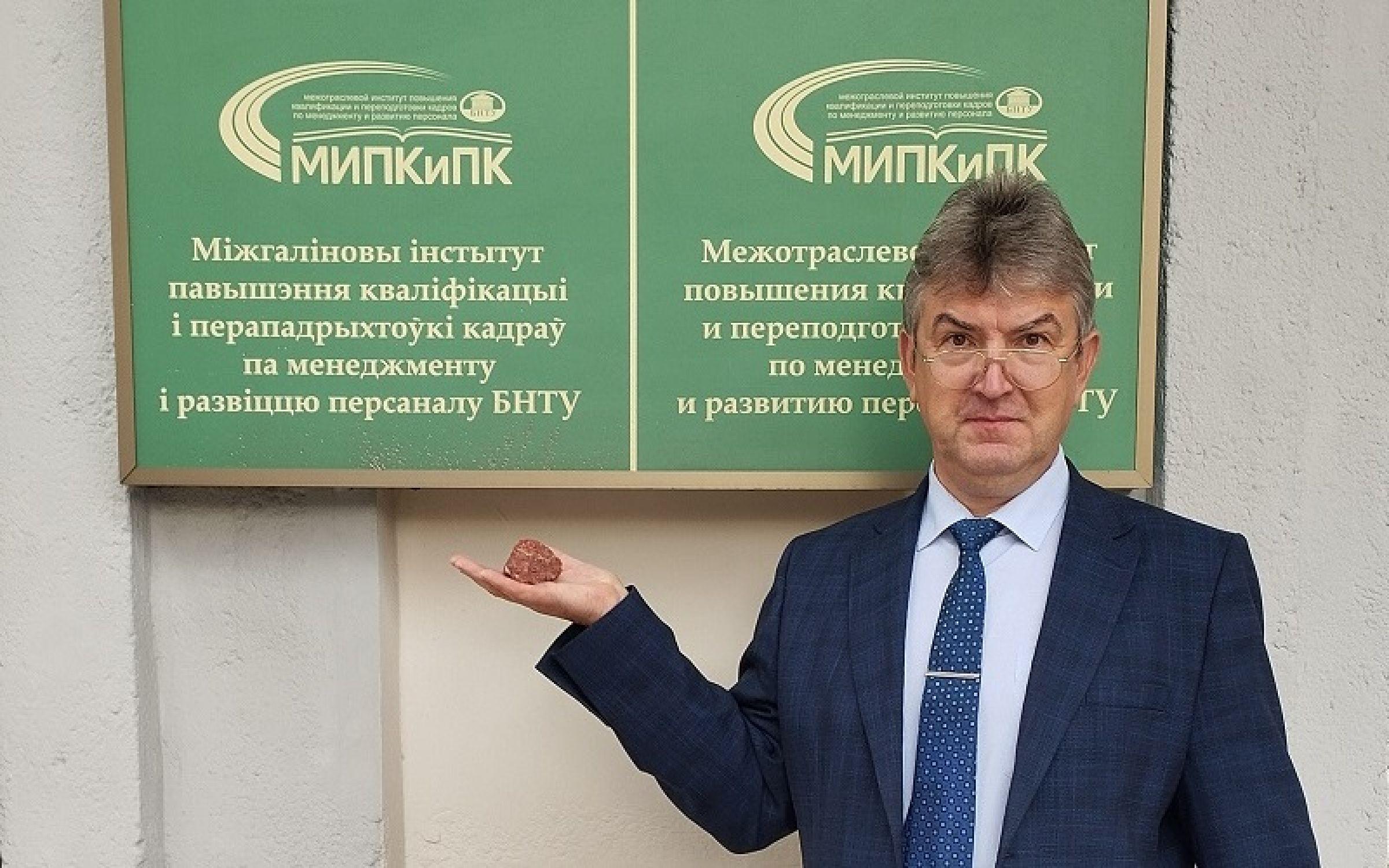
In this article, we discuss the retraining specialization "Underground Mineral Deposit Development." Our expert is Andrey Stanislavovich Snarsky—Dean of the Faculty of Industrial and Radiation Safety at IIASRP BNTU, Professor at the Department of Technological Process and Production Safety, Candidate of Technical Sciences, and Associate Professor. He also chairs the bureau of the Educational and Methodological Association (EMA) for adult continuing education in the "Mining" group of specialties, which includes the specialization in question. In other words, Andrey Stanislavovich oversees the retraining program in a dual capacity: as the head of the Soligorsk branch (in his role as Dean) and as the supervisor of the scientific and methodological support for the educational process (as the EMA bureau chair).


About this specialization and the current situation
The BNTU branch "Intersectoral Institute for Advanced Studies and Retraining of Personnel in Management and Personnel Development" (BNTU "IIASRP") is the only educational institution in the Republic of Belarus offering retraining in the specialty "Underground Mineral Deposit Development" (available both to those with a higher education background—awarding the qualification of "Mining Engineer"—and to those with a specialized secondary education background—awarding the qualification of "Mining Technician-Technologist"). This status is a source of great honor, but it also entails a high level of responsibility regarding the quality of training.
Our institute has been enrolling students in this specialty since 2018 (references here and below pertain to retraining based on prior higher education).
Two significant turning points mark the development of this specialty.
The first: 2024. The Ministry of Emergency Situations of the Republic of Belarus approached BNTU regarding the training of personnel from its units—specifically those whose duties involve working in the metro system or who might be tasked with emergency response operations in the metro in the future. Requirements dictated that the "Mining Engineer" qualification was necessary. While training in a similar specialty within the Russian Federation was seriously considered, the IIASRP BNTU and our specific program were ultimately selected based on logic and practicality. This essentially constituted a "state order." Nine Ministry of Emergency Situations officers completed the first training cohort in 2024. The ceremonial presentation of diplomas took place on November 22, 2024, attended by representatives of the Ministry's leadership. This highlights a new and important employment avenue for our graduates.
The second: 2025. We have undertaken a major, fundamental overhaul of the educational standard for this specialization: we revised the content of several courses to reflect modern approaches, adjusted the hourly breakdown to emphasize practical application, and reordered certain subjects to improve the logical flow of the curriculum.
Today, this is a modernized specialization with a strong focus on contemporary technologies and a greater emphasis on practical application. Proof of this lies in the fact that an increasing number of graduation projects are now being recommended for practical implementation.
An additional advantage of our program is the high-quality instructional support provided for all courses: students have access to a dedicated website containing digital versions of study guides and materials for every subject. In 2025, we developed and officially registered—at the national level—an electronic educational and methodological package (EEMP). This resource provides students with everything they need: exam questions, coursework topics, reading lists, and core textbooks and study guides for all the disciplines in the curriculum. Access is available from any location and any computer using a unique login and password reserved exclusively for students of this specialization.
Is this specialization popular?
Yes, it is in high demand. Since 2018, over 200 people (!) have completed the training.
Incidentally, the 15th (milestone) class of mining engineers graduated on May 22, 2026!
For the most recent intake (August 2026), there were 20 applications—a significant number for a specialization that has been taught since 2018!
Is there a tuition fee?
Yes. Typically, the training is paid for by the organization interested in the specialist—usually an existing employee who holds an engineering degree in a different field. A notable feature of the current cohort is that the majority of students (18 out of 20) are paying for the training themselves, while only two have been sent and funded by their organizations. However, this statistic applies only to the current intake; in previous groups, most students were sponsored by their employers. Why do people invest their own money? To secure engineering roles and advance their careers within companies involved in mineral extraction. Advancing in a field related to mineral extraction and/or processing requires the qualification of "Mining Engineer," which makes perfect sense.
Dear readers, take note of this! It is an excellent opportunity to find a prestigious, well-paid job and gain prospects for rapid career advancement following the retraining program.
Where can graduates work?
Such specialists are primarily in demand at JSC Belaruskali and JSC Trust Shakhtospetsstroy (the nature of the specialty is evident even from the companies' names), where the majority of our graduates are employed. However, there are other options as well. These include JSC Mozyrsol—one of the youngest enterprises in its sector, which has established itself as a key producer of "Extra" grade evaporated salt across the CIS and Eastern Europe—and RUEP Granit, Europe’s largest enterprise for the extraction and processing of dense rock, among others. Additionally, starting in 2024, opportunities exist for employment within various units of the Ministry of Emergency Situations of the Republic of Belarus.
How long does the training last?
Let us provide a more detailed answer.
The duration of the program is 18 months. The mode of study is part-time (correspondence).
Qualification: Mining Engineer.
Admission is granted without entrance exams!
The program is fee-based (payment is made in six installments; the estimated total cost for 2026 is 4,700 Belarusian rubles).
The training includes examination sessions, classroom instruction, and independent study under the guidance of highly qualified faculty—including associate professors, Candidates of Technical Sciences, and professors. It also involves an internship at an industrial enterprise (concluding with a report defense), as well as tests, exams, coursework, and a final diploma project.
The program concludes with the defense of a diploma project.
Upon completion, a state-recognized diploma of professional retraining is issued.
What is the training focused on?
First and foremost, on subjects related to the specialization—and there are many of them!
According to the curriculum for this specialization, the so-called "educational institution component" comprises 18 subjects! The key ones include (to give readers an idea of the specialization's specific nature): rock physics, rock fragmentation by blasting, mineral processing, mining machinery and equipment, and mine design—plus another 13 subjects! On top of that, there is the so-called "mandatory state component."
How much time is allocated to theory versus practice?
Most classes are designed with a focus on their utility for future professional practice—in other words, the training is practice-oriented.
However, based on the curriculum, the average share of practical sessions, laboratory work, seminars, and coursework—relative to the total number of in-class hours across various subjects—comes to approximately 50% (which is an excellent figure). That is in addition to internships and the final thesis project.
It is also important to note that 504 hours (50% of the total curriculum hours) are dedicated to independent study by the participants—which makes perfect sense. After all, these are not undergraduate students, but adults with a clear motivation to master the material and gain knowledge in their chosen field.
Who is eligible to undergo retraining in the specialty of "underground mineral deposit development" and obtain the qualification of "mining engineer"? Are there specific criteria?
Before answering this question directly, let me make a brief digression: in the Republic of Belarus, all (!) retraining specialties have a so-called "entry requirement"—specifically, the higher education majors that qualify an individual for admission to a particular retraining program. This is stipulated in a regulatory document: Resolution of the Council of Ministers No. 574 dated September 1, 2022.
In other words, individuals with a higher education degree are eligible for retraining (see the Resolution mentioned above). Students in the final two years of higher education programs, as well as master's students in relevant fields of study, are also eligible to undergo this retraining.
What skills will individuals acquire if they undergo retraining in the specialty of "Underground Mineral Deposit Development" and qualify as "Mining Engineers"?
The skills, knowledge, and competencies of graduates align with the state standard for this specialty (Resolution of the Ministry of Education of the Republic of Belarus No. 98 dated June 9, 2025, "On Approving the Educational Standard for the Retraining of Executives and Specialists"). This standard includes a dedicated section linking specific academic disciplines to particular professional and specialized competencies, enabling graduates to become true experts in the field and effectively perform their practical duties as mining engineers. In total, there are 29 such competencies, covering all aspects of the specialty and the specialist's future professional activities.
What does the internship entail for those seeking retraining in the specialty of "underground mineral deposit development" with the qualification of "mining engineer"? When does the internship begin?
The internship constitutes a distinct stage of the retraining program for this specialty. Just as one cannot become a competent military professional in any field without "getting a taste of the action"—as the saying goes—so too in our line of work: without an internship at actual production sites (including underground mine environments), it is impossible to grasp the core of the profession, see what it looks like "in the real world," or understand how everything actually functions. That is precisely the purpose of the internship.
We would like to take this opportunity to express our sincere gratitude to the management of JSC Belaruskali for organizing internships for our trainees at the production facilities of the company's mining divisions.
The internship takes place during the third stage (the final session), prior to the diploma project phase.
What does the diploma project entail?
It follows the classic model: the student demonstrates what they have been taught and what they have learned. A topic and an assignment are provided, outlining the specific issues to be addressed—which form the content of the explanatory report—as well as a list of required graphic materials. Essentially, the student must select a solution for a specific operational challenge and justify it, including through technical and economic calculations.
The project topics are always linked to the specific tasks of a particular mineral extraction enterprise. Examples include: "Selection of technology and mine planning for reserve extraction at [specific mining division of JSC Belaruskali]," "Project to increase production capacity at [specific mine]," or "Comparative analysis of mining method options for [specific potash seam at a specific mining division]," and so on. This is both interesting and valuable for the student's future career.
Where does the training take place, and what documents are required for enrollment?
Retraining in this specialty is organized at the Soligorsk branch of the BNTU "Intersectoral Institute for Advanced Studies and Retraining of Personnel in Management and Personnel Development" (BNTU "IIASRP").
Address: 31 Kozlova St., Offices 53 & 55, Soligorsk (5th floor, RUE "Beltelecom" building)
Mailing address: P.O. Box 156, Soligorsk, 223707
Phone: +375 (174) 33 67 67; 26 00 26; 33 39 99
Mobile: +375 (29) 398 91 42, +375 (29) 180 81 31
E-mail: soligorsk@mipk.by
List of documents required for enrollment:
Original and copy of your secondary specialized or higher education diploma (or a certificate from the dean's office for current students)
Application addressed to the BNTU Rector
Medical certificate
Two 3x4 cm photographs
Important note: Enrollment is not tied to the start of the academic year in September! Training begins as soon as groups are formed.
We look forward to welcoming you, future mining engineers!
