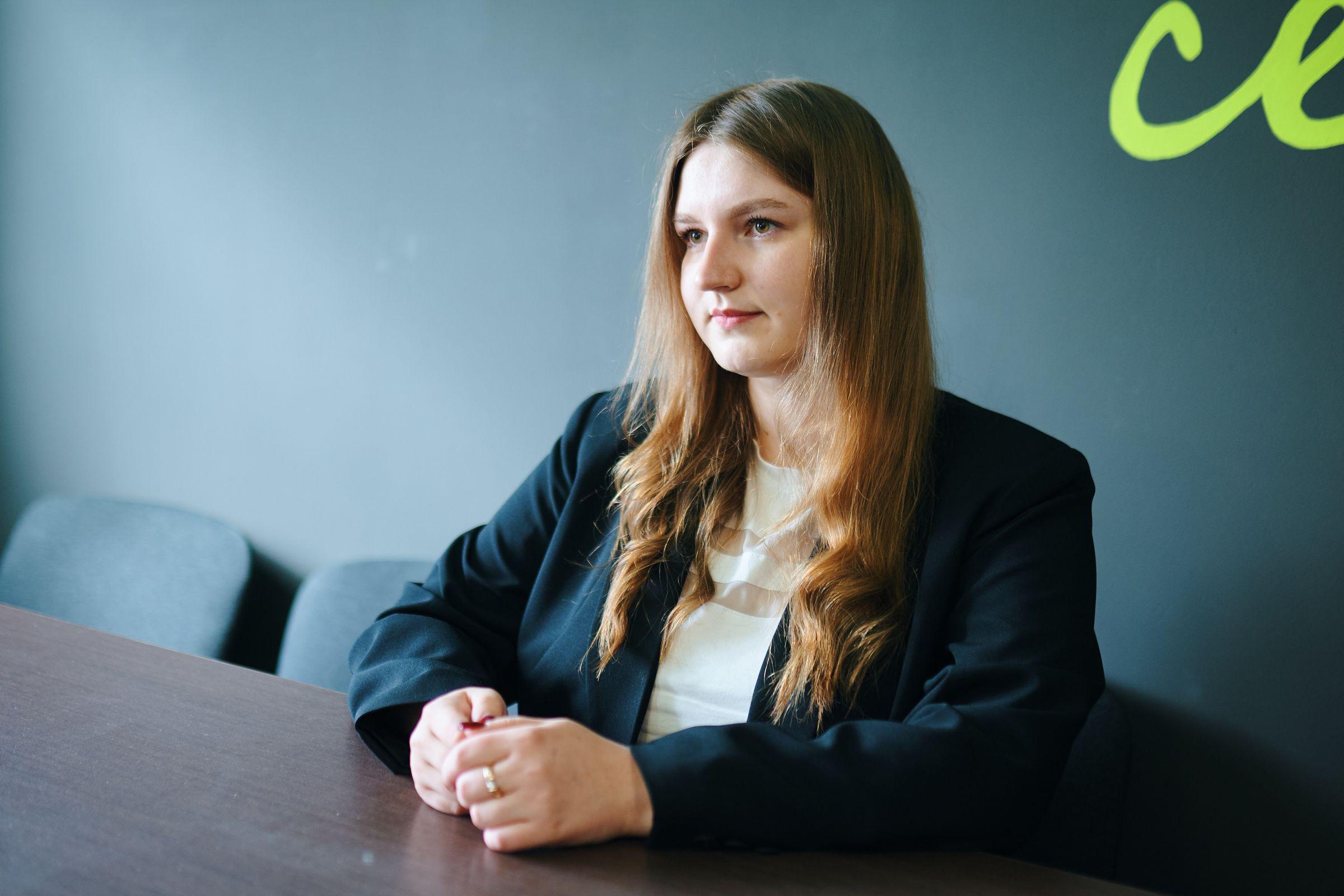
We continue to highlight women in engineering education. In the Year of Belarusian Women, it's especially important to share the stories of those who are challenging stereotypes and proving that technical professions are not divided by gender. The heroine of this new issue is Darya Bugayova, a teaching intern in the Department of Transport Systems and Technologies at the Belarusian National Technical University's Automobile and Tractor Faculty, a participant in the city finals of the "Minsk Shift - 2025" competition, and the faculty's volunteer coordinator. She shared how family traditions led her to engineering, what it's like to be a young female teacher at a technical university, and why volunteering is just as important as science.
Daria Leonidovna chose the transport field not by chance, but after analyzing the transport sector and its prospects.
"I've always liked technical fields, where it's important not only to know the theory but also to understand how everything works in practice." The transportation sector seemed very vibrant and promising to me: it involves technology, engineering, logistics, urban development—everything that directly impacts people's lives. Furthermore, I wanted to develop in a field where I could constantly learn and see the results of my work.
Her student years, she admits, were her most memorable. She recalls not only classes and exams, but also the people, the atmosphere at the faculty, joint projects, and preparation for conferences. She considers those moments when, after much work, something finally worked out—whether it was a research project or a complex subject—to be especially valuable. Furthermore, her student years taught Daria Bugayeva to be independent and not to be afraid of responsibility.
Her love of engineering and teaching runs in her family.
"My love for both engineering and teaching runs in my family. My father is a mechanical engineer, and my mother is a teacher, so choosing a major was a no-brainer." Since childhood, I've had an interest in technology and a respect for the teaching profession, so the transportation field came naturally to me. The desire to teach came later, more for the soul, because I truly enjoy sharing knowledge, working with students, and seeing them develop.
Now she teaches classes herself, and the small age difference sometimes surprises students.
— Sometimes, at first, students are surprised because the age difference is really small. But I think the most important thing for a teacher isn't age, but the ability to explain the material and build rapport with the audience. Perhaps it's easier for students to communicate with me because I've recently been in their shoes and understand many of their experiences and difficulties.
— What's more difficult for you: understanding a new scientific problem or finding an approach to a specific student?
— Finding an approach to the individual. A scientific problem can be solved through analysis, literature, and experiments, but motivation varies from person to person. Sometimes a student just needs to feel believed in or that the subject is truly useful.
Darya Leonidovna is a participant in the final round of the "Minskaya Smena 2025" project. Together with Sergei Skirkovsky, Dean of the Automobile and Tractor Faculty, and Yuri Burtyl, Associate Professor of the Department of Transport Systems and Technologies, she presented the "Smart Pedestrian Crossing" project.
"Minskaya Smena" is a citywide competition for youth initiatives and innovative projects that brings together active young professionals, students, and researchers. For me, participating in the project was an opportunity not only to present my idea but also to gain valuable experience in public speaking, teamwork, and discussing pressing urban issues. In the final round, I presented the "Smart Pedestrian Crossing" project alongside Sergei Skirkovsky, Dean of the Automobile and Tractor Faculty, and Yuri Burtyl, Associate Professor of the Department of Transport Systems and Technologies. This project involved reconstructing a pedestrian crossing using an intelligent traffic safety system. The project's idea was to make pedestrian crossings safer by implementing modern technologies: automatic lighting systems, motion sensors, and elements that attract drivers' attention at night or in poor weather conditions. We viewed the project not simply as a technical solution, but as a tangible step toward reducing accidents and improving the safety of all road users. It's especially important to me that this project combines an engineering approach, social significance, and modern technology—exactly how I envision the development of the transportation sector today.
The trainee teacher admitted that, like many young professionals, she initially had doubts and concerns about participating in various competitions, but the overwhelming support of Elena Grinevich, Deputy Dean for Ideological and Educational Work at the ATF, was very helpful. According to Daria Bugayeva, it's crucial to have someone by your side who truly believes in you and helps you move forward.
In addition to teaching and research, she coordinates volunteer activities at the faculty. For her, it's an opportunity to give back to those in need.
"For me, volunteering is an opportunity to do something useful for people and unite students around good initiatives. Even at a technical university, it's crucial to develop not only professional skills but also human qualities: responsibility, empathy, and teamwork."
"How do you manage to combine teaching, research, and volunteer coordination? Do you have a personal time management strategy?"
"Sometimes it seems like there's too much to do, but actually, being active gives me energy. I can't live without something to do; I always want to do something, develop, and try new things. And, oddly enough, it's work and constant movement that keep me moving forward and give me even more strength. I guess my main principle is to never put things off and try to manage my time wisely. When you're truly interested in what you do, you can juggle a lot of things."
She's now actively engaging students in research, because it's important for her to show that science is interesting and easy.
"I already have students who have begun participating in research and project work. It usually starts with an interest in the subject, discussions after class, or collaborative work on ideas. For example, we developed the project for "Minskaya Shift 2025" together with the students: we discussed the concept, proposed solutions, and refined the ideas. It's important for me to show the students that science and projects aren't something distant and complicated, but an opportunity to express themselves, implement their ideas, and gain valuable experience."
Speaking about stereotypes, Darya Bugayeva noted that sometimes you hear surprise that a girl chose a technical field, but these stereotypes are gradually disappearing. In today's engineering world, knowledge, professionalism, and a desire to develop are much more important than gender. She is confident that girls bring attentiveness, patience, the ability to explain, and find common ground with others to the engineering field. The young woman tries to explain complex concepts in simple terms, using real-life examples and associations—this makes the material easier and more understandable.
— How would you describe a modern female engineer in Belarus?
— A person who isn't afraid to take responsibility, develop, and prove that engineering is a field of opportunity for everyone. Modern women successfully combine professional development, social activities, and science, while remaining highly versatile.
Her advice to female applicants who are unsure whether to pursue an engineering major is as follows:
— Don't be afraid to try. If you're interested in a technical field, you're already on the right path. Don't doubt yourself just because it seems "not feminine." The most important thing is the desire to learn, develop, and believe in yourself. Everything else comes with experience.
Daria Bugayeva's story is further proof that engineering education at BNTU has long been a space for equal opportunity. Here they teach not only how to calculate and design, but also how to be a person ready to help, lead, and inspire by example.
