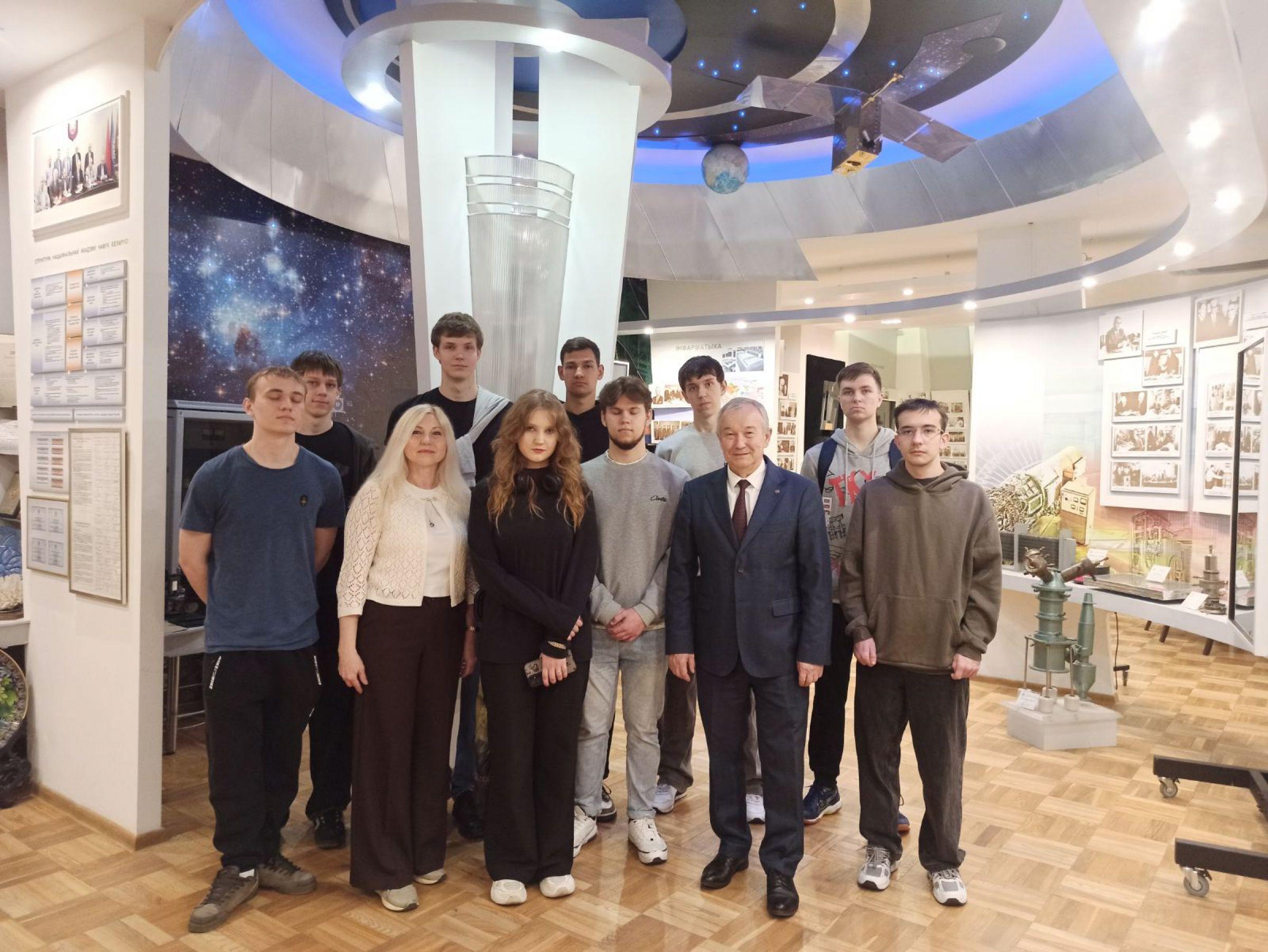
On May 8, 2026, students of group 11310125 of the Department of Micro- and Nanotechnology of the Instrument-Making Faculty, together with their curator, senior lecturer Natalya Anatolyevna Kondratyeva, visited the Museum of History of the National Academy of Sciences of Belarus. The organizer and main guide of the event for the students was Academician of the National Academy of Sciences of Belarus, Doctor of Technical Sciences, Professor Sergei Antonovich Chizhik, Head of the Department of Micro- and Nanotechnology at BNTU, and from 2014 to 2025 — First Deputy Chairman of the Presidium of the National Academy of Sciences of Belarus.
The museum's exhibition is located in the main building of the National Academy of Sciences of Belarus and covers an area of 250 square meters. The future engineers of micro- and nanotechnologies became acquainted with the main stages of the formation and development of academic science in Belarus, the history of the formation of the modern organizational structure of the Academy of Sciences, and the achievements and results of scientific and scientific-technical activities of its scientists and organizations.
The students studied the content of the stands with interest and examined the exhibits, which consist of halls reflecting the modern structure of the academy. Seven departments are represented here, uniting scientific institutions by research profile: the Department of Physics, Mathematics and Informatics; the Department of Physical and Technical Sciences; the Department of Chemistry and Earth Sciences; the Department of Agricultural Sciences; the Department of Biological Sciences; the Department of Medical Sciences; and the Department of Humanities and Arts.
Particular interest was aroused by the developments of:
The Minsk Research Institute of Radio Materials in the form of sensor technology, represented by: limit switches (inductive of various modifications), strain gauges, and monitoring systems for carbon monoxide, carbon dioxide, and methane concentrations.
The B.I. Stepanov Institute of Physics using the example of a small-scale terahertz spectrometer, which has the advantage of simultaneous registration of transmission spectra and refractive index. It can be used in security systems for detecting drugs, explosives, and other substances.
The Institute of Genetics and Cytology, which presented genetic technologies in reproductive medicine, human DNA testing technologies, and genetic certification of farm animals and fish.
The Republican Center for Polar Research, demonstrating the formation of the infrastructure of the Belarusian Antarctic Research Station.
The Institute of General and Inorganic Chemistry, which developed technologies for wastewater treatment and dehydration of clay-salt dispersions (for OJSC Belaruskali), as well as technologies for enrichment and processing of polymineral potash and phosphate ores.
The students were especially impressed by Chizhik S.A.'s story about the construction of the Belarusian nuclear power plant, new super-strong and lightweight materials, instruments for the International Space Station, new models of skis with a core made of foamed polymer material, unmanned aerial vehicles and systems, LED devices for studying the effect of light on plants and animals, and much more.
A student of group 11310125, Anastasia Ignatenko, shared her impressions:
"The excursion with Sergei Antonovich Chizhik to the Museum of the National Academy of Sciences left the most pleasant impressions. What pleased me most was how worthily the exhibition presents the achievements of Belarusian science — especially in the field of space (our satellites and instruments for the ISS) and in the field of waste processing, where Belarusian developments look very modern and environmentally friendly. I was also interested in the stands related to applied mathematics and Belarusian microchips. Thank you to Sergei Antonovich for the excursion, which allowed me to take a fresh look at the achievements of our country."
In the thematic areas of the museum exhibition of the National Academy of Sciences of Belarus, students were able to look into the future of the country through its present, getting acquainted with the country's advanced achievements in various fields of science.
