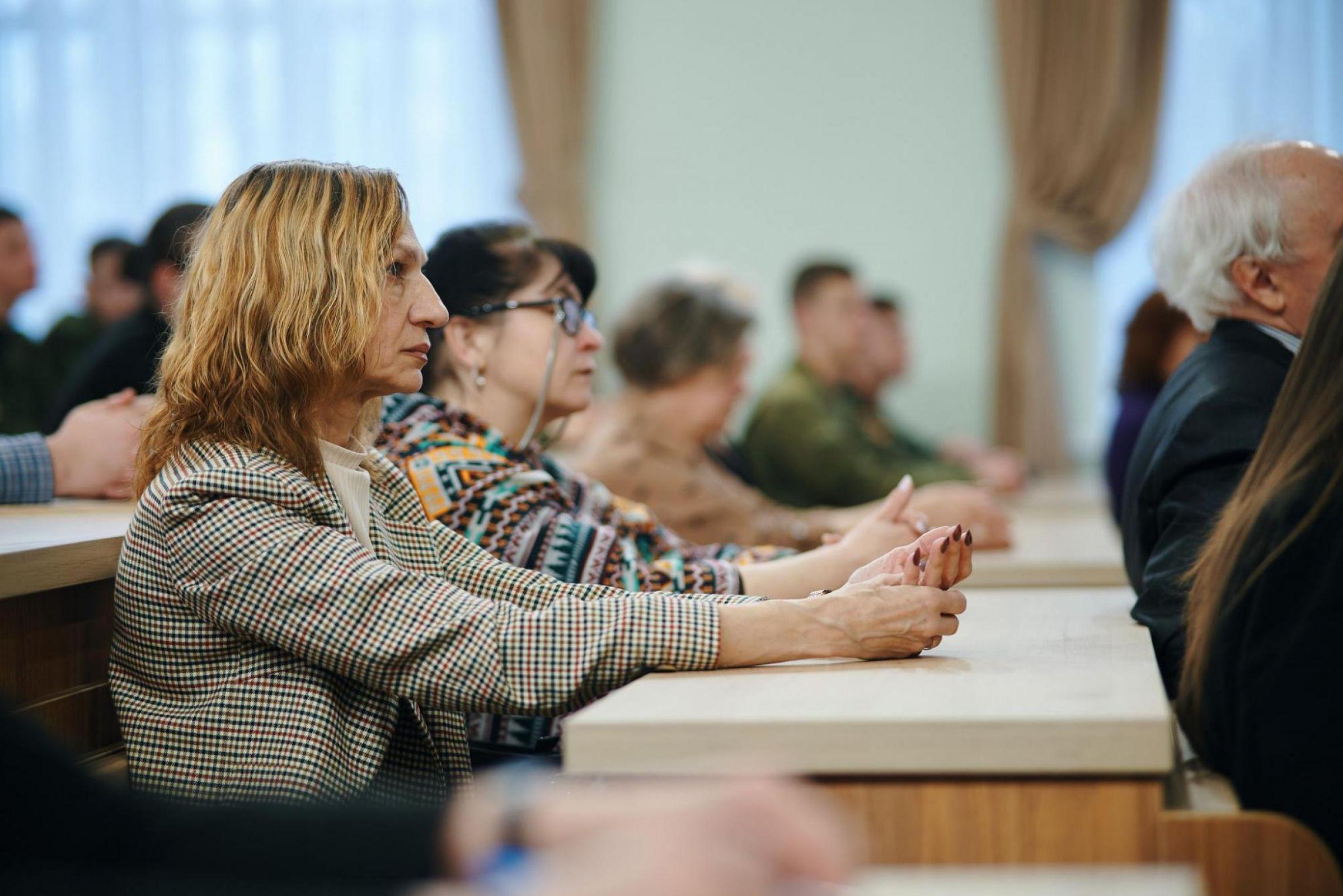
Today, April 16, the Belarusian National Technical University held a Unified Information Day for staff and students. The main topic on the agenda was the 40th anniversary of the Chernobyl Nuclear Power Plant tragedy.
The key event was a university-wide dialogue platform. In parallel, large-scale information meetings were held for students and staff from other faculties, to which experts were also invited. Ellada Vlasenko, a member of the Minsk City Council of Deputies, a member of the Standing Commission of the Council on Management and Disposal of Municipal Property and Advertising, and Director of Minsk Gymnasium No. 15, met with the audience at the Faculty of Mechanical Engineering.
Mikhail Milovanov, a member of the Minsk City Council and advisor to the Secretariat of the High-Tech Park Supervisory Board, spoke at the Faculty of Information Technology and Robotics.
Oksana Besko, a member of the Minsk City Council, a member of the Council's Standing Committee on Economic Development, Finance, Budget, and Entrepreneurship, and Director of the Minsk State College of Finance and Economics, moderated the dialogue session at the Faculty of Automobile and Tractor Engineering.
Oleg Kuzmin, a member of the House of Representatives of the National Assembly of the Republic of Belarus and a member of the Standing Committee on Education, Culture, and Science, served as a guest speaker at the central meeting. Vitaly Adamovich, Deputy Head of the Center for Ideological Work and Youth Affairs and Head of the Department of Ideological Work and Crime Prevention at BNTU, also participated in the events.
Participants were first shown a video clip that reminded them of the events of the spring of 1986. Oleg Alekseevich then began his speech with words of gratitude to the university and its staff:
– Thank you for your contribution to the economic development of our country, and for nurturing students who are becoming, dare I say it, great people. They work in the national economy, our economy, and create a product of which we can rightfully be proud.
Moving on to the main topic, the deputy recalled April 26th and paid tribute to the heroism of the firefighters and liquidators. According to the speaker, the rescuers, unaware of the full extent of the invisible threat, rushed first to extinguish the fire, fulfilling their duty and protecting millions of lives.
Speaking about the consequences, Oleg Kuzmin recalled that the accident caused irreparable damage: the country irreparably lost 479 settlements. However, the young sovereign state, led by the President, did not abandon the contaminated territories. Instead of a populist distribution of funds, the money was concentrated on creating vital infrastructure: building safe housing, roads, water pipes, and gas networks.
The deputy cited impressive figures demonstrating the state's unprecedented efforts. He noted that over the past decades, a significant portion of the state budget has been allocated to restoring damaged lands. The Republic of Belarus consistently invests colossal resources in rescuing and developing these territories, creating all the necessary conditions for a full and safe life for its people.
Particular attention was paid to the revival of agriculture. The speaker emphasized that the country annually "reclaims" approximately 2% of contaminated lands and forests from radiation, while maintaining a strict monitoring system. Products produced in affected areas undergo even more stringent testing than goods from "clean" regions. Furthermore, as Oleg Alekseevich noted, not a single product exceeding permissible radionuclide levels has entered retail outlets since the accident. Strict radiation monitoring has now become a true national brand, guaranteeing the safety of Belarusian goods even in export markets.
Social protection, which traditionally receives more than half of the relevant funding, was discussed separately. Twelve rehabilitation and health centers have been established to improve the health of children in the affected areas, and the unique Republican Scientific and Practical Center for Radiation Medicine and Human Ecology in Gomel plays a vital role in preserving public health. Its specialists save lives and regularly conduct on-site examinations throughout the country.
Concluding the meeting, Oleg Kuzmin called on young people to preserve historical memory, honor the selfless sacrifice of the liquidators, and understand the enormous efforts the state is making to preserve the nation's health and ensure the robust development of our country.
