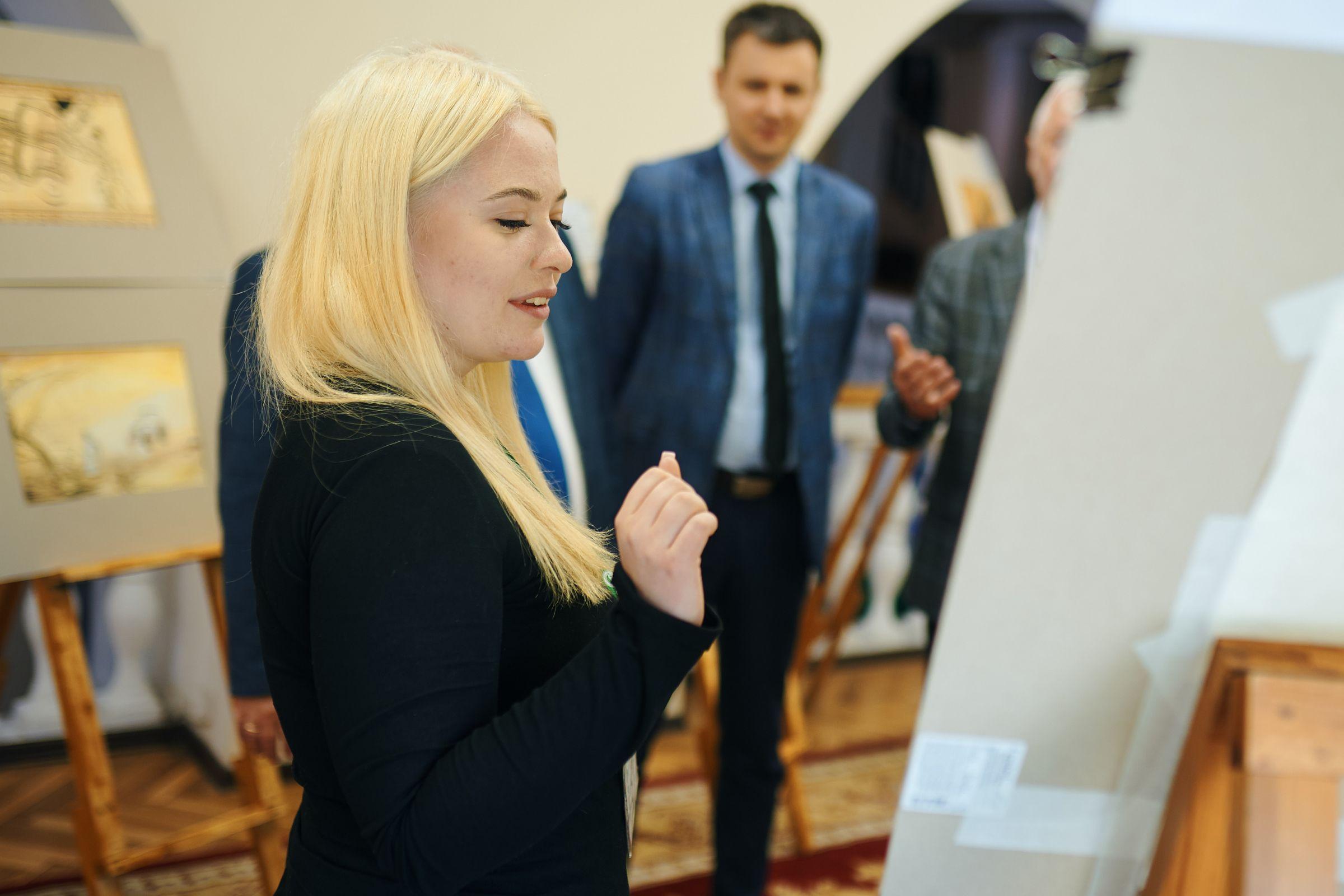
On Monday, May 25, the exhibition "Tractors of MTZ Belarus in the history of world art culture", dedicated to the 80th anniversary of Minsk Tractor Works, opened in the main building of BNTU. The exhibition features works by students of the third and fourth years of BNTU, which depict Belarusian tractors in various historical eras.
Vladimir Boikov, Head of the Tractors Department at ATF, spoke about why the Belarus tractor can be considered not only a machine, but also a cultural phenomenon, as well as about the long-term cooperation between BNTU and MTZ.
— The idea of the works is to show the tractor in different historical periods. We are currently preparing for the 80th anniversary of MTZ and we decided to arrange everything as congratulations to the Minsk Tractor Plant in connection with this landmark event. Today, there is not a single country in the world where the MTZ tractor would not work. We used to find tractors in Argentina, where the MTZ-2 tractor is owned by a farmer. In other words, MTZ is a unique enterprise with which BNTU has developed a favorable cooperation. These are educational, scientific and industrial relations. Also, a branch of our department is located at the enterprise and we train personnel for the plant. On the basis of the plant, educational and production practices and diploma design are organized for BNTU students.
Today, on May 27, representatives of MTZ OJSC visited the exhibition. The delegation from the company included Igor Drozd, Head of the Industrial Design Bureau, Igor Zemtsov, General Designer, and Sergey Kovalchuk, Chief Designer.
The guests were given a guided tour of the exhibition, where they showed the works of third and fourth year students made in various artistic styles of historical eras. Each work was accompanied by a brief history of its creation: the authors sought to show the Belarus tractor not only as a technical achievement, but also as an image inscribed in the context of world visual culture.
During the tour, the students and organizers also revealed the ideas of individual paintings: what examples were used and how the idea was born to combine industrial themes with elements of folk or ritual art.
Galina Ivanova, the creator of the exhibition, senior lecturer at the ATF Tractors Department, told how the training assignment turned into an anniversary exhibition.
— The exhibition began as a series of educational works in the course of the subject "Project graphics". We have a task for work in different styles, and it includes work in different historical styles, but we decided to expand the task a little, to dedicate and introduce images of a tractor in different variations. How it would be drawn, sculpted, and depicted by representatives of different cultures, mostly ancient ones. We did not specifically take the new time, which requires very good academic training. Therefore, archaic art is mostly the art that was made by people without academic education. Then we found out that MTZ has an anniversary, and next year we continued to solve the same problem with the students. So there's been two years of work here. We selected not only the quality for the exhibition, but also, if possible, to assemble and exhibit, to make a passepartout, so not all the works are here, but it seems to me that it turned out well. Special thanks to those who helped to print, cut, transfer, clean easels, design, type fonts. It wouldn't look like this without it. Signatures to works quite often appear at different exhibitions when describing the era, the task and the concept of the exhibition. I was specifically prompted by one of Mikhail Zadornov's speeches, when he told me how he was preparing a concert for Uzbekistan. I liked this idea, so such humorous texts were made in the spirit of a student skit.
In turn, Timofey Satskevich, a student of the Faculty of Automotive Engineering, shared the idea of his work, inspired by shamanic drums.
— As the main reference for the creation of my work, which is present at this exhibition, examples of very old shamanic drums were taken. Shamanic drums embodied the mythology, sensations, and feelings of those people who used them — shamans. When they beat the drums, crops grew in their imagination, cattle fed a lot, and thus they improved their lives with the power of thought. My work also conveys the state of universal well-being, and the MTZ tractor is integrated into this picture not for the sake of subtext, but as a natural and appropriate addition. Regarding the idea, it appeared unexpectedly, and our teacher Galina Ivanova helped with its implementation.
The newly opened exhibition is another example of effective cooperation between BNTU and MTZ OJSC in the framework of engineering personnel training and joint projects. We invite everyone to visit the exhibition!
