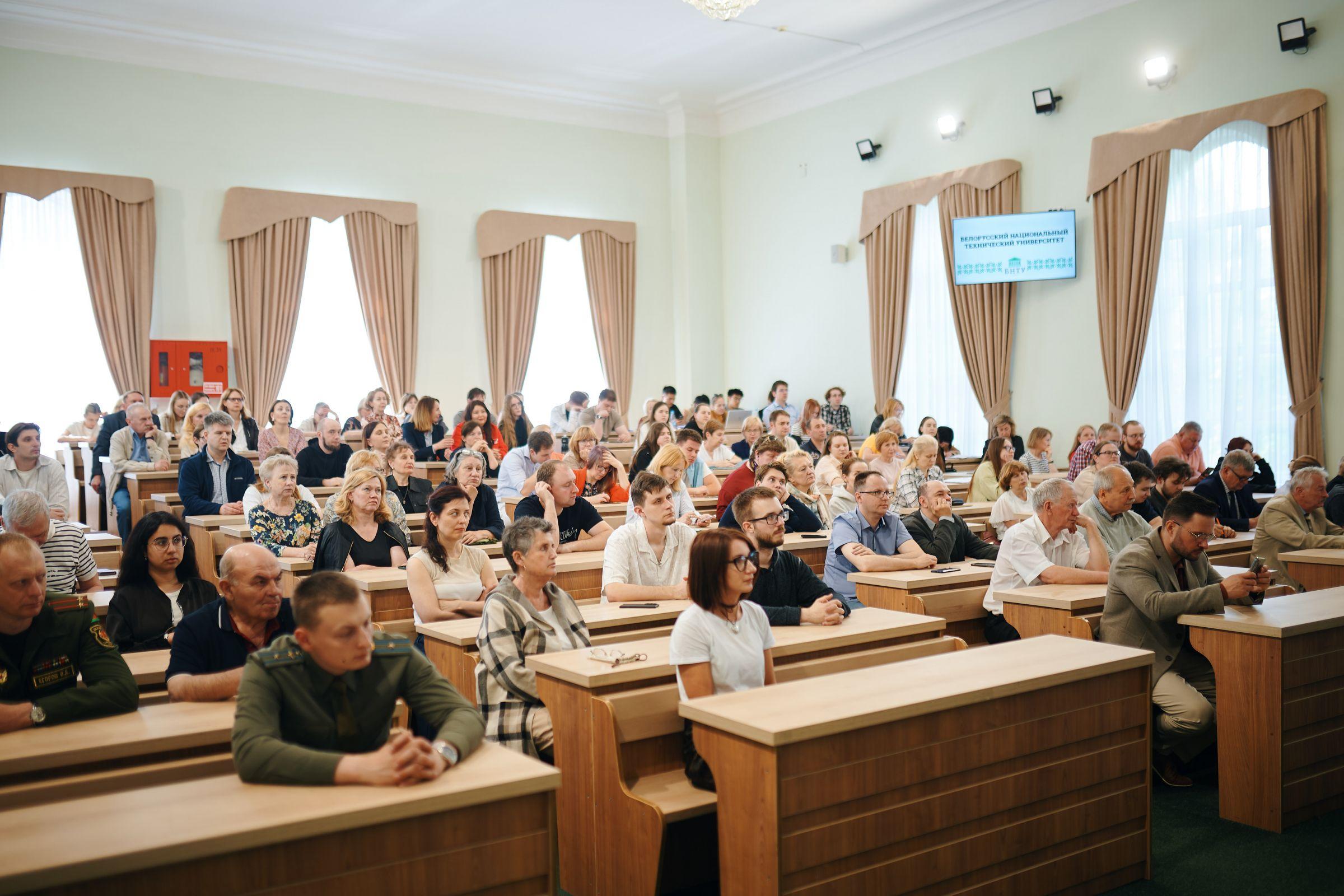
Today, on May 25, the Belarusian National Technical University held a dialogue platform on the topic "Prevention of Offenses and Crimes" for employees. This time, the prevention of offenses was discussed by Nikolai Zanevsky, an operative of the Department for Combating Cybercrime of the Department of Internal Affairs of the Frunze District Administration of Minsk, and Vladislava Rusakovich, a senior inspector for agitation and propaganda of the Department of Internal Affairs of the Frunze District Administration of Minsk. During the meeting, the speakers provided real-life examples and gave specific recommendations on how to avoid becoming a victim of cybercriminals and traffic accidents.
Nikolai Zanevsky explained in detail the types of cybercrimes that citizens are increasingly facing. A special emphasis was placed on the fact that anyone can become a victim of fraud, but vigilance and basic digital literacy reduce the risks to almost zero.
- The main rules that will help you avoid becoming a victim are as follows: never share SMS codes or internet banking passwords over the phone, and if a "relative" or "boss" asks you to transfer money urgently, call them back in person. Additionally, avoid clicking on suspicious links or downloading apps from unknown websites, said Nikolai Dmitrievich.
Vladislava Rusakovich, in turn, reminded the audience of the importance of following traffic rules for both drivers and pedestrians.
"Every year, the number of accidents involving pedestrians and those who use personal mobility devices increases in the spring and summer," added Vladislava Rusakovich.
The speaker urged the participants to follow the speed limit, dismount when crossing the road, and not use their phones or headphones while operating a personal mobility device. To illustrate her point, Vladislava Rusakovich showed the audience a video featuring real-life accidents and their consequences.
The dialogue platform was held in an open format. Employees of BNTU asked the speakers clarifying questions and shared their personal experiences.
We would like to thank the speakers for a useful and informative meeting.
