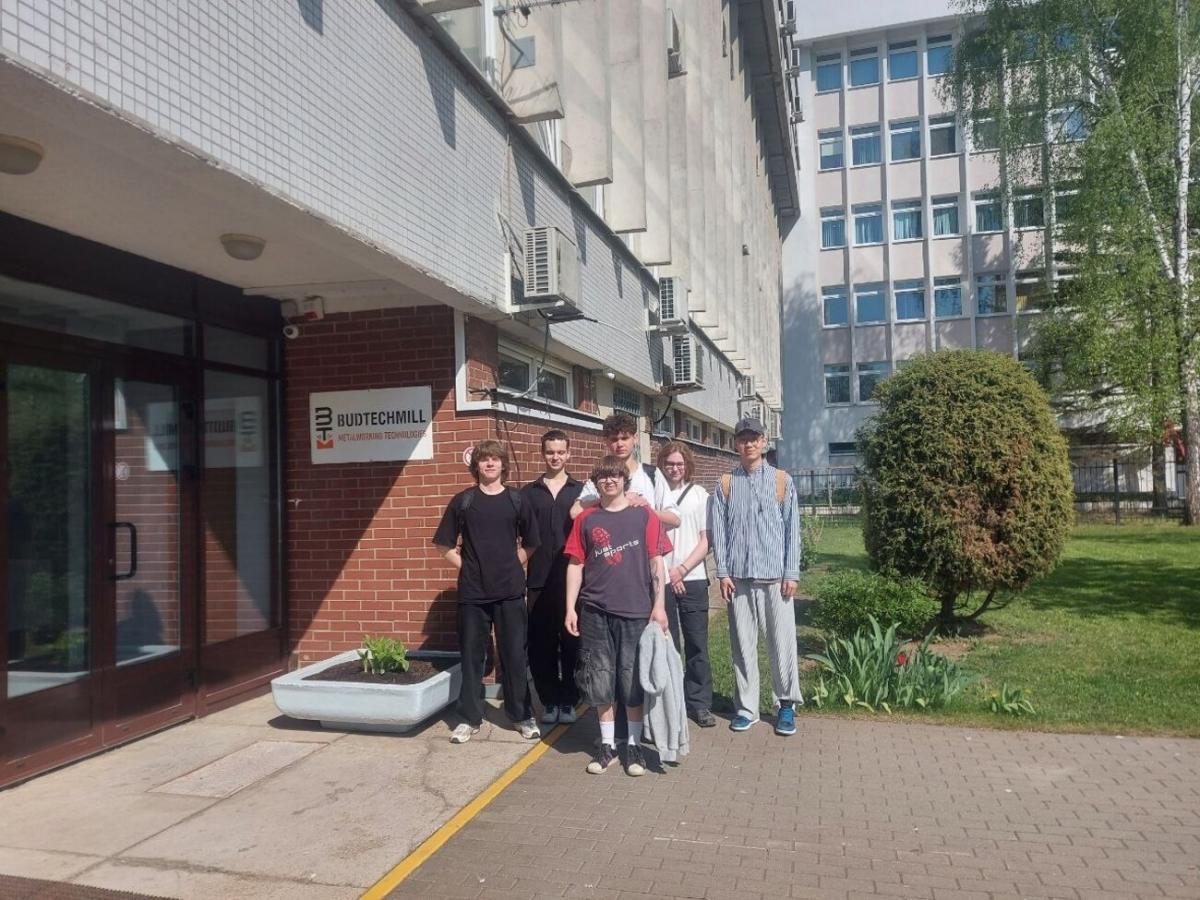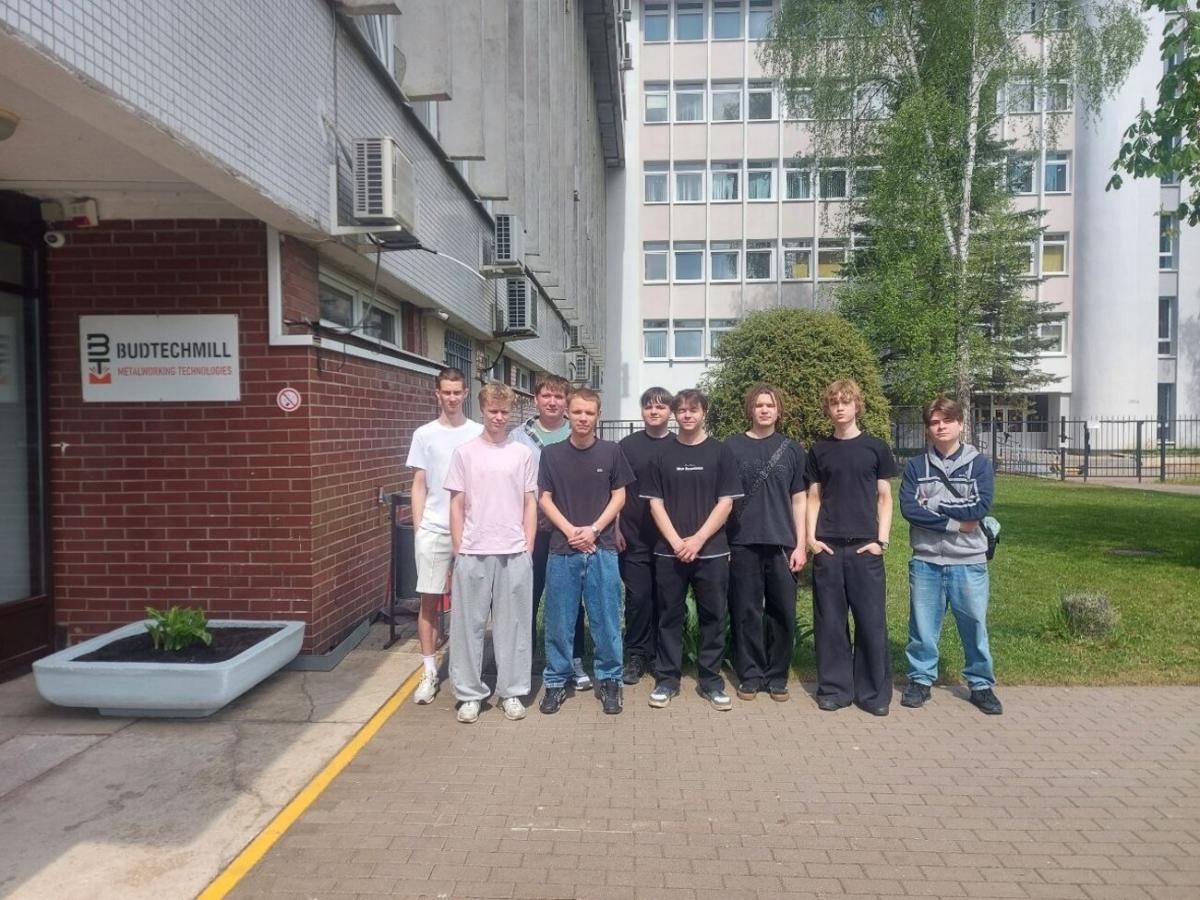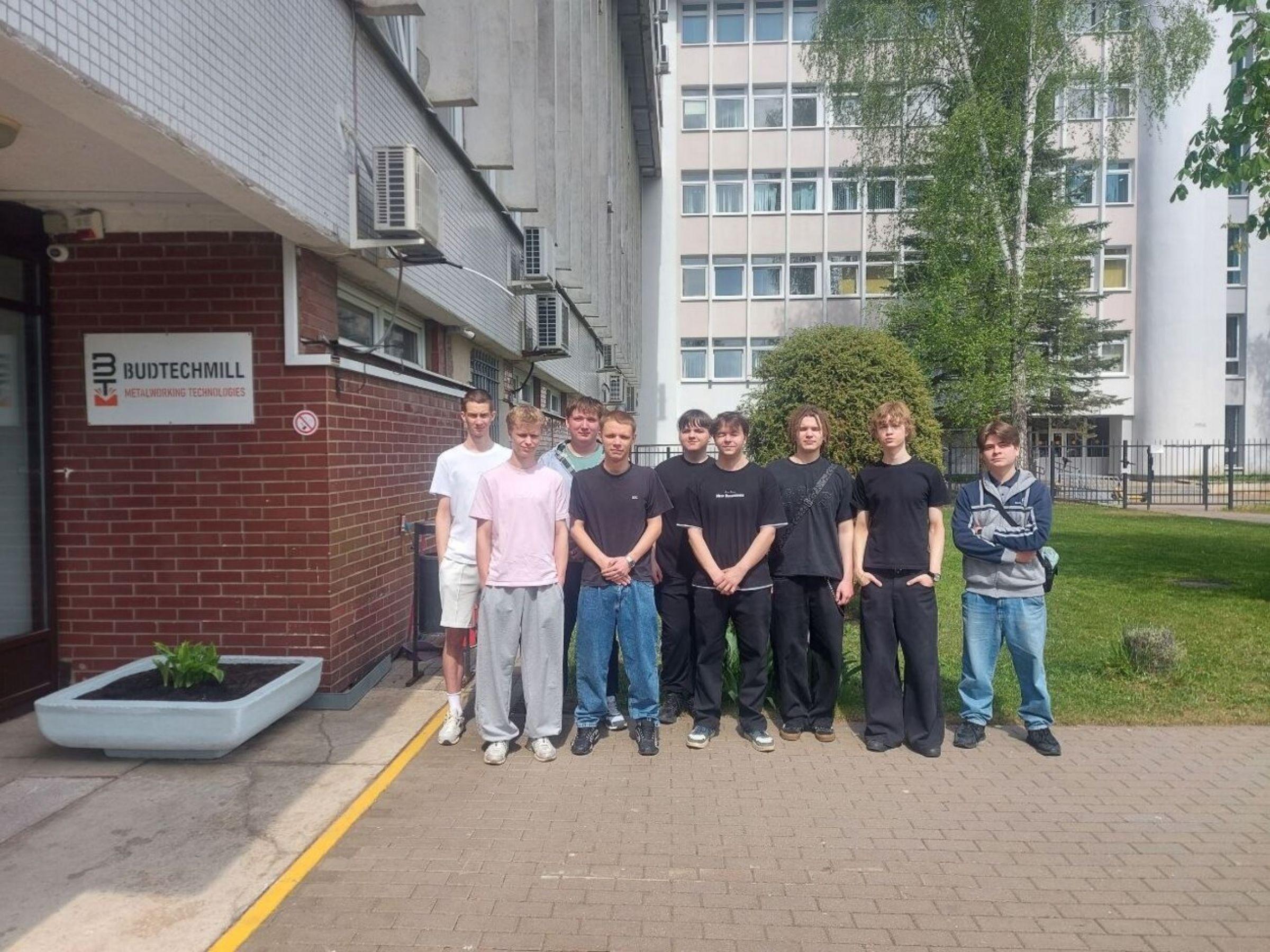
On May 5, 2026, as part of the practice-oriented training program for specialists, Veronika Danilovich, an assistant professor in the Technological Equipment Department of the Mechanical Engineering Faculty of the Belarusian National Technical University, organized a field trip for students in group 10305224. The location was the manufacturing facility of ZAO BudTekhMil, where the future mechanical engineers were able to visualize the actual technological processes they will be monitoring and improving in their professional careers.
Pavel Veremey, a specialist at the facility, led the students on a tour, demonstrating in detail the entire process chain, from the receipt of raw materials to the production of finished products with protective coatings.
The first stage of the tour was an introduction to rolled products. Pavel demonstrated the types of blanks used at the facility: profiles of various cross-sections, pipes, sheet metal, and other standard components. The future specialists were able to not only view the warehouse inventory but also hear a brief description of each type of rolled metal, its typical dimensions, and areas of application in mechanical engineering.
The tour then moved to the cutting section, where the students observed the metal cutting process firsthand. Of particular interest was the fact that the company uses four different cutting methods simultaneously, each with its own advantages depending on the thickness, shape, and required precision of the workpiece. These include plasma cutting, laser cutting, guillotine cutting (mechanical cutting), and band sawing. Pavel explained in detail the differences between these methods, their productivity, and the typical applications for which each is best suited.
After the cutting demonstration, the students were shown the next technological stage—assembling the cut parts into a finished structure. The future engineers saw subassemblies, methods for securing elements, and geometric control at intermediate stages. However, the processing of parts does not end there: mechanical machining is used to improve the quality and precision of finished products. The tour continued in the metal-cutting machine shop, where the students were able to familiarize themselves with the impressive equipment. Pavel demonstrated the operation of vertical and horizontal milling centers, various types of lathes, as well as jig boring and radial boring machines. In addition, the students were shown other types of equipment used at the plant to achieve high-precision manufacturing.
The final stage of the tour focused on finishing and protecting finished products. The students visited a special chamber where shot blasting of workpieces is performed. This process removes scale, contaminants, and microscopic irregularities from the surface, preparing the metal for coating. Pavel then demonstrated how parts are coated with anti-corrosion compounds—paints, including polymer paints—that provide long-term corrosion protection and impart the necessary performance properties to the products.
A tour of BudTekhMil JSC allowed students from group 10305224 to see the connection between the theoretical subjects studied in the Technological Equipment Department and real-world production challenges. The future engineers were able to ask questions, learn about process modes, and gain insight into modern work organization at a mechanical engineering plant. Such field trips play an important role in training qualified personnel, as they enable students to acquire professional competencies not in an abstract form, but through concrete examples of existing production.