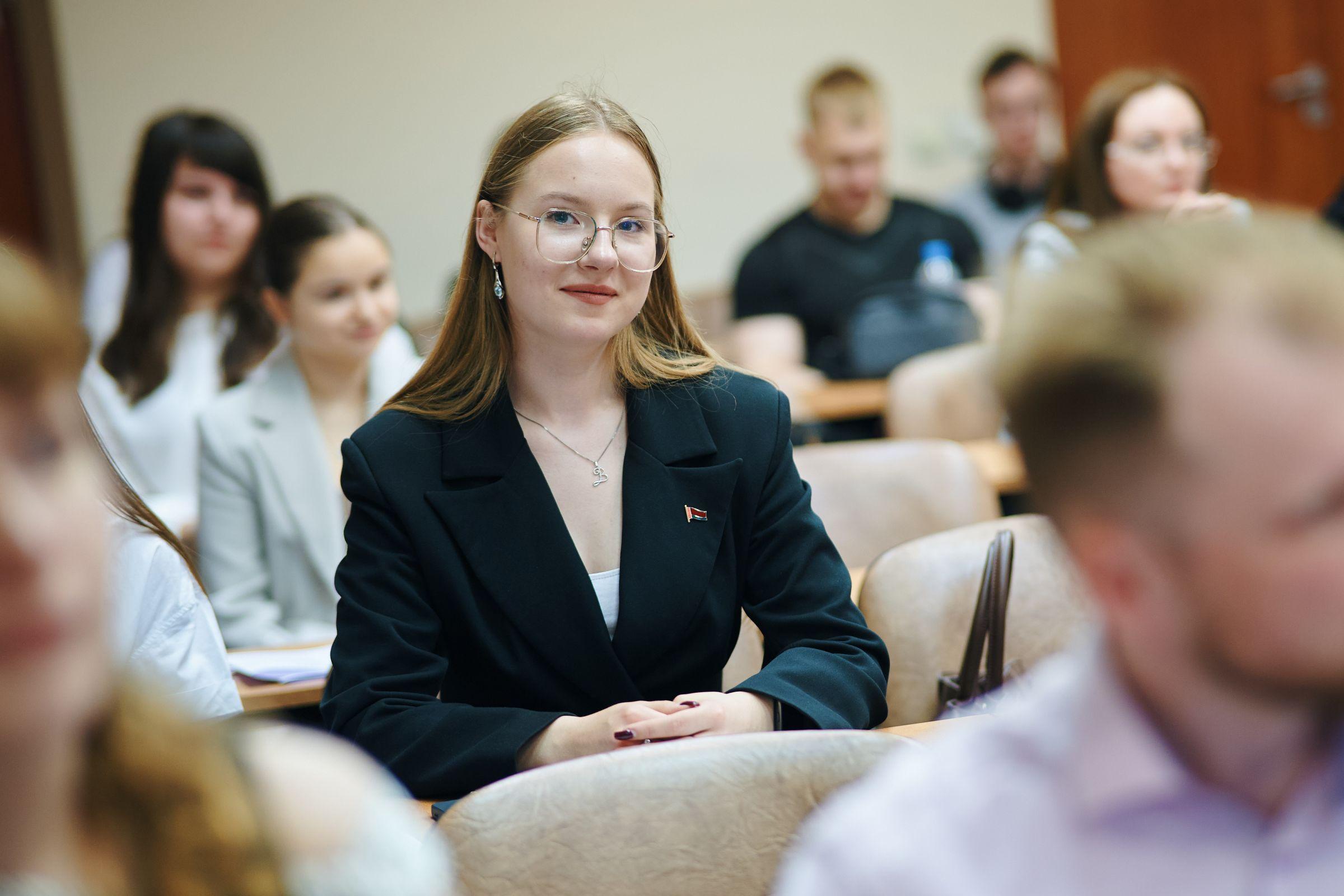
Today, on May 5, the IX Republican Youth Scientific and practical conference "i-Customs.by", which brought together young researchers in the field of customs and digital economy. The organizer was the Faculty of Management Technologies and Humanitarization, and the participants were students and undergraduates of BNTU, Euphrosyne Polotskaya Polotsk State University, Yanka Kupala Grodno State University and Belarusian State University.
The students' reports were evaluated by a competent jury. Its members included Yulia Mazanik, Dean of the Faculty of Information Technology and Robotics, Anastasia Zhevlakova, Deputy Dean for Ideological and Educational Work at FTUG, Olga Veremeychik, Head of the Department of Foreign Languages, and Artyom Golodok, Chief Inspector of the Digitalization Department of Customs Authorities at the Main Information Technology Department of the State Customs Committee., Anna Podrebinkina, Senior Inspector of the Department of Customs Operations and Control at the Minsk National Airport Customs post, Minsk Regional Customs, and Ekaterina Germanovich, Chief Inspector of the Department of Customs Value and Customs Clearance at the Minsk Regional Customs.
The conference program covered a wide range of topics, from applied digital solutions to historical and legal aspects. The participants discussed the institutional and technological innovations of the customs system as a vector of development for Belarus, as well as the role of the Chinese language in shaping the professional competence of Belarusian customs officers.
The comparative analysis of tax benefits in Belarus and Russia and the introduction of digital cargo tracking to ensure economic security aroused great interest among those present. Separately, the speakers touched upon the topic of "customs – business" partnership mechanisms, a prospective analysis of uniforms of customs officials from the late 18th century and regulation of the intellectual property market in the EAEU.
Among the technical innovations presented were the prospects of computer vision in customs, the use of online simulators in English language teaching, and the introduction of a cloud service for digital archiving of cultural heritage sites within the framework of Belarusian-Chinese cooperation.
The participants also discussed modern customs control technologies, national security issues in the context of digitalization and socio-cultural threats, the digital transformation of international trade and the evolution of customs instruments in the era of globalization.
Following the results of the conference, a solemn awarding ceremony was held for the participants whose research turned out to be the best. So, the prizes were distributed as follows:
Congratulations to the winners, and we wish all participants continued success in their scientific and professional activities!
