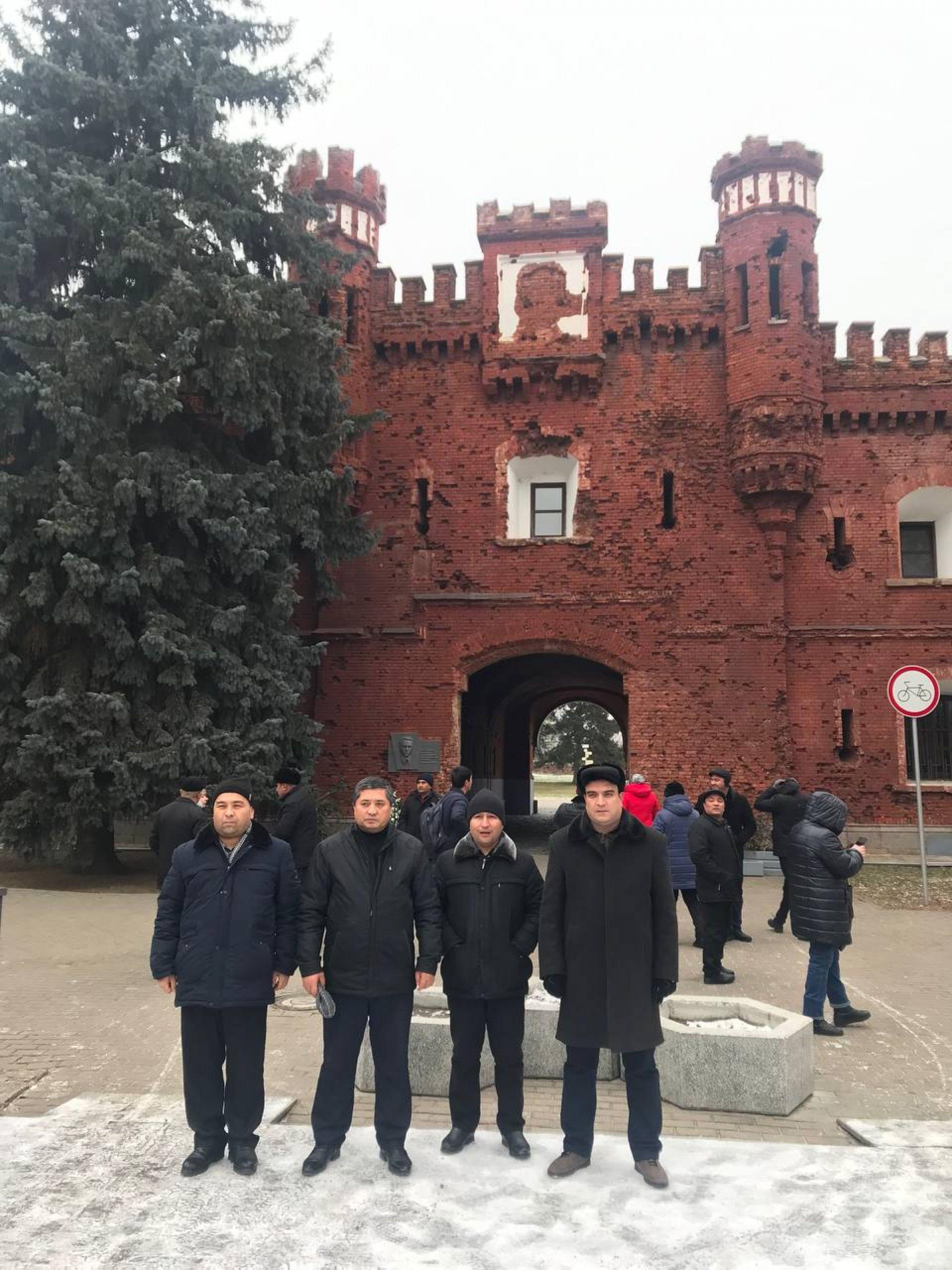
December 23, 2021 a delegation of Namangan Engineering and Construction Institute visited Brest.
The program included a visit to the Memorial Complex "Brest Fortress-Hero" and a sightseeing tour of the city of Brest.
The "Brest Fortress-Hero" memorial is one of the largest monuments of courage and bravery of the Soviet people who defended their freedom during the Great Patriotic War. The world-famous memorial has become a symbol of the unwavering steadfastness of the Soviet people during World War II.
In 1971, the memorial was created, which includes several locations commemorating the heroes:
- The central monument "Courage," a 33.5-meter-high sculpture depicting individual episodes of the fortress defense, as well as the silhouette of a warrior;
- In front of the obelisk "Bayonet" in three rows are tombstones of the heroes buried here (only 216 names are known);
- the sculpture "Thirst" symbolizes the courage of the defenders, who held the defense without food and drink until the last moment (a soldier is depicted drawing water from the river with a helmet);
- Ceremonial Square and the Eternal Flame;
Also, the delegation visited the Museum of Defense of the Brest Fortress, where you can see photos, things, historical documents and collections of documentaries.
Brest Fortress is deservedly considered the most frequently visited architectural, historical and military monument in Belarus.
Uzbek colleagues also visited: the pedestrian street of Brest, which stretches for almost two kilometers from Ordzhonikidze street to the Mukhavets embankment. It used to be called Millionnaya Street, Policeway, Jerzy Dombrowski Street, and even Generalstrasse, but since 1944 and until now it has been Sovetskaya Street.
It is a pretty street with partly historic buildings - there are still residential houses from 1915. The most interesting objects are St. Nicholas Brethren Church, Grinberg Pharmacy of 1925, the former Alexeevskaya Gymnasium of 1903, and now the Pushkin State University of Brest. The cinema "Belarus" is built on the remains of a synagogue from 1862.
Here the delegation also saw sculptural compositions "Old Town", "Bat", a huge monument to the Millennium of Brest. By the way, for the 1000th anniversary of Brest, which happened in 2019, there were dancing fountains on Sovetskaya. But the main feature of the street are the lanterns. Every evening they are manually lit by a lanternman dressed in a uniform of Peter the Great times. The spectacle gathered a crowd of spectators. The alley of forged lanterns, where you can count nearly four dozen unusual metal art objects, was also memorable. The alley of lanterns appeared on the eve of the 1000th anniversary of Brest in 2013. Local companies, organizations and individuals sponsored the forged lanterns, showing wonders of imagination and ingenuity. Some of them put their wrought iron logo directly on the lantern, while others were more creative and disguised their involvement in the creation of the art object. There are lanterns with abstract themes - for example, the Little Prince and the Rose. And then there's the fireman, the merchant, the blacksmith, the shoe shiner.
A separate category is the lanterns, embodying the characters or plots of Nikolai Gogol's works. For example, the lantern "The Nose", Devil from "Evenings on a Farm near Dikanka" or an episode from "Viy". It's worth taking a walk here after dark: when the lanterns are lit, Gogol Street takes on a truly mystical appearance.
No less fun was the road to Brest. The guide told interesting stories, listened to songs, told poems in Uzbek and Russian, and made stops to take pictures in the magical snowy forest.
