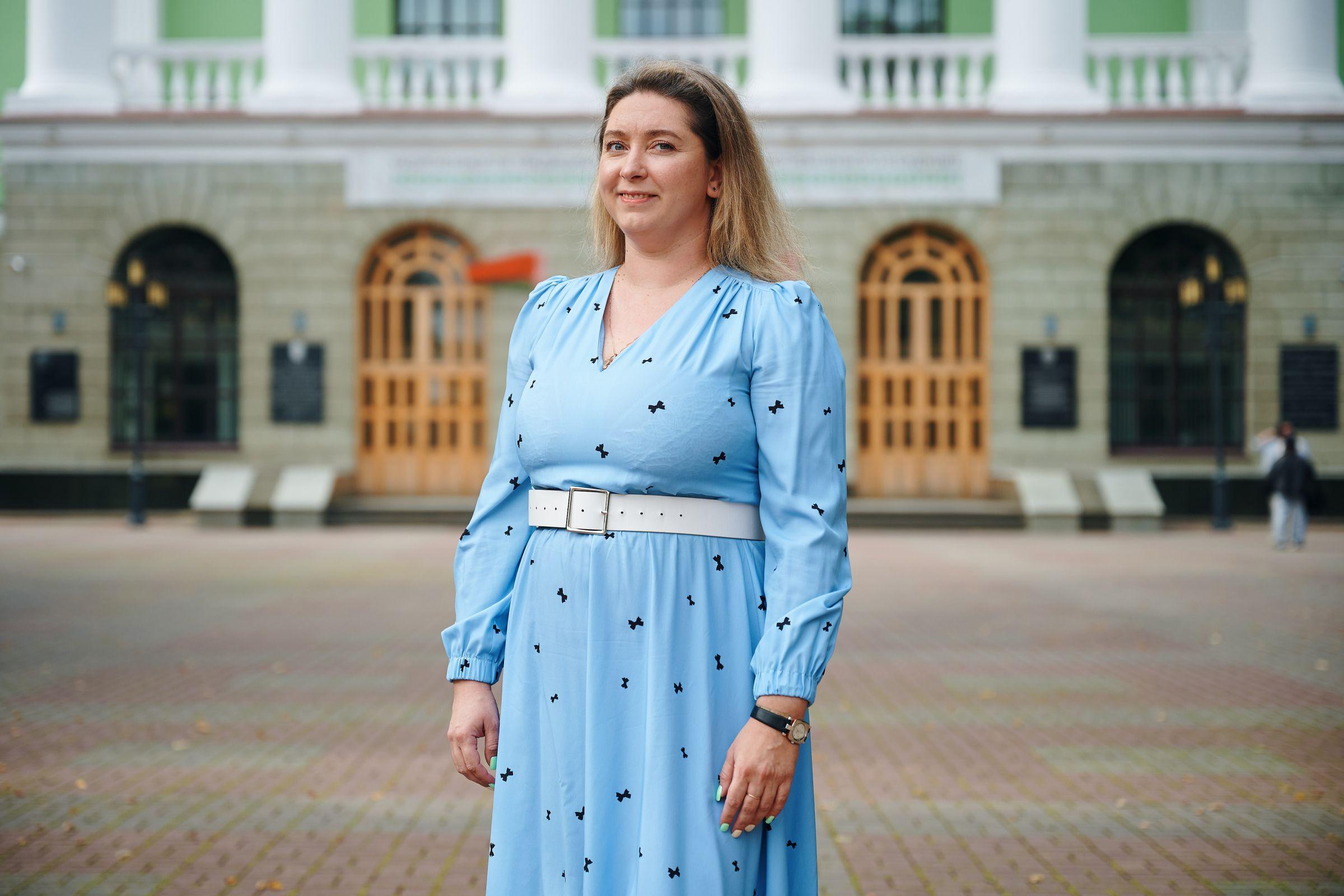
Engineering, nanotechnology, and instrument‑making are often stereotypically considered to be exclusively male fields. However, modern reality proves the opposite: it is precisely women’s attentiveness, interdisciplinary thinking, and the ability to see non‑obvious connections that drive modern science forward. One such example is the story of Karina Lyutsko, a senior lecturer at the Department of Micro‑ and Nanotechnology at the Instrument Engineering Faculty.
Karina Lyutsko’s school years were a time of self‑discovery. Unlike many future engineers, the girl was not a “purely technical” person. She equally enjoyed physics and chemistry, as well as literature and history.
– I wasn’t a “pure” techie or a humanities person — I’ve always been drawn to the opportunity to think, analyze, and look for connections. Chemistry and biology fascinated me with their logic, while literature and history offered the chance to reflect on people and events. Art is a special love of mine, and I owe that to the art school. And another constant love is books. I read a lot back then, and I still do: every day I make time for a paper book. For me, it’s a little tradition that I never break.
After graduating from school, Karina Sergeevna studied at the Belarusian State Pedagogical University. After receiving her diploma from BSPU, the girl joined BNTU and started working at the Department of Micro‑ and Nanotechnology at the Instrument‑Making Faculty. At her new workplace, she quickly realized that in order to teach at a serious engineering level, she needed to improve her knowledge in technical disciplines.
– I didn’t just want to retell textbooks — I wanted to understand the processes from the inside. That’s when I decided to apply to the master’s program at BNTU.” It was important for me to immerse myself in the engineering environment, master the fundamental basics, and learn to see technologies not from the outside, but from the inside. Thus, my pedagogical education was complemented by technical education, and this became the starting point for my professional growth.
– What ultimately played a decisive role in choosing a technical profile?
– My school years were filled with various hobbies. The art school and decorative and applied arts taught me to see form and detail, which still helps me visualize complex things. Sports were also an important part of my life: gymnastics, swimming, and I even made it onto the university team. I also always loved writing essays and poems. Today, when I work on scientific publications, I feel that it’s all the same skill: the ability to work with words, structure, and meaning. Creativity stays with me; it’s just the form that changes. All of this shaped my understanding that pedagogy is not just about imparting knowledge, but about a creative process. In it, it’s important to engage, ignite, and find the right key to each person. And technical education became for me a way to delve deeper into the profession, to add engineering strength to creative pedagogy.
In Karina Sergeevna’s family, she is not the only engineer: her father and brother are engineers, and her brother studied at the instrument engineering faculty of the Belarusian National Technical University.
– This created a certain background — I always knew that the technical field was not something distant and incomprehensible. But the decisive role in my professional path was undoubtedly played by Yuri Pleskachevsky, a corresponding member of the National Academy of Sciences of Belarus. It was he who recognized my potential when I started working at the department, became my academic supervisor during my master’s studies, and recommended that I apply for a PhD program. He showed me that my knowledge is not a weakness, but a foundation for micro‑ and nanotechnologies. The most important thing he taught me is not to be afraid to take unconventional paths. He always gave me the freedom to explore, try, and make mistakes — and at the same time, he was there, guiding and supporting me, and he continues to do so. It was he who recognized my potential when I started working at the department, became my academic supervisor during my master’s studies, and recommended that I apply for a PhD program. Today, my academic supervisor in the PhD program is Sergey Chizhik, the head of the Department of Micro‑ and Nanotechnology — and that’s also a great stroke of luck. He helps me move forward, systematize my research, and see its practical applications. I really appreciate his support and approach to work. Two such mentors are probably a gift from fate.
As Karina Lyutsko said, the field of micro- and nanotechnology caught her interest due to its interdisciplinary nature. She saw that it was a junction of chemistry, biology, physics, and engineering.
– My area of scientific interest is chemical sensors and bioengineering. For example, I worked on the topic of membrane biosensors – devices that can “sense” biological processes at the level of cell membranes. For me, this was a way not to move away from biology and chemistry, but to find a new “engineering body” for them.
– Did you ever have any doubts before enrolling in the master’s program at BNTU that the technical field is “not a woman’s job”?
– When I was doing science, I didn’t think about “masculine” or “feminine” at all. There are many girls in biology and chemistry, but only a few know how to translate that knowledge into the language of engineering. I decided that I would be that very “translator” between the world of living things and the world of silicon. Stereotypes are shattered by concrete results. When I participate in conferences or represent BNTU, no one looks at my gender – they look at my knowledge. And when it comes to accuracy and attention to detail, these are qualities that are unrivaled in our field, regardless of gender.
Karina Sergeevna also said that she is inspired in her work by specific people.
– At our department and university, we have female teachers and colleagues who combine science, teaching, and family life – and they do it with such dignity and passion that it’s impossible not to be impressed. They show by example that there is a place for women in the technical field and that doing science is natural, interesting, and not at all scary. And for me, this is the most convincing inspiration – when you see living examples right before your eyes.
– What do you love about your work, despite all its complexity and high level of responsibility?
– For the opportunity to be at the forefront of science. We are creating something that will work for people. Besides, I enjoy working with students. As I say, “Students are our future.” It’s nice to see our students among the participants in competitions and projects, to rejoice in their successes, and to learn from them. And, of course, for the opportunities for professional growth — forums, conferences, and the exchange of experience with colleagues.
Karina Sergeevna believes that what female students need is not so much a special approach as support at the outset. Girls often doubt themselves more than boys, even if they know the material just as well.
– It’s important for them to hear: “You can do it, you’ll succeed.” I’ve been through this myself and I know what it’s like to be a girl in a technical environment. That’s why I try to be an example for my students that it’s normal, interesting, and not at all scary. I tell them: your neatness, attention to detail, and ability to see processes from the inside are not a disadvantage, but an advantage. And when they see that the teacher is a woman who is successfully engaged in science and teaching, their stereotypes break down on their own.
– What would you say to a schoolgirl who dreams of enrolling in a technical program at BNTU but is afraid of gender stereotypes?
– Forget about “girl” and “not a girl.” Ask yourself one question: “Am I really interested in how the world works at the micro- and nanolevel?” If the answer is yes, then go for it. Nanotechnology is about curiosity, research, and the opportunity to create something new. And stereotypes exist only in the minds of those who are far removed from this field. As soon as you find yourself in a laboratory or at a lecture, you’ll realize: what matters here is your intellect and interest, not your gender. So don’t be afraid — follow your curiosity.
We thank Karina Sergeevna for the interview and the clear example. It’s precisely such women who become real role models. Through their personal success, they prove that science knows no gender, and perseverance and talent will always find their way.
