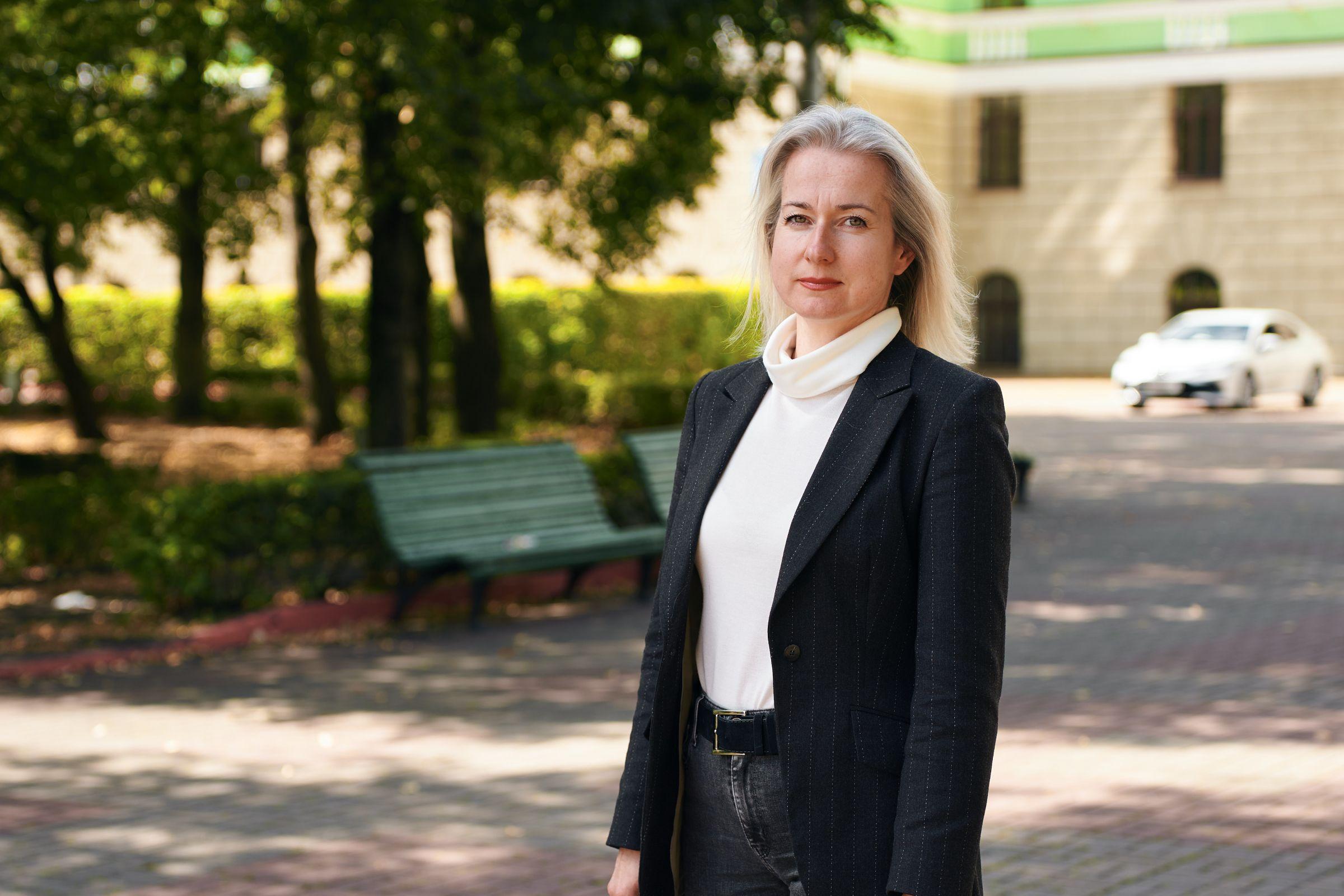
We're used to taking clean tap water for granted. However, the comfort of entire cities and the environmental safety of the country are the result of the enormous work of engineers. In the new issue of this column, we meet Valeria Gruzinova, head of the Water Supply and Sanitation Department at the Faculty of Power Engineering at the Belarusian National Technical University.
As Valeria Leonidovna admits, choosing her major wasn't the result of much deliberation – her mother advised her to apply. However, her family's intuition was right, and her decision turned out to be absolutely correct.
"I've never regretted my choice and I sincerely love my work, the university, and my major." In 2000, I graduated with a degree in water supply, sanitation, and water resource protection, then completed my master's degree at the Belarusian State University of Transport in Gomel, and later completed my postgraduate studies at BNTU. I rose through the ranks from assistant to associate professor in Gomel, and in 2018, I moved to Minsk, where I was offered a department head position, first at the BNTU branch "MIPK and PK," and then at the Faculty of Power Engineering.
Although Valeria Gruzinova has always worked in education, she has accumulated extensive practical experience:
"In addition to teaching, I constantly worked with companies, conducting research and development for them to improve on-site water treatment systems. Among my main clients were the locomotive and wagon depots of the Belarusian Railway, as well as major industrial giants such as SvetlogorskKhimvolokno OJSC and the Mozyr Oil Refinery." With this kind of experience, you approach students with more than just theory from textbooks; you can demonstrate how engineering structures work using real-world examples.
Research and practice have always gone hand in hand for the department head. While still a master's student, she received a grant to conduct her own research, and later participated in the development of landmark projects for the capital.
"Regarding large-scale projects, we developed water consumption and wastewater disposal standards for Belarusian Railways, including the new railway station building in Minsk. Generally speaking, a civil engineer specializing in water supply and wastewater disposal designs, builds, and maintains systems for collecting water from sources, treating it to the required quality, and transporting it to consumers. This also applies to wastewater disposal. The most important things in our profession are ensuring the quality of life, human health, and environmental protection, and the most interesting part is solving large-scale engineering problems and working with advanced technologies."
There's a common stereotype that engineering and construction are exclusively men's work, "in the field," which discourages many female applicants. However, the department head is confident that in today's industry, mindset and perseverance are paramount.
"Construction isn't limited to being a foreman on a construction site. Today, our graduates are actively pursuing design, and they have no equal. Flat drawings have been replaced by BIM technologies and 3D modeling. Women excel at these complex engineering programs because they are naturally more diligent and attentive to detail. Furthermore, there's a wealth of work available in chemical laboratories at water utilities or hygiene and epidemiology centers. Another popular field among women is working with regulatory documentation in natural resources and environmental protection committees. Therefore, there's no need to be afraid of engineering. The main thing is to recognize your inner needs. If you have a technical mindset and are interested in calculations and research, you'll definitely find a place in this profession.
Daily interaction with students is another important and inspiring part of a teacher's job. Comparing her university years with today's first-year students, Valeria Gruzinova notes that a completely different generation is entering the classroom today:
"The current generation is fundamentally new students, from their approaches to teaching to their thinking. But working with young people is always interesting. They energize me, push me toward fresh ideas, and help me implement them in research and studies. I always encourage them to think. Even if a student doesn't know the exact answer to a question, I always encourage them to think, build a logical chain of reasoning, and arrive at the correct answer independently. A teacher's job isn't to force students to memorize theory, but to teach them to think.
The position of department head requires a great deal of dedication. According to Valeria Leonidovna, the secret to successful leadership lies in not trying to artificially divide life into "before" and "after" the workday.
"Because I enjoy my work, I don't feel burdened by high responsibilities. For me, work is the main part of my life. I don't see a strict boundary: the workday is over, I close the office door, and forget about everything. My mind is constantly swirling with plans, projects, thoughts about who I need to meet with, and what management decisions I need to make. When work brings you joy, it will never be a burden. Incidentally, if it weren't for engineering, I probably would have chosen law. I've always been drawn to solving unconventional problems, where you need to find hidden arguments, develop ironclad logic, and help people."
Valeria Gruzinova advises those just beginning their careers in the technical field to make the most of their student years:
"This is the best time for internships, volunteering, and networking with professionals through internships, scientific conferences, and exchange programs. During their studies, students gain insight into their passions through internships at various facilities. Our main goal is to provide them with a variety of choices and rewarding employment opportunities. Speaking of qualities, perseverance, determination, and mental flexibility are key to success for any specialist. The key is to believe in yourself, quickly adapt to new technologies, and be able to bring complex projects to completion."
Looking at Valeria Gruzinova's example, you realize that there truly are no barriers in modern engineering. The most important assets always remain a sparkling eye, a willingness to think big, and a genuine love for a cause that makes the world a little better.
