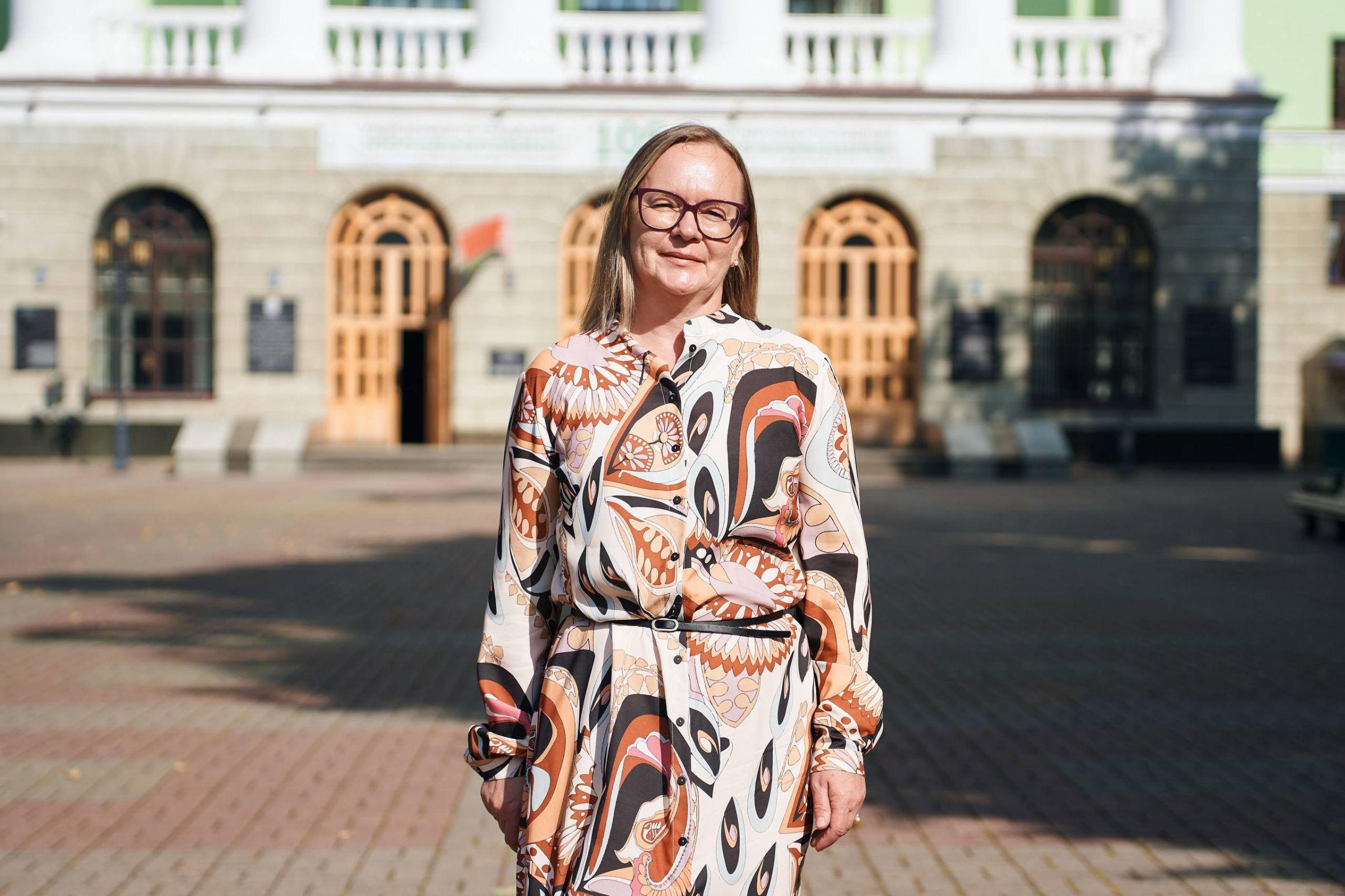
Very soon, on September 1, BNTU will traditionally open its doors to first‑year students, among whom there are many girls who have consciously chosen an engineering profession. To dispel the myths about the difficulty of studying and working at a technical university, we continue to tell the stories of girls who have devoted their lives to engineering and found their calling at a technical university. In this article, we talk about Alina Gerasimova, deputy dean of the Faculty of Energy, and associate professor at the Department of “Thermal Power Plants.” Her journey at BNTU began as a student at the Faculty of Mechanical Engineering, and today she is the one who trains engineers for the country.
– Until the 9th grade, I was a humanities student; I liked literature and languages, but then my school opened a physics and mathematics class, and I ended up in it. The math teacher was very strict, but he was passionate about his subject. I especially liked algebra. In general, studying in that class predetermined my admission to BNTU, the deputy dean shared.
Alongside the school curriculum, Alina Gerasimova studied art at art and music schools and also practiced track and field.
– I also loved sewing outfits for myself and my friends. I even thought I would apply to become a fashion designer. But studying in the physics and mathematics class helped me choose the Belarusian Polytechnic Institute (now BNTU).
Alina Gerasimova made the choice in favor of a technical university on her own, even though no one in her circle worked in the engineering field. After enrolling in the mechanical and technological faculty, the girl had no doubts about the correctness of her choice.
– Studying was interesting; we had an excellent teaching staff that knew how to engage and captivate students. I found studying engineering disciplines quite easy.
The deputy dean of the Faculty added that in the early years, engineering graphics and materials science were her favorites among the subjects. By the way, Alina Gerasimova now teaches subjects related to structural materials for thermal power plants and nuclear power plants.
– Did you do any practical training at enterprises? Did you encounter any difficulties there specifically as a girl?
– Yes, we always did practical training at enterprises; even after the first year, we did an internship at MAZ, in the small stamping workshop, at the workstations. We worked alongside the guys. It was physically demanding, but we learned how production works from the inside.
From 1996 to 2000, Alina Gerasimova worked as a software engineer at the Radiation Control and Monitoring Center, where she, among other things, dealt with issues related to monitoring the radiation background around nuclear power plants located in close proximity to Belarus.
– That’s when I became interested in energy, and especially in nuclear power plants. I enrolled in the full‑time postgraduate program at the Belarusian State Pedagogical Academy, and my candidate’s dissertation already included a section related to energy. After completing my postgraduate studies, I joined the Department of Thermal Power Plants; there was a vacancy for a lecturer in disciplines at the intersection of materials science and energy, and since 2004 I have been working at the Department of Thermal Power Plants. Initially, I worked as a senior lecturer, and from 2008 to the present, I have been an associate professor at the department.
In addition to teaching, Alina Gerasimova is also engaged in research in the field of monitoring and diagnosing the metal of equipment at thermal power plants and nuclear power plants.
– In 2014, I was offered the position of deputy dean of the Faculty of Energy, and to this day I combine my work in the dean’s office with my work as an associate professor at the Department of Thermal Power Engineering. I’ve always enjoyed learning, and this is precisely the place where it needs to be done constantly. I don’t like routine work; I’m interested in everything new, and working at a university allows me to keep developing.
As Alina Gerasimova noted, there are almost never any problems with female students at the Faculty of Energy.
– If girls do end up here, they mostly do so consciously, and in many subjects they even perform better than the guys. By the way, girls do a better job of being student leaders in study groups; they are more organized and disciplined.
– What would you say to a schoolgirl who wants to enroll in a technical program at BNTU but is afraid she will feel “out of her element”?
– Don’t be afraid of anything; if you’ve chosen a technical program, it means you have a talent. In many fields, there are far fewer women than men, but, as practice has shown, our women are more organized and systematic, which is very important in technical professions and allows them to achieve high career growth.
The example of Alina Gerasimova proves that it is not difficult to be a female scientist, even in a male‑dominated environment.
