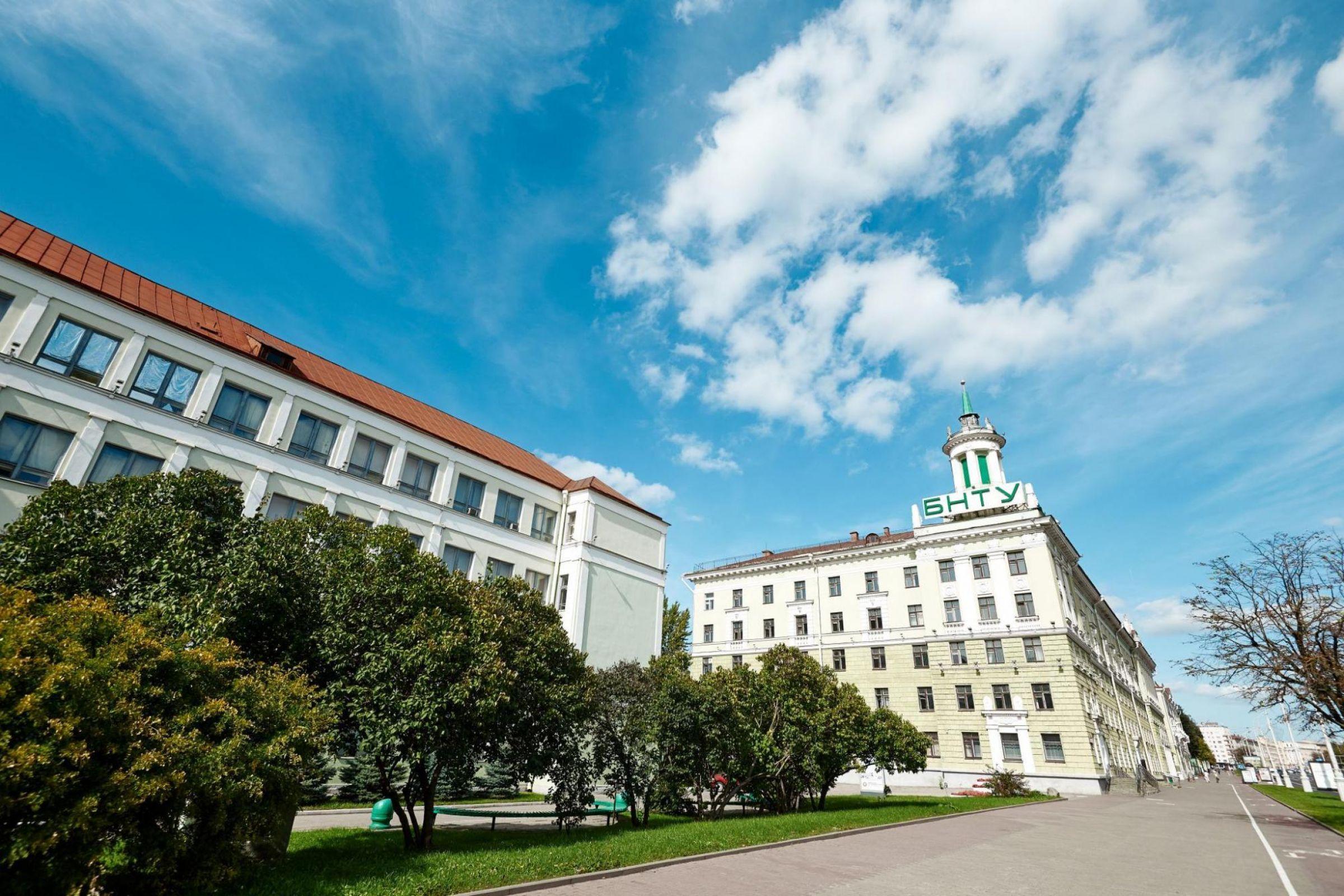
The Belarusian National Technical University is a real city within a city: everything has been thought out to make studying and student life as comfortable as possible. The university campus is designed so that the buildings, dormitories, sports complexes, and leisure facilities are within walking distance of each other. The compact location eliminates unnecessary trips around the city and helps freshmen quickly adapt to the new rhythm without being distracted by the long journey to the required classroom.
Study map
The student campus of BNTU is bounded by Independence Avenue, Yakub Kolas Street, Surganov Street. It is within this perimeter that the main academic life is in full swing.
Let’s start with the main building (No. 1), located at 65 Independence Avenue. This is the administrative heart of the university: it houses the rector’s office, the admissions office, the accounting department, the human resources department, and other units.
Behind the inner courtyard of the main building are buildings No. 2 and 3. Building No. 2 houses classrooms, computer labs, and laboratories for the departments of the Faculty of Energy. Building No. 3, in turn, belongs to the Institute of Integrated Forms of Education and Education Monitoring.
A little further along the avenue (Independence Avenue, 59) is Building No. 4. This is the domain of the military‑technical faculty, where future reserve officers and regular military engineers are trained. The students’ profile is serious: from the operation and repair of military equipment to the study of radio engineering systems and military electronics.
On the right side of the main building is Building No. 18: students from the Faculty of Marketing, Management, and Entrepreneurship hurry here for classes. This location should be noted immediately by every first‑year student, also because it is here that the university’s medical station operates, where they are always ready to provide first aid.A whole group of buildings is located on Yakuba Kolas Street, as well as on the adjacent Bogdan Khmelnytsky Street:
Building No. 6 (24, building 2, Ya. Kolasa St.) is the base of the Mechanical Engineering Faculty, featuring modern laboratories and the “Digital Mechanical Engineering” competence center.
Building No. 7 (24, Ya. Kolasa St.) houses the Mechanical and Technological Faculty, which trains engineers in the fields of metallurgy, automation, and modern additive technologies (3D printing).
Building No. 8 (Y. Kolasa St., 12) is the building for the automotive and tractor faculty, which is one of the oldest at the university.
Building No. 9 (Ya. Kolasa St., 14) is the place where students from two faculties study simultaneously: mining and engineering ecology, as well as management technologies and humanities.
Building No. 11a (B. Khmelnitsky St., 9) is assigned to the Faculty of Information Technologies and Robotics, which combines a classical engineering school with modern digital technologies.
Building No. 13 (Ya. Kolasa St., 22, building 3) is a true center of student activity. It is here that the primary trade union organization of BNTU students and the public organization “BRSM” with the rights of the BNTU Student Council operate.
Building No. 14 (Ya. Kolasa St., 22, building 2) – the building is allocated for the needs of the administrative and economic service, which ensures the uninterrupted operation of the entire campus.
Building No. 17 (Ya. Kolasa St., 22) – this is where future specialists in the field of precision mechanics, optics, and electronics from the instrument‑making faculty study.
Building No. 21 (Ya. Kolasa St., 16) – the newest academic building, opened this year. It has become a modern home for the energy faculty, featuring cutting‑edge laboratories and research centers.
The coworking space “KB‑16” at the Scientific Library of BNTU (Y. Kolas St., 16) deserves special attention. It is a modern space with a capacity of up to 150 people, where you can work in silence, gather as a team to work on a project, or hold an event — the rooms are equipped with a projector, a screen, and a flipchart, and BNTU students can book them free of charge. The workstations are equipped with power outlets and Wi‑Fi, and there are computers with access to electronic databases. Here, you can also take advantage of on‑site printing services – you can print, scan, or laminate documents right on the spot.
Inside the library itself, students will find spacious reading rooms with open access to a million‑strong collection of educational and scientific literature, spaces for individual work, and computer labs.
The sports infrastructure of the BNTU campus is part of the “Polytechnic” sports and recreation complex and includes two modern sports buildings. Thus, the first sports building is adjacent to the main building and is located next to the university stadium. The building itself has halls for basketball, volleyball, boxing, wrestling, aerobics, and a gym. The outdoor stadium is equipped with two artificial turf mini‑football fields, volleyball and basketball courts, and 400‑meter running tracks. This is where the annual solemn assembly for first‑year students, which marks the beginning of the new academic year, takes place.
The second sports complex is located in building No. 11b, 9 Bogdan Khmelnitsky Street. It houses a 50‑meter swimming pool with 10 lanes, two gyms, and halls for handball, mini‑football, aerobics, karate, table tennis, and dry swimming. The same building also houses a cycling base, a skiing base, a chess club, and an archery range, as well as the Departments of “Physical Education” and “Sports Engineering” of the Sports and Technical Faculty.
Outside the student campus, there are separate buildings that complement the educational space. Building No. 15 on Borisovsky Trakt is particularly noteworthy. This year, after the reconstruction is completed, it will once again open its doors to students and faculty from four faculties: architecture, construction, transport communications, and energy construction. Nearby, you will also find:
Building No. 16 (25, building 1, F. Skorina St.) is the academic building of the Faculty of Construction. It trains civil engineers, designers, and specialists in the production of building materials;
Building No. 20 (25, building 3, F. Skorina St.) is a joint building of the Faculty of Transport Communications and the Faculty of Engineering and Pedagogy.
Where students live
Most of the dormitories at BNTU are located a few minutes’ walk from the academic buildings. For those who live on the Borisov Highway, the journey won’t take long either: three metro stations to “Academy of Sciences” – and you’re there.
The university’s housing stock is organized on a faculty basis: each dormitory is assigned to specific faculties, so fellow students usually live nearby – which is convenient both for joint preparation for classes and simply for student life. In total, the university has three types of dormitories at its disposal:
corridor type – dormitories No. 3, 4, 5, 6, 7, 8, 11, 12, 14;
block type – dormitories No. 9, 13, 15, 16, 17;
apartment type – dormitories No. 18, 19.
A first‑year student may find it difficult to figure all this out. However, after just a couple of weeks, the campus becomes familiar and homey, which is what makes the student years at BNTU so memorable.
