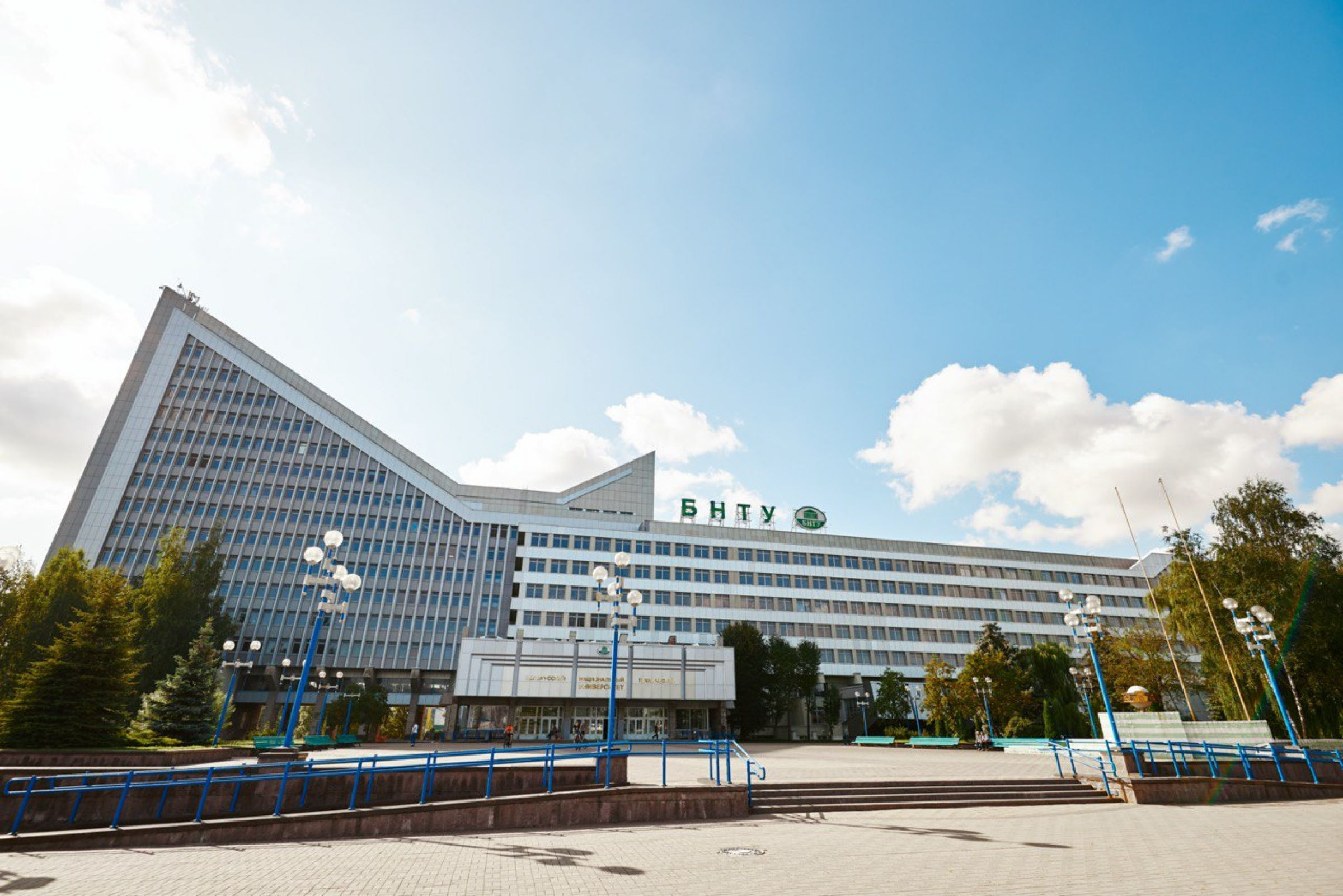
Anyone entering Minsk from the airport has surely noticed it: a monumental silhouette on the horizon, resembling either an ocean liner or an airplane about to take off. The legendary BNTU Building 15 is a place associated with special memories for thousands of engineers and architects. Now, after a lengthy renovation, the "boat" is returning. It's time to remember how it all began.
The Big Idea
The building's history began not with blueprints, but with an ambitious concept. In 1970, the question of constructing a new building arose: plans were underway to separate six construction-focused departments from the Polytechnic and create the Minsk Institute of Architecture and Civil Engineering (MASI) on their premises, designed to accommodate over 6,500 students. One of the main proponents of the idea was Vladimir Korol, People's Architect of the USSR, co-author of Victory Square and the Main Post Office, Chairman of the State Committee of the Council of Ministers of the Byelorussian SSR for Construction and Architecture, and Head of the Urban Planning Department. It was he who wanted to establish a distinctive identity for the construction professions and give them a worthy home.
The design was entrusted to Igor Esman and Viktor Anikin, architects from Minskproekt. Three other design institutes were also involved. Pyotr Masherov personally oversaw the initial phase of construction. However, after his death, attitudes toward the project changed, and the budget was cut. "You can't remove the floors, the foundation, and the columns. All that remains is the finishing," recalled Igor Esman. The planned student campus, complete with an athletics arena, swimming pool, and dormitories, never materialized on 96 hectares. Of the four planned buildings, only one was built. Nevertheless, in 1983, Building No. 15 officially opened and immediately became the district's dominant architectural feature.
Ship, Airplane, or Something More
What exactly the academic building represents is a question Minsk residents have been debating for forty years. Is it a jetliner, an airplane, or perhaps a ski jump? In an interview, Igor Esman set the record straight:
"Using standard industrial details to create a memorable image of the building—that was the goal the design team set for themselves when they began designing the Minsk Institute of Architecture and Civil Engineering."
The image emerged naturally—from reinforced concrete blocks, wide swaths of glazing, and a stepped silhouette. For the first time in Belarusian architecture, such an airy and seemingly fluid form emerged from simple structures." Interestingly, the original design called for the building to be twice as wide. Its location along the avenue—rather than perpendicular to it, as originally planned—was deliberate: it offers a breathtaking panorama for those entering the city.
Interesting facts and reasons for the renovation
The building and the Belarus department store were the first buildings in the republic to have escalators. Originally planned for 17 elevators, some were replaced with them. Igor Esman recalled this story with humor: the escalators were delivered from Leningrad, wrapped in thick white fabric:
"The next morning, these covers simply disappeared." In the early 1980s, white jeans were fashionable and considered a big shortage. Apparently, enterprising citizens stole this fabric for new clothes.
Furthermore, there were many stories about the escalators in the "korablik" (little ship). They said vibrations weren't taken into account during installation, and the building nearly split in half. They were also said to have emitted the sound of an approaching tank, so their use was quickly decommissioned. Although their lifespan was short, they remained forever etched in the memories of those who rode them.
In the main entrance hall, a mosaic panel by Belarusian muralist Ales Kvyatkovsky remains – one of the few decorations that survived budget cuts: the sculptural compositions on themes of architecture and construction, originally planned, never appeared.
The main complaint about the "boat" before its renovation was the microclimate. The classrooms in the eight-story block were swept by air from all sides and didn't connect with the ground. Student stories are filled with recollections of lectures in jackets and gloves. Legend has it that the ink in pens froze during class in the classrooms.
The Path to Renovation
The first renovations began in 2007, but without interrupting the educational process. By 2020, it became clear that the building needed a thorough modernization. Outdated wooden frames, inadequate ventilation and fire safety systems, and worn-out utility systems required a complete renovation rather than just spot repairs. That same year, the building was closed, and four faculties relocated to other buildings. The work continued for several years, but the finishing touches have finally been reached.
What's inside, what the renovated "boat" looks like after the renovation, what technologies are now supporting the educational process, and why this building will once again become one of BNTU's best buildings—we'll discuss in our next article.
