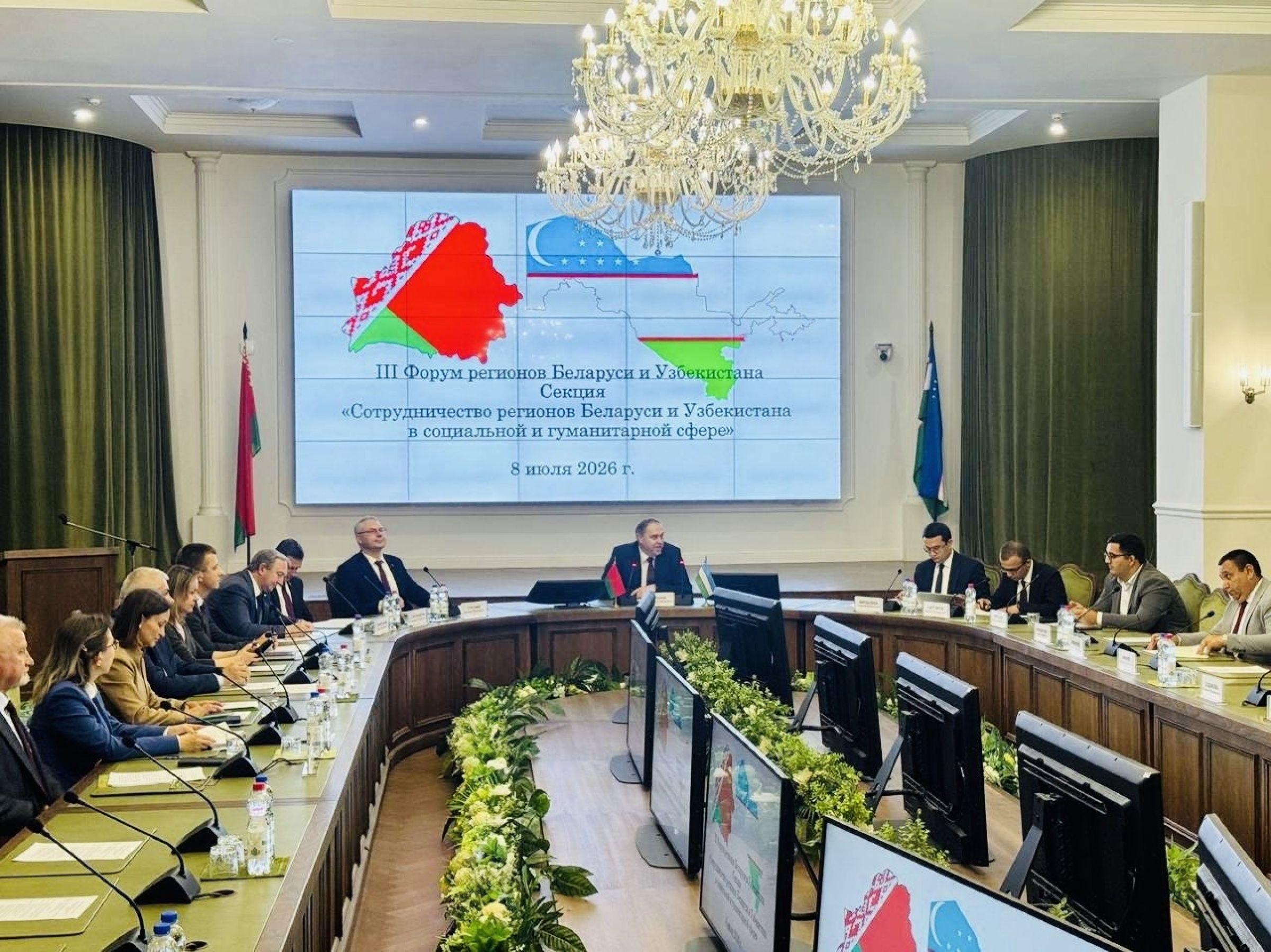
Yesterday, July 8, the National Academy of Sciences of Belarus opened a thematic section entitled "Cooperation in the Social and Humanitarian Spheres," held as part of the III Forum of Regions of Belarus and Uzbekistan. Participants in the discussion included representatives from academia, university research, healthcare, sports, and tourism, as well as government agencies from both countries.
Opening the section, Vladimir Karanik, Chairman of the Presidium of the National Academy of Sciences of Belarus, emphasized that the signed interdepartmental documents are a real tool for launching new breakthrough projects in pharmaceuticals, biotechnology, new materials, and green energy. He also emphasized the similarities in their approaches to organizing scientific work and expressed confidence that today's discussion will identify new growth areas.
The Belarusian National Technical University actively participated in the discussion. BNTU Rector Sergei Kharitonchik presented a comprehensive presentation on their long-standing partnership with their Uzbek colleagues.
Addressing the section participants, Sergey Vasilyevich noted that the slides presented were not simply devoted to statistics, but to the history of a deep and long-standing partnership, launched by the official visits of the Presidents of Belarus and Uzbekistan in 2018 and 2019. Over the past years, BNTU has systematically developed a strategy for interaction with Uzbek educational institutions, moving from initial bilateral agreements to the formation of a fully-fledged interstate system for training engineering personnel.
Today, this cooperation is truly strategic: while in 2018, BNTU had only two partner universities in Uzbekistan, today their number has reached 29. The partner network covers virtually all regions of Uzbekistan, from the western to the eastern regions, and a solid contractual framework comprises over 50 cooperation agreements.
The presentation paid special attention to the human resources aspect of the interaction. Sixteen leading universities in Uzbekistan—from the Islam Karimov Tashkent State Technical University to regional universities in Karshi, Namangan, Samarkand, Andijan, Urgench, Bukhara, Fergana, and Navoi—are successfully implementing 75 joint educational programs, combining the best practices of higher education in both countries.
The culmination of this cooperation was the establishment in 2019, by decision of the President of the Republic of Uzbekistan, of the Joint Belarusian-Uzbek Intersectoral Institute of Applied Technical Qualifications (SBUITIQ) in Tashkent. This unique project trains specialists in in-demand fields—from mechanical engineering, tractor manufacturing, and welding to computerized mechatronics, transport logistics, and biotechnical apparatus—directly according to Belarusian educational standards. The curriculum is structured according to a two-stage model: students complete their first years in Tashkent using integrated curricula, while their senior years and diploma defenses are held at the Belarusian National Technical University in Minsk.
Sanjar Mirzaliev, Executive Director of SBUMIPTK, also spoke about the joint training of engineering and technical personnel at SBUMIPTK, as well as the Institute's achievements and development paths.
According to the rector, youth diplomacy has become an equally important area of work. Sergey Kharitonchik noted that humanitarian and cultural exchange is not an addition to educational programs, but rather an organic continuation, forming a common value foundation for future specialists. BNTU and TSTU are successfully reviving the student brigade movement: Uzbek students worked on construction sites in Minsk, while BNTU student brigade members worked at the Pskem and Chatkal hydroelectric power plants in Uzbekistan. BNTU's summer and winter schools are actively operating, helping Uzbek applicants get to know the university well in advance and adapt to their future studies. They also offer reciprocal internship programs, allowing students from both countries to immerse themselves in the centuries-old culture and industrial potential of their neighboring countries.
Cultural initiatives play a key role in strengthening bilateral ties. In May and December 2022, Belarusian and Uzbek Cultural Centers were officially opened in Tashkent and Minsk, becoming key platforms for the exchange of experience, knowledge, and traditions. Since 2022, BNTU has hosted the annual "Navruz – Celebration of Friendship" festival, which has attracted over 4,500 participants over the past four years and allows students to immerse themselves in the rich traditions of the Uzbek people. Uzbek youth are also actively involved in historical and patriotic projects: BNTU students from Uzbekistan took part in the restoration of military burial site No. 4830 and the surrounding area in the village of Zagvazdino.
Summing up his speech, the BNTU rector emphasized that cooperation with Uzbekistan has long since gone beyond classic academic exchange and has evolved into a systemic project to provide human resources to key sectors of both countries' economies. Today, the priority is to ensure high-quality training at every stage – from undergraduate education to advanced training for practicing specialists. The potential accumulated over seven years and the high level of trust between partners allow us to confidently look to the future and reach qualitatively new horizons for cooperation.
