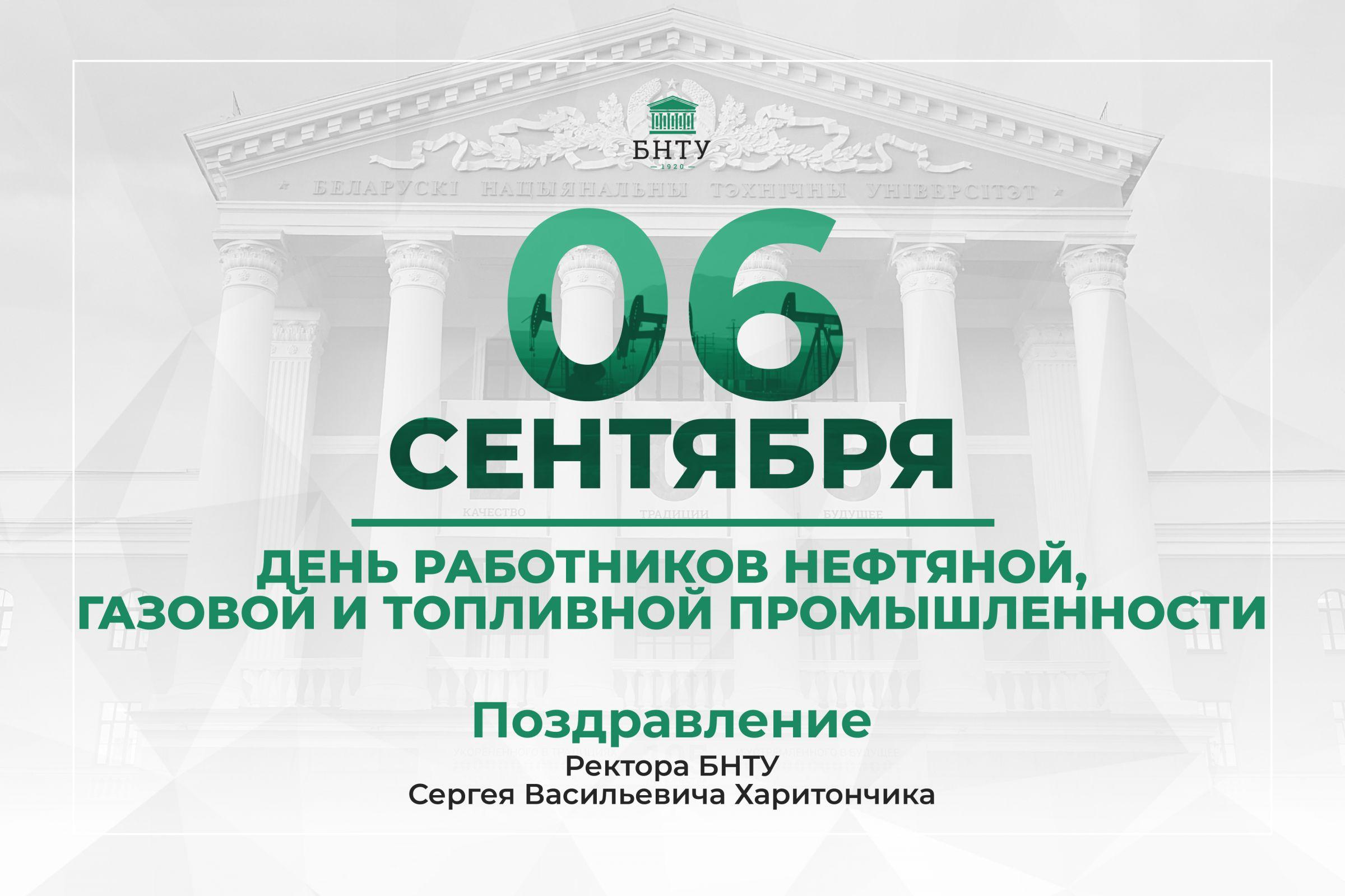
Every year on the first Sunday of September, Belarus celebrates Oil, Gas, and Fuel Industry Workers' Day. In 2026, this professional holiday will fall on September 6th. This is the day of those who create Belarus's energy stability and the familiar comfort we enjoy in every home. The holiday brings together a huge team of professionals: from geologists and drillers extracting resources to specialists who maintain kilometers of gas and heating networks around the clock.
"Dear colleagues, dear students, graduates, and partners! On behalf of the entire staff of the Belarusian National Technical University and on my own behalf, I sincerely congratulate you on Oil, Gas, and Fuel Industry Workers' Day!
This holiday has a special, deeply symbolic meaning for our university. The fuel and energy complex is the foundation of the stability of the Belarusian economy, its confident progress, and the comfort of millions of our citizens. Behind every technological process in this vast system are people—engineers, researchers, and experts in their fields. We are proud to acknowledge that a significant portion of the human resources potential of this powerful industry was formed at our university.
Today, BNTU serves as a reliable strategic partner for leading companies in the industry. Our graduates successfully design and build complex utility networks, modernize gas and heating mains, conduct precise mine surveying, and implement automated digital systems in production. Industry is rapidly changing, and we face the important task of training a new generation of specialists capable of working at the intersection of energy, ecology, and information technology.
It is for these purposes that we are continuously modernizing the university's facilities and equipment. At the start of the new academic year, the completely renovated BNTU Building 15 opened its doors, becoming a cutting-edge educational center for future engineers. The opening of the new academic and laboratory building for the Faculty of Energy – BNTU's 21st academic building, designed to accommodate over 800 students – was a crucial step forward. These modern educational facilities will take training to a new level and cultivate specialists ready to confidently strengthen our country's energy sovereignty.
I thank the faculty for their dedication to the engineering school and the high quality of their education. I wish the students to learn from the experience of their senior colleagues, set ambitious professional goals, and never stop developing.
I wish all workers in the oil, gas, and fuel industries new production achievements, trouble-free, and stable operations. May your energy never run dry, the most complex projects be easily implemented, and the warmth you give to people every day always return to your homes. Happy holidays!
Rector of BNTU
S. Kharitonchik"
History of the holiday and the peat heart of Belarus
All-Union Oil and Gas Industry Workers' Day received its official status during the era of large-scale development of the largest oil and gas fields in Western Siberia. In the 1960s, the work of geologists and drillers, working in the harsh conditions of the taiga and swamps, was considered a true heroic achievement. The initiators of establishing the holiday in January 1965 were Nikolai Baibakov, Chairman of the State Committee for the Oil Production Industry under the USSR State Planning Committee, and Yuri Ervie, Head of the Tyumen Main Production Geological Directorate.
The idea was immediately supported at the highest level, and on August 28, 1965, an official decree establishing the annual holiday was signed. The date of the celebration was set as the first Sunday in September, and it was first officially celebrated in 1966. The timing had both practical and symbolic significance: by the beginning of autumn, geologists had completed their arduous summer fieldwork, and the entire country was beginning active preparations for the autumn-winter heating season.
After gaining sovereignty, the Republic of Belarus made a crucial addition to the name, renaming it Oil, Gas, and Fuel Industry Workers' Day. This is not just a legal statement, but a tribute of deep respect to the peat industry, which literally raised the post-war republic from ruins and warmed it. Long before large-scale gasification, Belarusian peat provided over 70% of the country's energy balance.
For BNTU, this addition has a sacred meaning, as the history of training personnel in this field began at the university three decades before the official establishment of the holiday in the USSR. Back in 1934, the Department of Peat Fuel Production was opened at the Belarusian Polytechnic Institute. It was its students who developed this tradition.
They developed technologies for the mechanized extraction, drying, and briquetting of peat that were unique for their time. Thus, university research helped transform peat bogs into a strategic raw material resource. Today, as the industry is experiencing a "green" renaissance and Belarus occupies a global leadership position in peat briquette production, BNTU remains a key custodian of these traditions. The historical peat base has been transformed into a modern cluster where ecology, energy efficiency, and the processing of local fuels go hand in hand.
Professional customs and traditions of the industry
Working with complex equipment and the elements has shaped strong traditions in the industry, passed down from generation to generation. The oldest and most enduring ritual in the fields remains the "baptism of oil." A young specialist or trainee arriving at a drilling site for the first time is officially accepted into the profession through contact with fresh crude: a foreman smears freshly extracted oil on the newcomer's face, and only after this ritual is the individual considered a full member of the team.
Gas workers traditionally open their ceremonies with the lighting of a special bowl or miniature torch. This flame symbolizes the continuity of the gas transportation system, the uninterrupted supply of heat to homes, and the very life of the industry. Work in the fuel and energy sector requires tremendous dedication, so generational continuity is more developed here than anywhere else. One of the main traditions of the holiday is the celebration of labor dynasties – awarding awards to families where grandfather, father, and grandson all work at the same company and their combined work experience exceeds 100-150 years. For the industry, this serves as a key marker of reliability and stability.
The country's energy shield
BNTU's theory is always supported by real-world production, and its graduates are engineers who form the core of the three key sectors of the domestic fuel and energy complex. University specialists ensure the smooth operation and safety of the country's entire gas distribution and transportation system. The university's main industrial partners here are Gazprom Transgaz Belarus, the state-owned Beltopgaz State Production Association, and its leading utility company, MINGAZ. Engineers at these companies are responsible for ensuring the smooth delivery of natural gas to homes and production facilities.
In the oil industry, Polytechnic University students are involved at all stages: from exploration to raw material processing. The key production enterprise is the Republican Unitary Enterprise "PO Belorusneft," which drills and develops domestic wells. Further processing of this black gold and the production of high-quality fuel are ensured by the country's largest world-class oil refineries – Mozyr Oil Refinery and Naftan.
A unique sector of the Belarusian energy sector, where our country has traditionally held a leading position, is the peat fuel industry. BNTU graduates are in demand at numerous peat extraction and peat processing plants that are part of the Beltopgaz State Production Association, such as Ditva Peat Briquette Plant, Usyazh Peat Briquette Plant, and others. Here, engineers are engaged in the automation of production lines and the implementation of modern standards for the extraction of local fuels.
BNTU Engineering Cycle
Ensuring the country's technological sovereignty requires a comprehensive approach, and the university covers the entire life cycle of energy resources. The journey of any fuel begins with the earth, and this is where the Faculty of Mining and Environmental Engineering comes into play. Thus, future engineers studying "Mining Deposit Development. Underground Mining" ensure the safe and efficient extraction of minerals deep within the earth. Meanwhile, engineers studying "Mining Deposit Development. Open-Pit Mining" manage large-scale surface mining processes, including operations in peat fields.
Graduates of the "Machinery and Equipment for Mining Industries. Mining Electromechanics" program are responsible for the smooth operation of heavy equipment at peat processing plants, while experts in the "Engineering Ecology. Environmental Audit and Environmental Quality Assurance" program strictly monitor the proper reclamation of land and the preservation of nature after resource extraction.
Once the raw material is extracted, it requires a reliable transport artery. This strategic task is addressed by graduates of the Faculty of Power Engineering. The stable operation of the gas industry is unthinkable without specialists in the "Engineering Networks, Building and Structure Equipment, Heat and Gas Supply, Ventilation, and Air Protection" program. Engineers in this field design, build, and operate complex urban gas distribution networks on a daily basis, ensuring the safe delivery of natural gas to industrial giants and residential areas across the country.
The final stage of taming the elements occurs at the Faculty of Power Engineering, where extracted resources are converted into real megawatts. Engineers majoring in "Thermal Power Engineering and Thermal Engineering. Thermal Power Plants" manage giant combined-cycle plants and turbines at combined heat and power plants, while specialists in the "Thermal Power Engineering and Thermal Engineering. Industrial Thermal Power Engineering" program install energy-efficient systems in industrial facilities. Graduates of the "Heat Power Engineering and Thermal Engineering. Automation and Control of Heat Power Processes" program are taking on the digitalization of the entire process, setting up smart automation for energy flow control.
The fuel and energy complex is the living, fervent heart of our country, and BNTU engineers are the very impetus that keeps it beating smoothly and confidently. Happy holiday, dear oil, gas, and energy workers! May every workday run smoothly and safely, and may comfort, prosperity, and light always await you at home.
