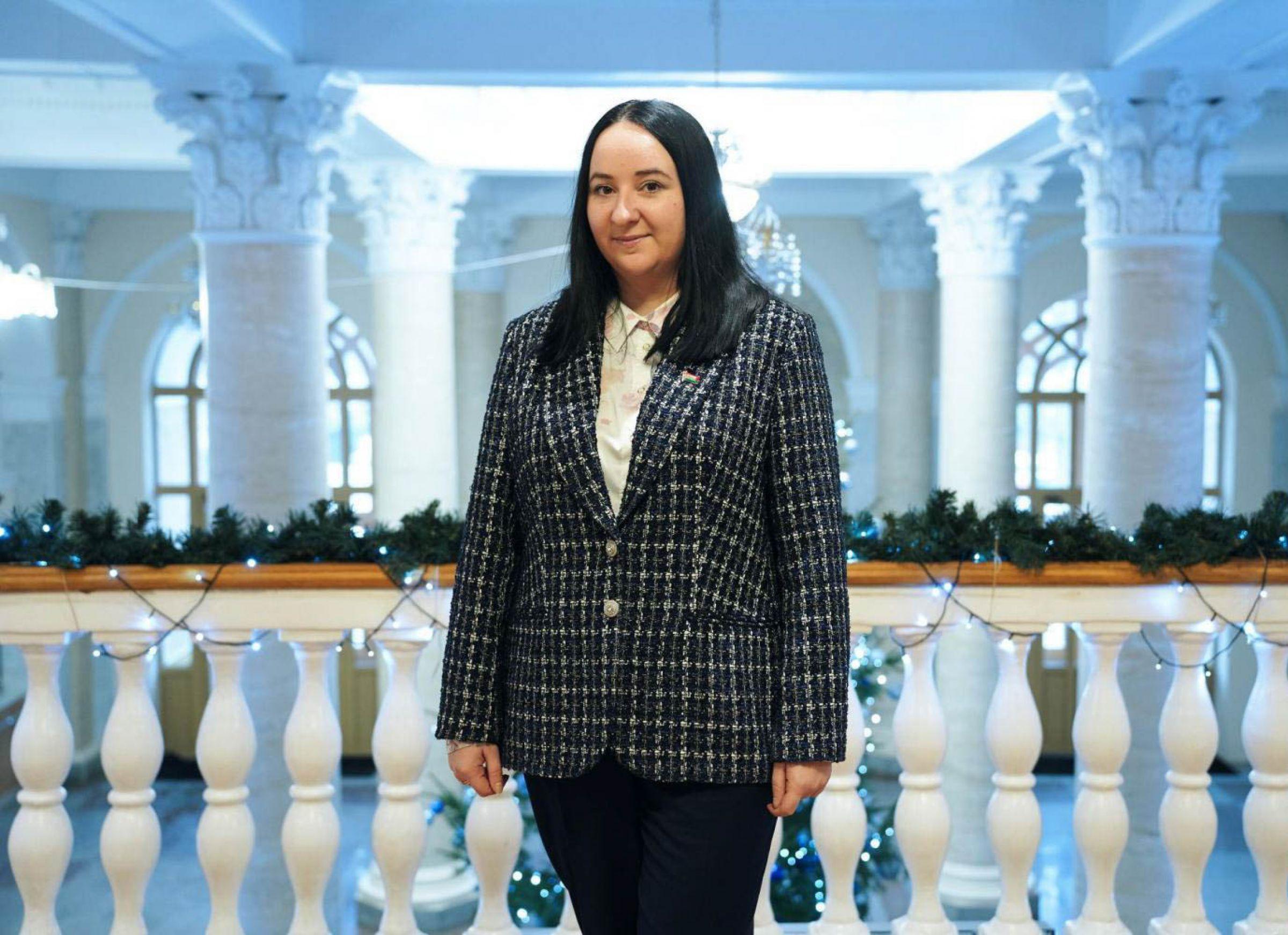
“Technical science is not about boring formulas, but about living creativity, where there is a place for beauty and discoveries.” This is how Ekaterina Korsak, Chairman of the Council of Young Scientists of the BNTU, Senior Lecturer at the Department of Economics and Organization of Energy of the Faculty of Energy, describes her professional journey. For her, engineering is not just a job, but a family tradition and an opportunity to make a real contribution to the development of Belarusian energy every day.
Ekaterina Korsak's journey into the world of energy began long before she enrolled in university. Her family, particularly her grandmother, Valentina Chizh, a Candidate of Technical Sciences and Associate Professor at BNTU, played a significant role in her decision.
As a child, I often visited my grandmother at work. I remember the long corridors of the energy building and the classrooms where senior students were drawing on large sheets of paper. For me, it wasn't something foreign and incomprehensible, but almost a familiar world. I saw my grandmother passionately explaining complex processes to her students, and how she was passionate about her work. In the seventh grade, we prepared for a chemistry research competition together, growing crystals. It was truly captivating. It was then that I realized that science is a living art," shared Ekaterina Pavlovna.
At school, Ekaterina Korsak was a jack-of-all-trades, excelling in both the sciences and the humanities. However, her passion for logic and her interest in applied problems led her to the Faculty of Energy at BNTU. There, she gained a practical understanding of how complex systems work and how to improve their efficiency.
– What experiences helped you realize that you had chosen the right path?
– There were many moments of realization, but the most significant was when my first scientific papers began to receive recognition. I became a winner of the National Student Research Competition and was included in the President's Special Fund for Supporting Talented Youth. It was not just a pleasant experience, but a confirmation that my ideas and research were truly important and needed. When you see that your work is helping to solve real-world problems, you know that you are in the right place.
Despite their obvious achievements, women in the technical field sometimes face stereotypes. One of the most common is the belief that engineering is "not for women."
Many people still wonder when they see a young woman who is knowledgeable about energy, business economics, or nuclear power plant risk management. Sometimes you hear: "Oh, do you know anything about this?" – with such sincere surprise, as if I should be engaged in something more "feminine". But, fortunately, times are changing. When you prove your competence with deeds, not words, questions about who you are and what gender you are, no one asks. All stereotypes are shattered by reality.
According to Ekaterina Pavlovna, the fear of the stereotype "not a woman's business" prevents girls from entering science much more than the fear of complex formulas. Mathematics can be mastered, but the imposed belief that technology is a man's world can discourage the desire to try. At the same time, she is sure that women bring their own unique vision to engineering.
– We girls are often more attentive to details, we are able to build communication, find a common language with different people and think systematically. These qualities are very helpful in the work where it is necessary to coordinate the activities of young scientists and organize scientific events. But the main thing is the opportunity to be an example. When girls see that a woman can be a successful scientist and leader, they stop doubting themselves, said Ekaterina Korsak.
The difference between men and women in science, according to her, is not in their abilities, but in their work styles. Men are often more prone to taking risks and working on large-scale, ambitious projects, while women are more focused on careful detail-oriented work and systematic analysis. However, the best results are achieved when both approaches are combined.
Today, Ekaterina Pavlovna not only conducts her own research in the field of energy, but also actively contributes to the development of the university's scientific potential as the Chair of the Young Scientists Council at BNTU.
– I am inspired by my work in the council. We create conditions for talented young people to realize their potential: this includes the "Young Scientist School," support for postgraduate students, and the organization of conferences. It is invaluable to witness the growth of young individuals and the transformation of their ideas into tangible projects.
– Who among female scientists or engineers inspires you?
– First of all, my supervisor, the head of the Department
of Economics and Organization of Energy, Tatyana Mantserova. She showed me that a woman in science can be not only successful, but also truly passionate about her work, capable of igniting others. I am also inspired by many female scientists who work at BNTU and throughout Belarus - their example proves that there are no "male" and "female" professions, there are only those that you love and in which you feel comfortable.
The issue of career and personal life balance is always a pressing one for female scientists. There is a perception that science requires full dedication and leaves no room for family. However, Ekaterina Korsak believes that it is possible to find harmony.
– It is important to prioritize and plan your time effectively. We have a scientific family, and the support of our loved ones is invaluable. When you are understood and accepted for your passion for work, it provides immense strength. Science should not be an enemy of family; it can be a part of it.
– What would you say to a schoolgirl who is afraid to go into energy or science?
– Don’t be afraid! If you are interested, try it. Formulas and technical subjects are just tools, they can be learned. But interest and desire are what really matters. In Belarus, all conditions are created for the implementation of scientific aspirations of young people. And the main thing to remember: there are no “male” and “female” professions – there are professions that you choose with your heart. If you choose science or engineering, you won't be "different" - you'll be yourself. And that's the most important thing.
Ekaterina Korsak is a shining example of how family traditions, perseverance, and love for one's work can break stereotypes and pave the way for new generations of engineers. Her work proves that there are no gender boundaries in modern engineering and science - only professionalism, ideas, and a desire to make the world a better place.
