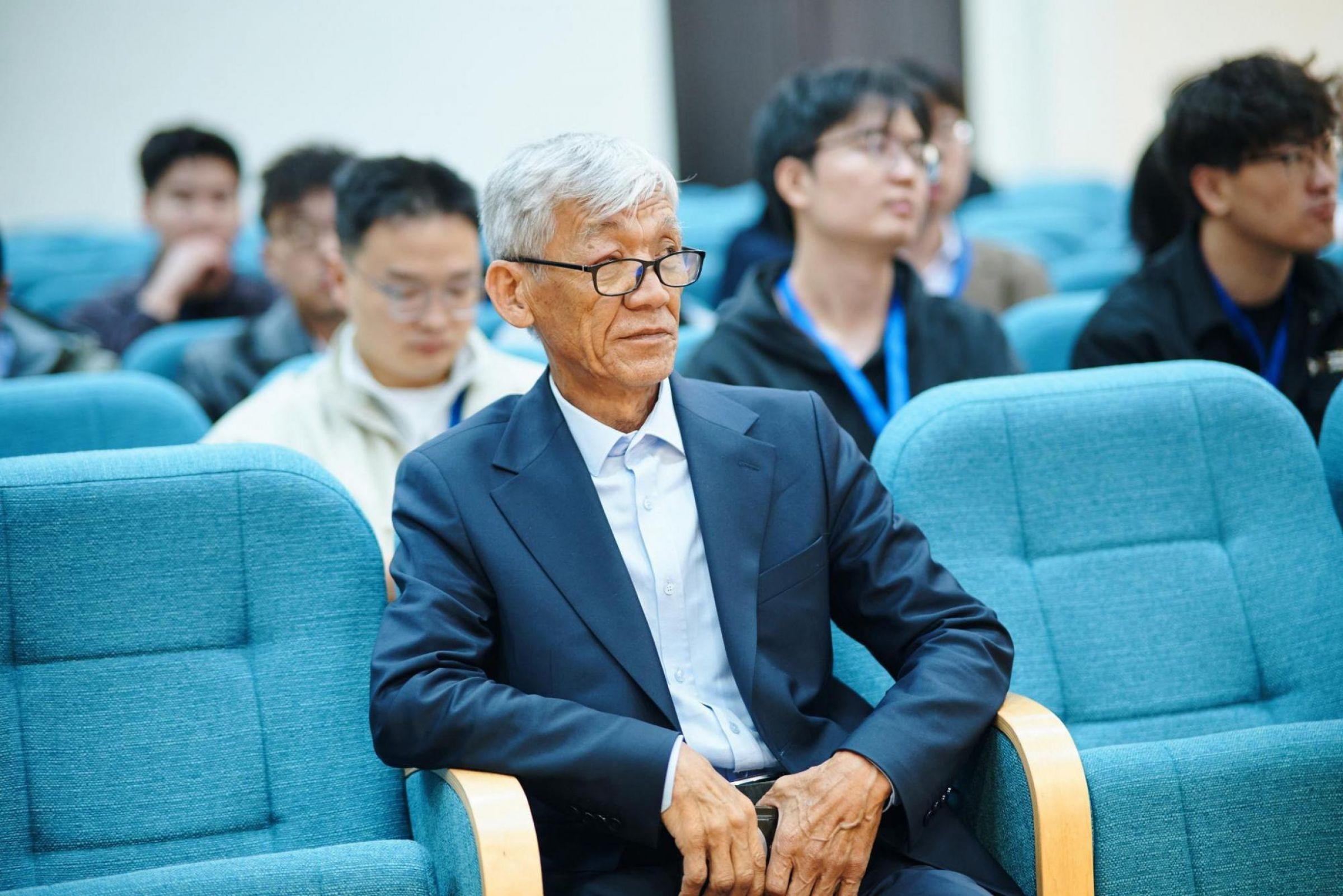
The Belarusian National Technical University unites generations and erases boundaries: its graduates can be found in various corners of the world, where they successfully manage enterprises, advance science, and head major educational centers. For our column, we spoke with Kalybek Dykanaliev, a graduate of the Faculty of Engineering and Pedagogics who currently holds the position of Vice-Rector for State Language and Digitalization at I. Razzakov Kyrgyz State Technical University.
Memories of student life are always a special chapter in life, full of bright moments, sincere friendships, and the unique atmosphere of Minsk.
What's the first thing that comes to mind when you recall your student years here?
Our student years were incredibly interesting; we had a very fun and friendly life. Besides studying, we always had many hobbies: we actively played football and played chess. We loved walking around the city: we often went to Chelyuskintsev Park and were regulars at Yakub Kolas Square, which was located right next to our dorm. Minsk has many beautiful, iconic places where we spent time with large groups and captured these moments in our memories.
Going from a recent student to one of the directors of Kyrgyzstan's leading technical university is a task that requires tremendous dedication. The vice-rector describes his professional journey and its main stages step by step:
"My path consisted of systematic and important stages: first, I worked as a teaching supervisor and engineer, then I began teaching. This was followed by graduate school and a successful dissertation defense. And then, as they say, it all started: senior lecturer, associate professor, department head, head of the academic department. And now I work as vice-rector for state language and digitalization at the I. Razzakov Kyrgyz State Technical University."
Among the dozens of disciplines at a technical university, there are always those that lay the foundation for professional thinking for the rest of one's life. For Kalybek Dykanaliev, graphics became such a fundamental subject:
"I still vividly remember the professor who taught us a course in descriptive geometry and engineering graphics. The course was incredibly interesting, and most importantly, it develops precise technical and spatial thinking." If you have a high level of descriptive geometry and engineering graphics, you'll be able to navigate spatially and professionally. This is a fundamental skill that will definitely stand you in good stead.
Now, looking back on his career, the vice-rector confidently notes how reliable, high-quality, and beneficial the educational foundation he received at BPI was for his career:
"At that time, our university was called the Belarusian Order of the Red Banner of Labor Polytechnic Institute. It was the Soviet era, and we received a deep, thorough education. After graduating, I was sent to a vocational school (they were called vocational schools back then), but I couldn't find housing there, so I started working as a training supervisor, and then as an engineer—and you know, it was very easy for me. I didn't experience any difficulties in production and didn't have to put in any superhuman effort simply because I had the powerful foundation of BPI behind me, where we were taught absolutely everything." Later, I was fortunate to become a teacher in the Engineering Graphics Department—incidentally, I always got a solid A in this subject. Since our department focused on engineering and pedagogy, our major in "Engineering and Pedagogical Activity: Mechanical Engineering" not only provided us with strong technical competencies but also provided us with a serious level of pedagogy and psychology. For example, our psychology course was taught by the great scientist Iosif Iosifovich Lobach. He was the chief scientific secretary of the educational and methodological commission for psychology throughout the USSR. The fact that such a specialist of national stature taught here clearly underscores the institute's exceptional quality.
Furthermore, looking back through the prism of many years of experience, I always want to provide the right guidance to those just beginning this long journey.
— What would you tell your student self if you met them today, and what advice would you give to today's first-year students?
"I would remind my younger self that the most important thing is to study hard, because if you realize that your chosen field and future profession are right for you, you'll definitely succeed. As for your first year, it's a crucial stage of adaptation and career guidance. It lays the foundation for all your subsequent successes in your senior years. So, don't miss out on opportunities and don't skip anything: lectures, practical classes, social or cultural events at the university. Be active from the very first day, because this is where your foundation for the future is being built.
Kalybek Dykanaliev's memoirs are proof that BNTU provides more than just an education, but a solid foundation that lasts a lifetime. Even decades later, graduates return to their hometown with warmth and gratitude. Their experience is a bridge between generations, a reminder: everything begins with the first year, the first blueprints, and the belief that you're on the right path.
