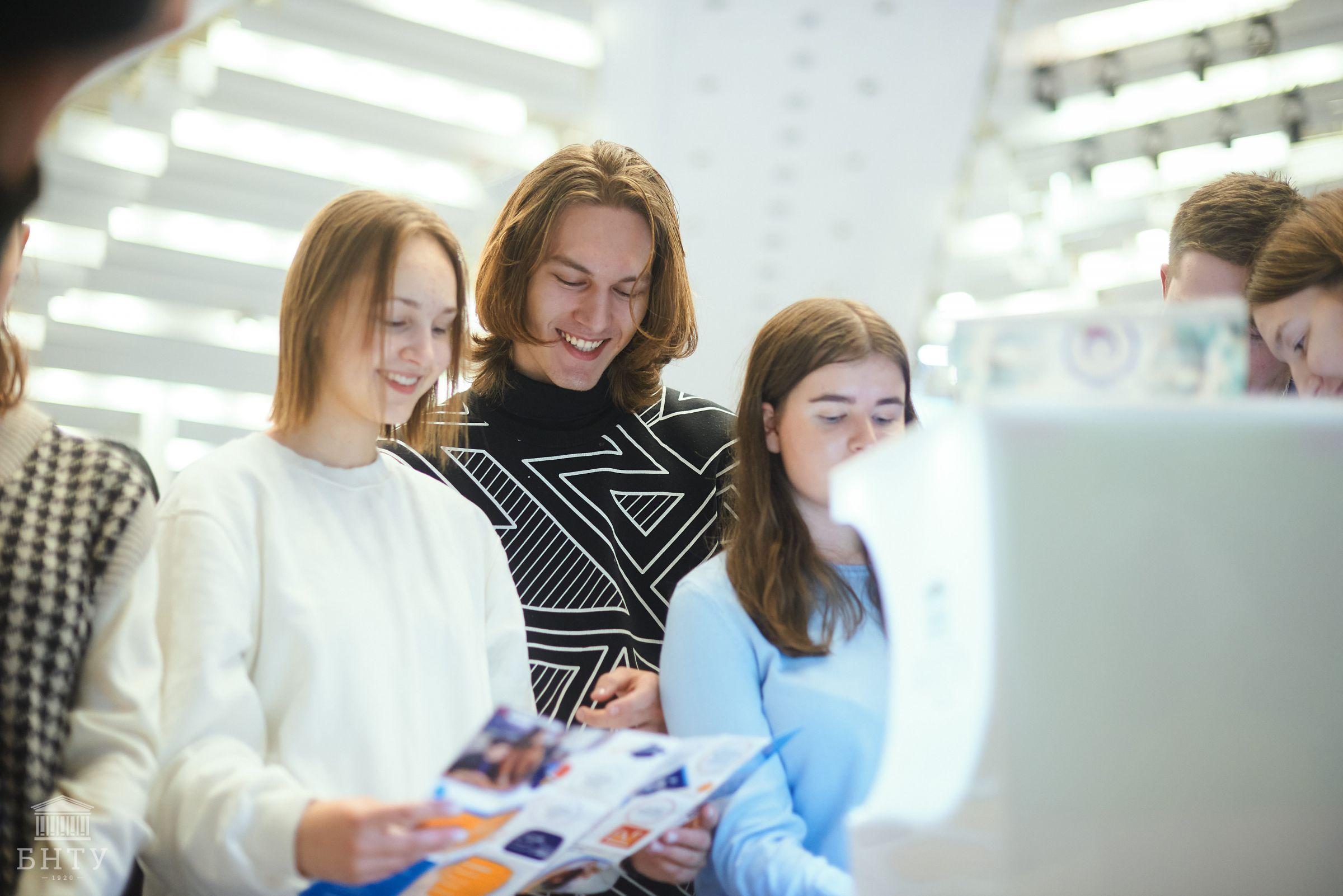
A modern city is not only houses and roads, but also parks, squares, stadiums and sports complexes. All this is the environment in which we live, work and relax. And every part of it requires a professional approach. BNTU believes that in order for the city to be comfortable, beautiful and safe, specialists of various profiles are needed. The Faculty of Architecture (AF) trains those who create the appearance of cities, design residential and public spaces, and think through every detail — from the facade to the layout of the area. The faculty has two specialties: architecture and architectural design. Urbanism and architectural Environment design".
The Faculty of Sports and Technology (STF) teaches engineers who ensure the operation of sports facilities and create equipment for sports. The specialty "sports engineering" includes two profiles: "Technical support for the operation of sports facilities" and "Design and manufacture of sports equipment". It would seem that there are such different directions. But they have one thing in common: the desire to make the world around us better, more convenient and more modern.
Faculty of Architecture
According to Natalia Shulyakovskaya, Deputy Dean of the Faculty of Architecture, architects are in high demand in the Belarusian labor market today. Graduates of the Faculty of Architecture work in a wide variety of organizations: from republican unitary enterprises of the Ministry of Architecture and Construction to private architectural and design studios.
— Forecast data suggest that every year for 10-15 years, the need for training of these specialties in the labor market will be at least 90-100 specialists. This is confirmed by the data for the last 5 years of the distribution of architects in the specialties "Architecture" and "Architectural Design". In accordance with the Message of the President of the Republic of Belarus to the Belarusian people and the National Assembly on 12/18/2025, the Faculty of Architecture clearly heard the message of revising the urban planning policy of small and medium-sized cities in Belarus (paragraph 10 "Strong regions are the main priority", paragraph 9 "Tourism is a point of economic growth"). In order to consolidate young specialists of various specialties in the field, improve the quality of life, housing affordability and security, the regional economy needs not only additional financing, but also coordination of urban development policy in populated areas. Modernity requires the integrated design and approval of projects of objects of the architectural environment as a single integral part of its aesthetic organization and urban planning.
If you explain to future applicants in simple words what the key task of an architect is, Natalia Shulyakovskaya answers succinctly and clearly.:
— The key task of an architect is to create not just beautiful buildings, but a comfortable, safe and functional environment for people to live in. The basis of architectural education is a harmonious combination of precise disciplines, engineering skills, artistic talent, aesthetic sense and cultural awareness.
— What unique disciplines or practical skills do students master within these specialties in order to work in such complex facilities in the future?
— To work on unique or complex objects (high-rise buildings, large public complexes, transport hubs), architects and designers study a complex of exact engineering sciences and artistic and aesthetic modeling. They master disciplines and practical skills that make it possible to create safe, comfortable and functional structures.
The theoretical base includes several key areas: architectural design, architectural structures, architectural physics, typology of buildings and structures, engineering equipment of buildings.
But the main thing is the practical skills that make a student a real specialist. These include BIM design, parametric modeling, prototyping and 3D prototyping, and urban planning.
Students practice at leading enterprises of the industry, including the UE "Minskproekt", JSC "Institute Belgosproekt", as well as the UE "Minskgrado", RUE "Institute of Housing — NIPTIS named after. Ataeva S.S.", JSC "Minskmetroproekt", JSC "MAPID" and many others. In addition, the faculty has branches of departments based on JSC "Institute of Belgosproekt" and the UE "Belniipgradostroitelstvo". The faculty has signed cooperation agreements abroad: with Novosibirsk State University of Architecture, Eurasian National University (Kazakhstan), Urgench and Namangan Universities (Uzbekistan). And in 2025, the coordination of documents on the creation of a joint laboratory "One Belt, One Road" with the Technological University of Inner Mongolia (PRC) began. This indicates that architectural education at BNTU is reaching an international level.
Angelina Tereshko, a graduate of 2026, spoke about studying at the Faculty of Architecture.
— To whom and why would you recommend studying at the Faculty of Architecture, and what is the main advice you would give to applicants who are currently choosing this faculty for admission?
— Those who are not looking for easy ways. Architecture is not just a beautiful picture that we see in the final version, there is a huge amount of work, accurate calculations and designs behind it. Yes, visual is important, but only if the building's frame is designed correctly. Architecture is a constant movement and development. Be ready to be mobile and flexible, adapt and explore new trends, technologies, designs and visual. This is the only thing that underlies a great specialist in architecture. Computer programs are studied while working in them, but the ability to clearly draw a sketch on a piece of paper is a separate task. The most important advice: learn to feel the line, proportions, so that you have the opportunity to make quick and competent sketches and sketches. Develop your viewing experience. Do not create "beautiful" or "ugly", but analyze: why does one facade work while the other hurts the eye? Don't be afraid to make mistakes, because in architecture, the best projects are born from dozens of failed sketches.
Sports and Technical Faculty
According to Yaroslav Potachits, Dean of the Faculty of Sports and Technology, the field of sports engineering in Belarus is developing dynamically in the context of modernization of sports infrastructure and digitalization of the industry.
— As in other engineering areas, there is a steady demand for qualified specialists who are able to ensure reliable operation of complex engineering systems, implement modern technologies and maintain high standards of safety and comfort at sports facilities. Enterprises and organizations of the physical culture and sports complex value young specialists with strong technical training who are able to solve practical problems. The state is actively investing in the development of sports, which creates the prerequisites for the demand for such personnel in the long term.
Yaroslav Potachits explained the essence of the profession as follows:
— The key task of a sports engineer is to make sports comfortable, safe and high–tech. He is a specialist who "revitalizes" sports facilities: he ensures the operation of lighting, ventilation, scoreboard, video recording and refereeing systems, climate control, and is also engaged in the development and improvement of sports equipment and equipment that improve the quality of the athletes' training process. In fact, it connects engineering skills with the world of sports, so that athletes can show the best results, and the audience can fully immerse themselves in the atmosphere of the competition.
Students practice at the Minsk-Arena International Olympic Sports Complex, the Chizhovka Arena State University, the Dynamo National Olympic Stadium, the Palace of the Republic, the Republican Olympic Training Center for Aquatics and others.
— Who do you think these specialties are most suitable for, and why should school graduates definitely consider this profile?
— These specialties are ideal for motivated young people who love technology, sports and want to create something really useful. If you are interested in physics, mathematics, programming or engineering and at the same time are interested in sports, this is your profile. There is an opportunity to directly influence the development of Belarusian sports. Graduates receive sought-after engineering qualifications that open doors not only in the sports industry, but also in instrument engineering, automation and other high-tech fields.
According to Olga Gulevich, a graduate of 2026, the combination of sports and technology initially attracted her to the specialty of Sports Engineering. I wanted to do more than just do engineering, but apply it in a real, "live" field.
— From the outside, this direction seemed rather narrow, but interesting and promising. In reality, it turned out that the specialty is much broader. In the course of our studies, we studied not only engineering disciplines, but also the specifics of the operation of sports facilities, modern technologies in sports, safety issues, management and organization of sports activities. I am glad that I chose this particular faculty.
Olga characterizes the faculty from the inside as a combination of fundamental engineering training and applied orientation. There is a theory, but a lot of attention is paid to practice — working with equipment, circuits, and systems.
Olga advises future applicants:
— It is important here not only the desire to get a profession, but also the willingness to constantly develop, study new technologies and apply knowledge in practice. It is also important to be prepared for the fact that learning requires responsibility and independent work. My advice is not to give up if something doesn't work out the first time. There are difficult moments in the learning process, especially during the study of technical sciences, but over time everything becomes clearer if you do not give up and continue to understand. It is also important not to limit yourself to studying. Participation in the social life of the university can be combined with the educational process — it gives you the opportunity to get a lot of vivid emotions, new acquaintances and experiences. For me personally, one of the most memorable events was the BNTU Spring Festival — it really is a special atmosphere that remains in my memory for a long time.
What do I need to know when applying?
"Architecture":
Qualification: architect;
duration and form of study: 6 years, full-time;
degree: Master's degree;
entrance tests: CSE or CT in mathematics, Russian or Belarusian language and creativity (drawing, composition, sketching);
passing marks for the budget (2025): 339.3.
"Architectural design":
Qualification: architect. Designer;
duration and form of study: 6 years, full-time;
Degree: Master's degree;
entrance tests: CSE or CT in mathematics, Russian or Belarusian language and creativity (drawing, composition, painting);
passing points for the budget (2025): 310.
"Sports engineering. Technical support for the operation of sports facilities":
Qualification: engineer;
duration and form of study: 4 years, full-time;
entrance tests: CSE or CT in mathematics, physics and Russian or Belarusian language;
passing points for the budget (2025): 224.
"Sports engineering. Design and manufacture of sports equipment":
Qualification: engineer;
duration and form of study: 4 years, full-time;
entrance tests: CSE or CT in mathematics, physics and Russian or Belarusian language;
passing points for the budget (2025): 237.
