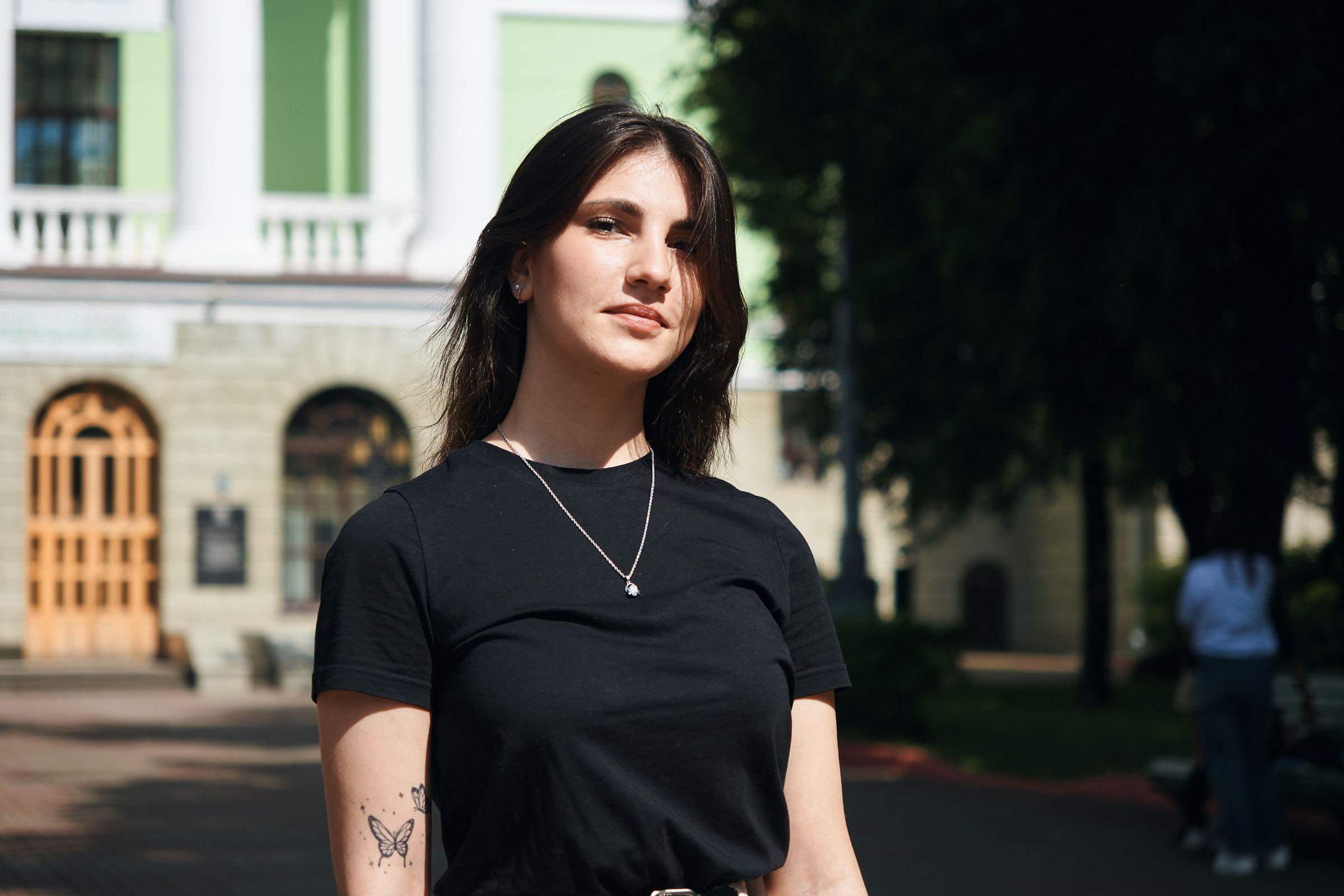
We continue to tell about girls who decided to link their lives with engineering. Angelina Ayvazyan, a student at the Faculty of Mechanical Engineering and Technology, is an activist, the winner of the district stage of the Golden Pen of White Russia 2025 competition for creative young people, dedicated to the 80th anniversary of Victory in the Great Patriotic War, and a young woman who believes that engineering is a space of equal opportunities.
Angelina chose BNTU and the Faculty of Mechanical Engineering and Technology consciously and without hesitation.
— I chose the Faculty of Mechanical Engineering and Technology because my entire family is made up of engineers and technologists. These are not empty words. My grandfather worked at the factory as a foundryman, my grandmother worked as a technologist, my father also works at the factory now. When I was little, they didn't talk to me in complicated terms, but I remember conversations at dinner about casting defects, about how to reduce the percentage of metal shrinkage. It seemed like a separate universe to me. At school, I tried to think about design, medicine, but I felt that it wasn't my thing. And when I came to the open day at OAO Minsk Tractor Plant, I heard about casting and immediately remembered my grandfather's stories and something clicked inside. I realized that I wanted to be like her — confident, knowledgeable, and hands-on.
The girl's inclination towards the technical field was evident even in school.
— In school, I loved chemistry and physics, especially the practical classes. I enjoyed mixing reagents and watching the colors change, as well as the fizzing and settling. When we were introduced to casting at university, I was immediately captivated by it, as it was essentially the same experiment but with metal. You take the charge, melt it, pour it into the mold, and then you open it and see the finished part. Sometimes you get a defect, and then you analyze why: gas pockets, shrinkage, or the wrong temperature. It's like a detective story. I love that I can learn new things all the time, because modern casting involves computer modeling and 3D printing of molds.
— How did your social activities at the faculty start?
— In school, I was the class representative, organizing all the discos and various interactive events. When I first arrived, I was quiet for a few weeks, getting used to things. Then, in the third week, I saw the deputy dean announcing a recruitment drive for the student council. I was afraid that I wouldn't be accepted, but I decided to give it a try, and the deputy dean suggested that I join the cultural and social activities department. This led me to attend various exhibitions, participate in events, and write essays. Currently, I am a member of the faculty council.
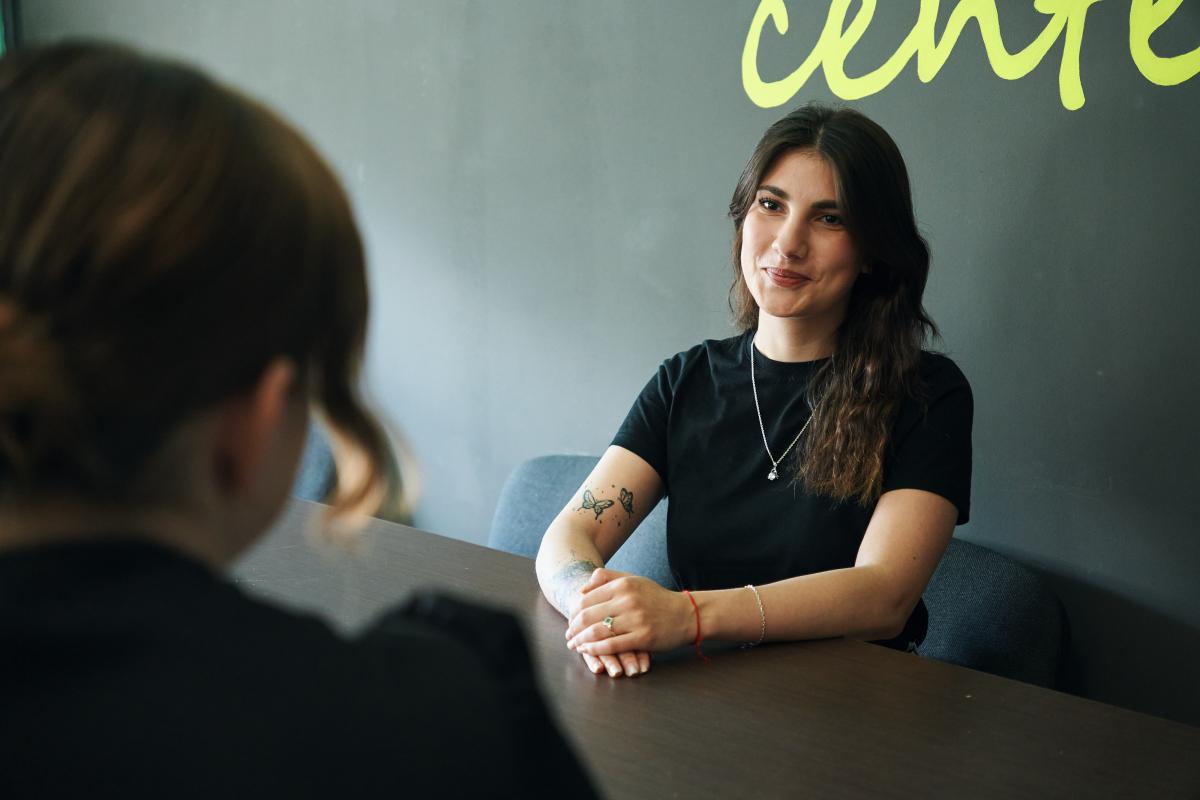
It can be challenging to balance my studies with active social engagement, but I have developed a "life hack" to manage it effectively.
— My assistant is clear planning. Not just "make a list", but time-blocking. I bought a large weekly planner with an hourly grid. On Sunday evening, I sit down and write down every 1-2 hours for the week: couples, shopping, sports, an hour of rest, TV series. And another strict rule: if some business is not written down - it does not exist, I do not jump between tasks. Thanks to this, I manage to close the session on 9 and 10. And most importantly, I get enough sleep because I have time for it in my schedule.
Angelina doesn't always grasp complex technical topics on the fly, but instead of getting frustrated, she has learned to use her main weapon - her ability to connect with people.
— I can sense the mood of the person I'm talking to based on their tone and facial expressions. Understanding complex topics is a challenge for me. For example, I struggled with hydraulics. I spent two evenings working on the Bernoulli equation until I found a YouTube video with animations. But I don't hesitate to ask for help. I can approach a fellow student and say, "Please explain the topic to me like I'm a child." Or, after a class, I can approach a professor and say, "I'm sorry, but I didn't fully understand the formation of gas shells. Can you provide me with another example?" People are usually willing to help if you're genuine. This is why being sociable can be beneficial in academic settings.
— What event or project organized by you or with your participation do you remember the most, and why?
— This is the Golden Pen of White Russia – 2025 competition of works of creative youth. I am not a philologist, not a journalist, just like to write essays. I wrote about the life of a girl in wartime. Named “Nadenka – Nadezhda”. The story is about a girl who sewed uniforms for the military, helped her mother, bandaged the wounded. Why did I decide to write on this particular topic? Because often people forget how hard it was at the time, how people coped with difficult tasks. And this was an incentive for me to go on, no matter how hard it was. My favorite expression from there is: “No matter how difficult it is – you need to go on.” I took 1 place with my essay.
Angelina admitted that working in the faculty’s asset has taught her to combine all tasks without failures. Previously, she thought that if she took on many tasks, then her studies or health would collapse. But it turned out that this was not the case at all. During the Spring, she actively studied during the day and switched to creative mode in the evening. As a result, she learned to say "no" to things that were not a priority and to ask for help, which helped her become more focused, calm, and improve her grades.
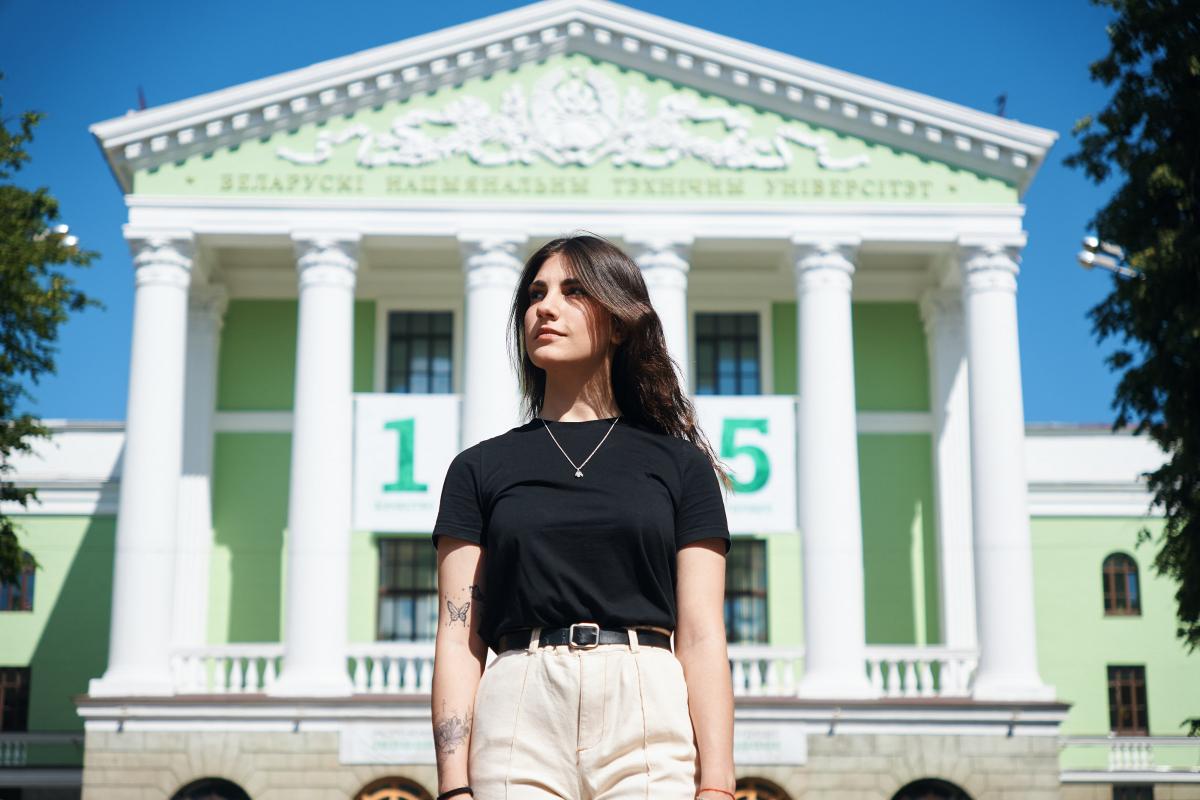
She feels natural and free at the university, without any tension or feeling of being out of place.
— At the faculty, I feel comfortable, like a flower in the right soil, with the right amount of light and water. For me, the university is like a pot where I don't get abruptly transplanted, but rather allowed to grow and develop. Although the professors at the Faculty of Mechanical Engineering and Technology are strict, they provide assistance when they see my interest. My supervisor always listens to me. My classmates support and help me. My friends from extracurricular activities provide encouragement. Even when I'm tired, I know that tomorrow I'll come to the classroom, sit in my seat, and see familiar faces, which makes me feel better. I also like that there's no fierce competition in the Mechanical Engineering Department, but rather a sense of camaraderie.
— What do you think women bring to engineering that men sometimes lack?
— I've been thinking about this for a long time, observing my classmates and professors. In my opinion, men often approach problems head-on, focusing on how to make things work. They look for a technical reason, power, and reliability of the unit. Women tend to ask, "Will it work as it should in real-life conditions? Will it be comfortable for the person holding the part? Will it be dangerous due to sharp corners or weight?" I believe that the female approach adds empathy and a systemic perspective, considering not only the mechanism but also the context of its use.
Angelina believes that more and more girls are choosing technical specialties today because old stereotypes are being broken down, and production is changing — less hard work, more computers and analytics. She gave an example: her aunt works at a factory as a technologist, where the department is made up of one-third women.
The student gave the following advice to female applicants who are afraid to choose an engineering specialty:
— Don't be afraid, go ahead with confidence, because everything will be fine. Find at least one friend in your class or course, as it's easier to do things together. Don't be shy about being a "nerd": go to consultations, ask silly questions, and ask for an explanation again - it's okay. Make sure to engage in activities outside of your studies (social activities, sports, and creativity) - it's a reset. Write down your small victories: understanding a topic, passing a lab, or helping a fellow student - it motivates you, and remember that in 5 years, you'll be a certified professional who is respected for their knowledge, not their gender. You can do it.
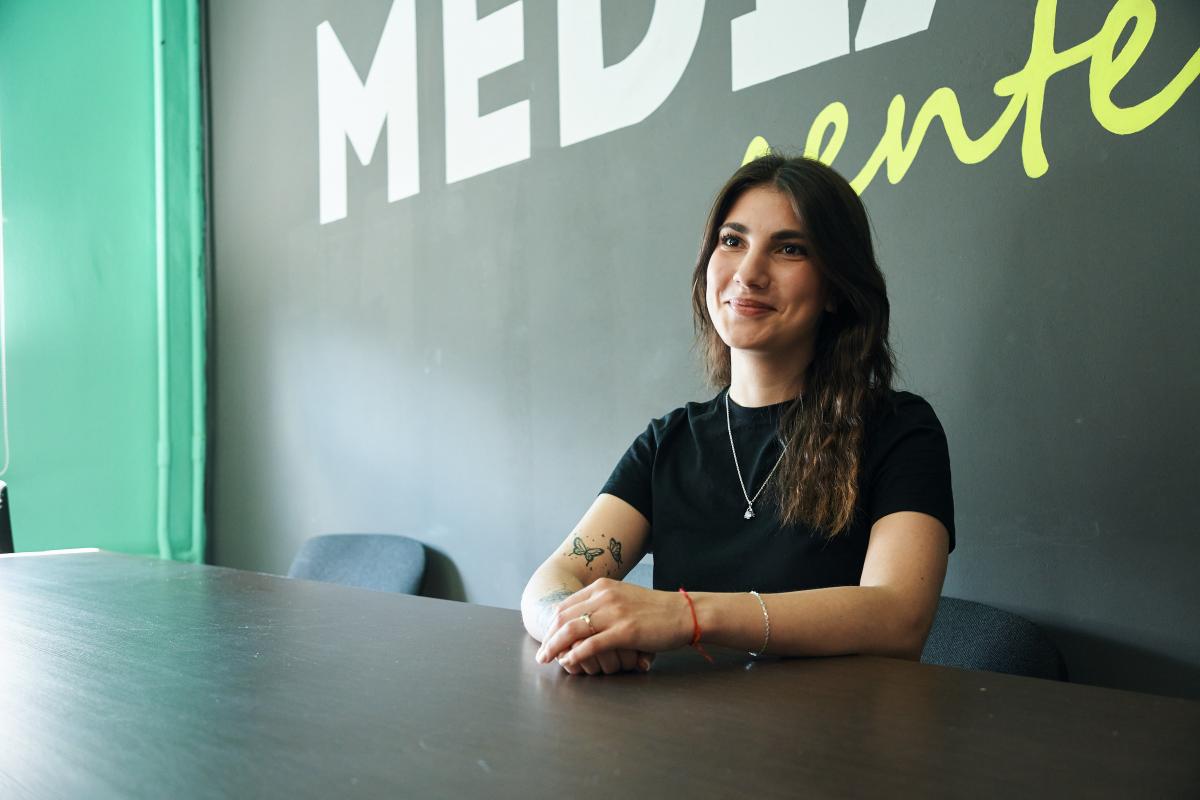
Angelina Ayvazyan studies, creates, and wins competitions. Her secret is simple: don't be afraid to try, ask for help, and remember that even a complex topic can be explained through a simple example.
