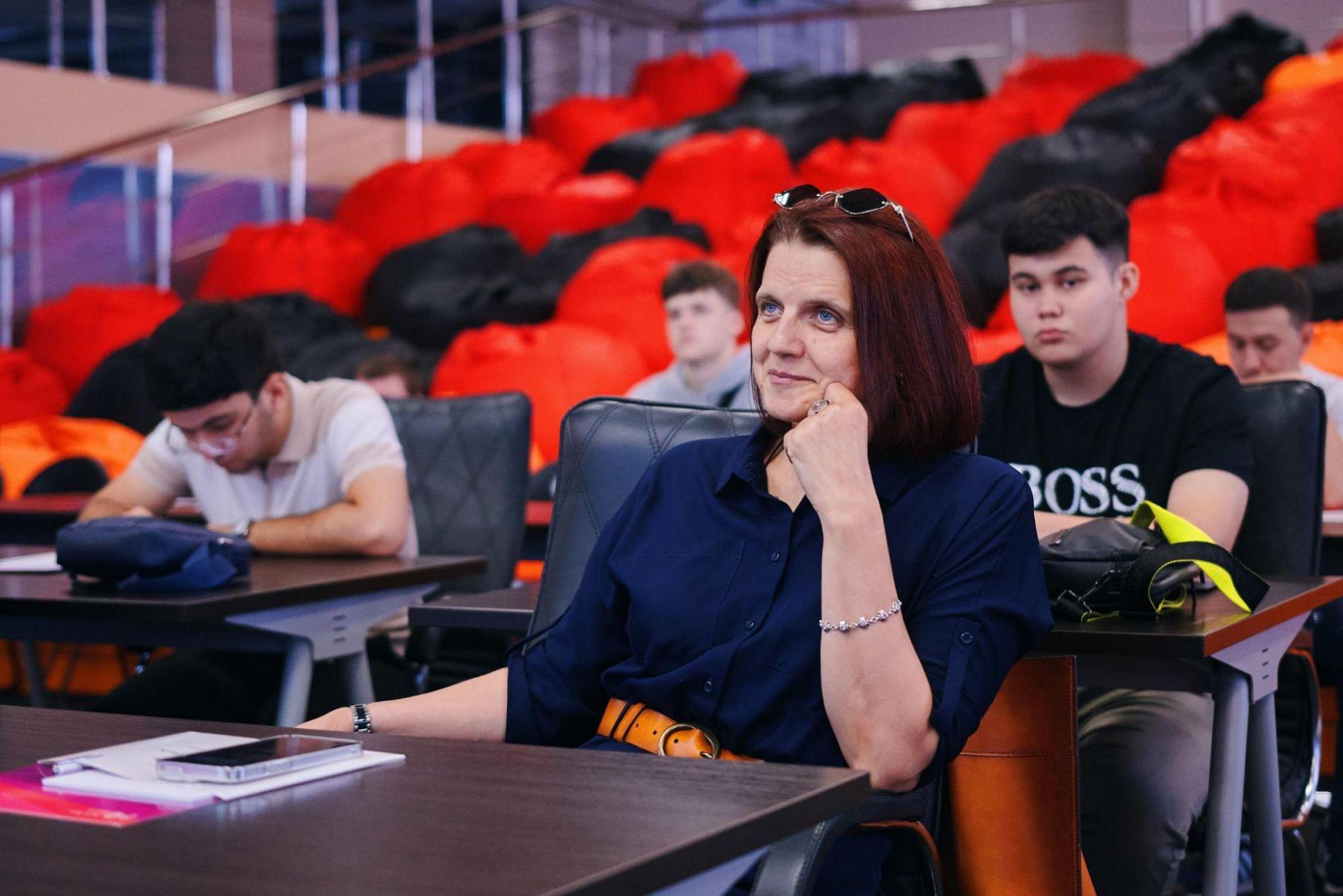
We continue our introduction to the women at the Belarusian National Technical University who are shaping the face of modern engineering. The heroine of this new article is someone who rose from student to head of a department in the Faculty of Mechanical Engineering. Tatyana Sakhnovich, PhD in Economics and Associate Professor, Head of the Engineering Economics Department, spoke about how female empathy and precise calculations are the formula for success at a technical university.
Choosing a life's work is rarely random; it's often the result of extensive research and analysis. Tatyana Sakhnovich shared how her professional journey began and the moment she realized that engineering economics was interesting, relevant, and promising.
"You know, my passion for engineering economics is the result of searching for interesting ideas and discussing with colleagues about the new level of training for engineers and economists at our university." For me, engineering economics is a kind of puzzle, consisting of numerous elements of engineering design (drawings, specifications, processes) and economic calculations (cost, profitability, payback), which fit together perfectly, transforming the chaos of a project into pure profit. In other words, engineering economics is a philosophy of expediency.
— When you were a student, were there fewer women in technical fields than now? Did you feel any particular pride or, on the contrary, pressure in choosing an engineering career?
— Yes, when, on September 1st, in my first year, the university sent our cohort to harvest potatoes in the small village of Svir in the Myadel District of the Minsk Region, there were 8 girls out of 120. As for pressure, there was pressure; the boys would joke, "Tanya, can you put pressure on me? Let's compete!" This pressure instilled in me the belief that everything in life needs to be proven through action and not to be afraid of experiments. From my first year, I accepted the rules of the game and started winning Olympiads: first place in chemistry in the first semester, first place in engineering graphics in the second semester, and so on. For many girls today, all of this is standard, but back then, it was tantamount to being the first female cosmonaut, just in the department.
From graduating with honors to heading an entire department—that's the career success Tatyana Sakhnovich has achieved. The associate professor revealed whether this was a well-thought-out strategy or a series of unexpected turns.
"It's a strategy with a large dose of luck, or, to put it another way, an optimization model. The plan was clear: graduating with honors, graduate school, publications, and so on. My main mentor, Professor Vladimir Ivanovich Demidov, said, 'An engineer without ambition is like an engine without fuel. And remember, Tatyana, a good engineer will make a great economist.'" His support and my mother's coffee in the mornings are the secret to my small success. Later, I received an offer to head the Department of Economics and Organization of Mechanical Engineering Production. Was it a coincidence? I don't know. For me, a design engineer, it was a pleasant surprise.
Female leadership styles at technical universities are not a myth, but a reality. The head of the Engineering Economics Department shared its unique characteristics, explaining how women's intuition helps find innovative solutions and support the team even in the most challenging situations, and what approach allows the department to achieve leadership positions at the university every year.
"Female leadership styles at technical universities exist, and they are a superweapon for any woman in a technical university! Men build hierarchies like bridges, women build networks like neural networks." There are, of course, some unique aspects: empathy with deadlines ("Submit the paper tomorrow, but if you don't have time, let's go with Plan B"), multitasking (lecture plus report plus the dean's office), and humor ("Students, if the formula doesn't add up, add two candies—it's a constant!"). The result of this work: for the second year in a row, the Engineering Economics department has taken second place in our technical university's competition among more than 60 graduating departments.
— How do you manage to connect with students?
— The secret is "technical empathy." I ask, "Where does this formula hinder understanding?" realizing that the phrase "memorize it" is extremely counterproductive for memorization. I offer real-life examples: "How much will your bike be worth in three years?" for first-year students; Real-life cases, such as "Calculate the Profitability of an Optical Rig at Peleng OJSC," are for master's students, while analytics such as "Evaluate the Dynamics of Tax Incentives for Mechanical Engineering Companies" are for postgraduate students. In general, undergraduates, master's students, and postgraduate students all work together: understand the input and you'll get the optimal output.
Tatyana Alexandrovna's main source of inspiration is live interaction with students, as their successes make any work truly meaningful. At the same time, the associate professor skillfully balances administrative routine, research projects, and teaching, ensuring that every day is filled with meaning.
"Communicating with students is the heart of everything for me. Administrative work is the grease, research is the fuel, and students are the engine. When a first-year student says, "I understand synergy!" that's worth more than any Scopus article—it means the day hasn't been wasted! At the same time, I try to keep a time balance in mind: Monday is paperwork, Tuesday is publications, and the rest is 'live engineering.'"
For Tatyana Alexandrovna, her most valuable life achievements weren't titles and awards, but the department's successes, the support of her colleagues, and the gratitude of those she helped to inspire.
"I consider the launch of the "Production Organization with a Digital Software Suite" training laboratory named after Honored Economist of Belarus, Doctor of Economics, and Professor Nikolai Sidorovich Sachko in December to be a success for our entire department team in 2025." Nikolai Sidorovich is the founder of the Belarusian School of Production Organizers. Under his leadership, the first engineering and economics program in our country was trained, and in 1970, the first graduate program of engineers and economists was completed. My greatest personal achievement was the words of my master's student (now Deputy General Director for Economics and Finance at a large industrial enterprise): "Tatiana Alexandrovna, thank you for believing in me! Without you, I would not have become who I am." I consider these words my personal ROI (return on investment, which cannot be measured by formulas).
— What challenges do you face in your professional career, and how do you overcome them?
— There are many, but the biggest one is constantly maintaining a balance between family and career. My system is complex, with seven inputs and one output—happiness. Anyone who knows systems theory or production organization understands how challenging this is!
Tatyana Alexandrovna also relies on her feminine intuition to make the right decisions in difficult situations. The economics PhD candidate is certain that this isn't mysticism, but rather a special tool for scientists, and the associate professor believes in it with almost 90%.
— I believe it with 87.5% confidence, and the rest is statistics. I've had moments when, in process modeling, I sense a lag of not 3, but 5 days; I check—it's spot on! Men call it "eureka," and we women simply call it "female intuition." Some believe intuition is a subconscious, trained by thousands of calculations, but I believe we mustn't forget our inner voice. Remember the words of Armen Dzhigarkhanyan's character in the film "The Meeting Place Cannot Be Changed": "You can't fool a woman, she sees with her heart."
— Has the ratio of women to men in technical majors changed over the past 5-10 years? Are women becoming more daring in choosing engineering?
— Yes! Even in a traditionally male-dominated department like Mechanical Engineering, the number of female applicants is steadily increasing year after year. They're more confident in choosing real, complex engineering calculations over the "safe" path of accounting. The reason? TikTok videos, Instagram stories about female engineers, various scholarships, and, most importantly, the prospect of higher salaries and interesting, creative work after graduation. Many have realized that "Engineering isn't a hammer in your hand, but an algorithm for success!"
For Tatyana Alexandrovna, the best way to recharge after a busy workday, to switch off thoughts from formulas and instruments, is through her hobbies—her clear and genuine joys.
"My hobbies are my dog and the sauna. I love taking morning walks with my beloved dachshund, and an evening sauna helps me relieve the 'administrative stress.'" Properly steaming a broom, selecting the right scents, and much more—it's a serious puzzle, devoid of formulas, and the only instrument used is the steam room oven. Designing and sewing clothes also helps me switch off: after all, I have six years of "Cutting and Sewing" courses at the House of Technical Creativity under my belt, and fond memories of international victories: I won first place for a skirt in Rome (9th grade), and third place for a sundress in Paris (7th grade). You might say that's engineering too, and I agree, but it's different—it's fabric engineering.
— If you had a time machine, which person from the past would you want to have coffee with, and what would you ask them?
— Ada Lovelace, the English mathematician and first female programmer. Perhaps something along the lines of: "Ada, imagine Babbage's engine coming to life right now. What's the first algorithm you would have it calculate?" Would you apply it to astronomy, as you dreamed, or to finance, so banks wouldn't have to count tons of paperwork by hand? What keeps you in science when Victorian society insisted, "Embroidery for ladies"?
Concluding our conversation, we asked the associate professor to give advice to young women who have yet to choose their career path, and to those already studying engineering.
"To those who are yet to make a choice, I'd like to say: 'Believe in yourself! Don't be afraid of numbers, calculations, and drawings—they're more honest than words!'" To those studying: "Build a personal portfolio! Join the student scientific society! And always remember: you are the future of Belarusian engineering!"
We thank Tatyana Alexandrovna for her sincere answers and wish her continued scientific achievements, proving that women in the engineering profession are a powerful intellectual force, the key to our country's prosperity.
