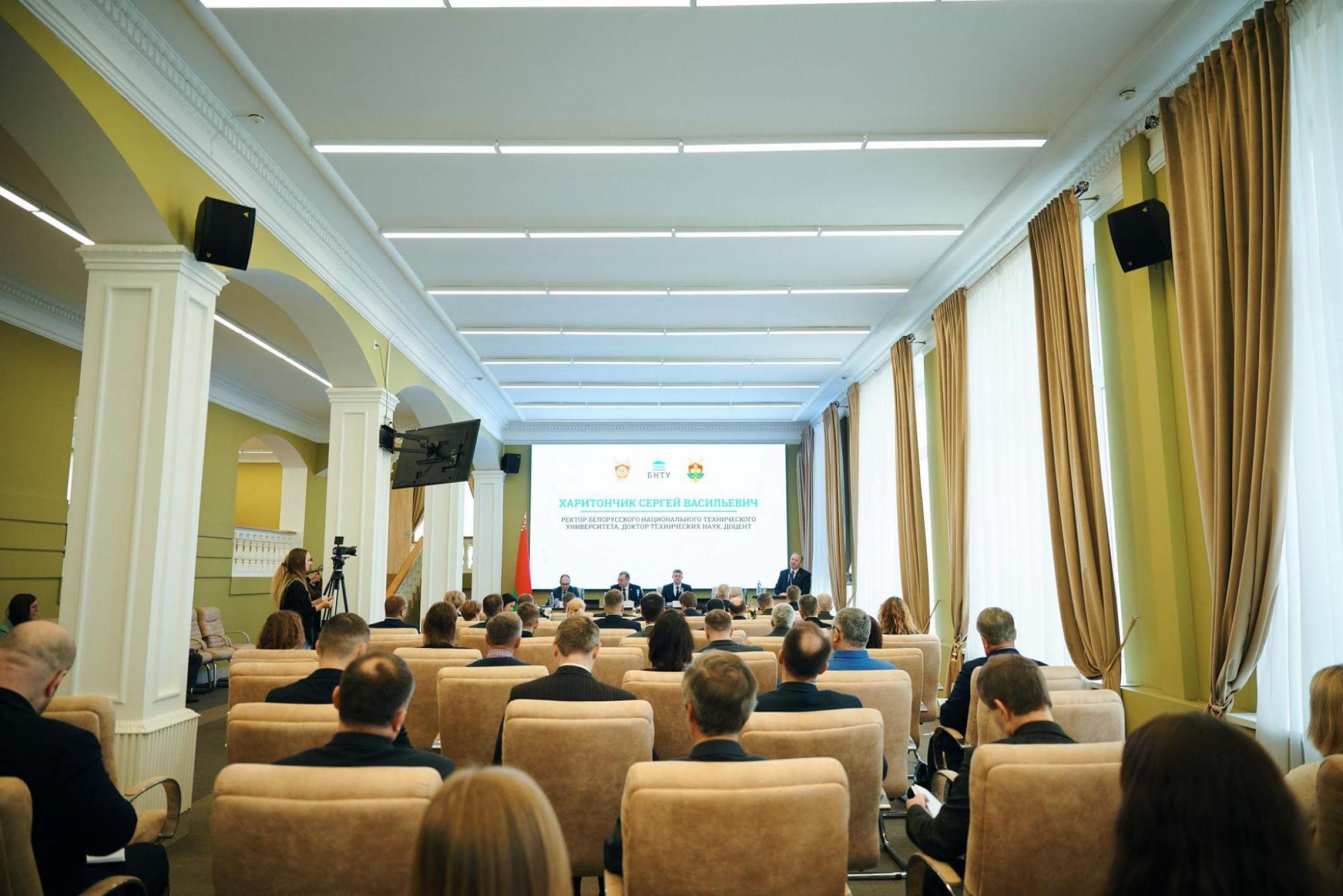
Today, April 3, the Belarusian National Technical University hosted a scientific and practical roundtable discussion entitled "Transport and Road Safety: Current Issues of Legal Regulation, Technical, and Information Support." The event was timed to coincide with the 20th anniversary of the Scientific and Practical Center for Strengthening Law and Order of the Prosecutor General's Office of the Republic of Belarus and the 105th anniversary of BNTU.
For reference: the main goal of the roundtable discussion was to develop approaches to ensuring transport safety and effective measures to prevent road accidents, as well as to coordinate the efforts of authorized government agencies and the scientific community in ensuring the safety of road users and other transport stakeholders.
Upon arrival at the event, participants were able to explore the work of scientists and future engineers at an exhibition. The exhibition showcased the achievements of the BNTU branch "Research Polytechnic Institute" and the student design bureau of the automobile and tractor faculty, as well as publications from the Scientific Library.
Before the official launch, Igor Moroz, Director of the Scientific and Practical Center for Strengthening the Rule of Law and Order of the Prosecutor General's Office of the Republic of Belarus and a PhD in Law, noted the center's role in ensuring transport safety.
"The Scientific and Practical Center conducts preventative studies and reviews of draft regulatory legal acts. Indeed, problems associated with deficiencies in legal regulation are identified. These, in turn, create causes and conditions that contribute to violations and reduce safety. These causes and conditions are identified and addressed thanks to the work of the Scientific and Practical Center of the Prosecutor General's Office. Currently, society is at a stage in its development where the emergence of new objects and road users poses new challenges and requires new fundamental solutions, including revolutionary legislative changes. Predicting the consequences of legislative changes is extremely difficult. Therefore, the event was organized to examine the issue of ensuring transport safety from all angles and to take it into account in all areas of preventive activities, including the rulemaking process." One of the major legislative changes occurred last year, amending our traffic regulations to include provisions concerning the use of personal mobility devices. These devices have long been a part of our lives, but the lack of legal regulation created a certain chaos, and this chaos affected both those who use them and those who share traffic with them.
The opening ceremony was also attended by BNTU Rector Sergei Kharitonchik, Chairman of the Supreme Court of the Republic of Belarus Andrei Shved, Chairman of the Highest Attestation Commission of the Republic of Belarus Alexander Guchok, and representatives of ministries, other agencies, and universities across the country.
Sergei Kharitonchik discussed the topic of technical regulation of road safety and BNTU's research in this area.
- Our university is directly involved in safety issues. For many years, we have been working on the development of a wide variety of equipment and devices. Experience has shown that while making progress in our mobility, we simultaneously see new tasks and challenges emerging. While our cars only traveled at low speeds just a few decades ago, over the course of intensive engineering research in this area, we've increased speeds and created more comfortable conditions for our vehicles. New vehicles are emerging that logically stem from our daily needs. And most importantly, we've seen new challenges and issues arise that need to be addressed. First and foremost, they relate to safety. High speeds offer advantages, but we must consider that by increasing speed, we must ensure equal comfort and safe travel conditions for all road users: cars, pedestrians, and others. Our university has conducted and continues to conduct extensive research in this area. I would even say that research schools have emerged within our university that focus on hydraulic and pneumatic drives for automotive systems. These developments have significantly improved vehicle safety and laid the groundwork for the future.
Andrey Shved, in turn, addressed the participants with parting words, wishing them productive work.
- In today's world, the intensity of vehicle traffic has become an integral part of our society. Under these conditions, the issue of ensuring citizens' rights to safe road conditions and transportation activities is particularly pressing. Judicial practice demonstrates that the increase in offenses is associated with failure to comply with traffic regulations before operating vehicles, necessitating further improvement of organizational, technical, and legal measures to improve traffic safety and prevent road accidents. Statistics for last year are disappointing compared to 2024. Based on the results of court hearings, we have noted an increase in offenses. On the one hand, this certainly suggests that we must intensively and effectively identify and prevent these offenses, but overall, it's probably safe to say that this trend indicates an increase in such offenses. I'm sure most of us are road users. I drive several times almost every day, and I've noticed that recently, people have become more careless, committing serious violations, and so on. Today, reports will be presented; I reviewed the meeting agenda and saw some interesting presentations. I think this will only be beneficial. The roundtable brought together representatives of various government agencies and organizations to discuss the most pressing issues in this area. The interest shown in the roundtable exceptionally underscores the relevance and practical significance of the issues under consideration. Effective proposals for ensuring road safety require widespread publicity and public engagement in maintaining safe road conditions. I am confident that the new knowledge and practical experience of the roundtable participants will enable them to develop sound legal and technical solutions. I sincerely wish the roundtable participants productive work, constructive dialogue, and success.
Furthermore, Alexander Guchok addressed current transport safety issues during the event.
- Transport and road safety issues will always remain a focus for both scientists and practitioners. The emergence of new vehicles and their integration into infrastructure that is not always suited for them requires serious scientific support, covering both legal regulation and technical and informational support. However, the implementation of scientific developments in this area does not guarantee the expected effect. Serious implementation of relevant projects is required, practically independently, by employees of the State Traffic Inspectorate of the Ministry of Internal Affairs, the Ministry of Transport, designers, road users themselves, and other stakeholders. Based on this, I wish everyone present fruitful work in a united creative spirit for the benefit of Belarusian science and the Republic of Belarus. In our opinion, solutions to such problems as developing a concept for constructing transport and pedestrian infrastructure along the northern route, taking into account the realities of the near future, defining concepts of classification, goals, and rules for the efficient and safe operation of new vehicles, developing software, reducing vehicle safety controls to ensure travel along specific routes, and establishing a set of grounds and reasons for holding violators accountable, along with effective algorithms for ensuring the inevitability of punishment for offenses that are far from always considered childish pranks, have every chance of being presented as qualified research papers, at least at the level of a PhD dissertation. Furthermore, it would be interesting to consider the possibility of moving away from the classical paradigm of holding law enforcement accountable, according to which this falls within the exclusive competence of government agencies.
Following the welcoming remarks, the roundtable participants began their presentations. Sergei Kharitonchik addressed the topic "Scientific and Technical Challenges of Ensuring Transport Safety in the Republic of Belarus." As the rector noted, BNTU trains highly qualified engineers, including those specializing in the design of key automotive systems, such as braking and steering systems. Furthermore, university researchers conduct in-depth research, developing modern standards and regulations to ensure road safety.
Those present also discussed the use of personal mobility devices, outlined measures to improve traffic management without accidents, and identified the causes of wild animal deaths in road accidents and ways to reduce them. Experts also addressed the issue of animal deaths on highways and proposed solutions. The roundtable participants paid special attention to the safety of agricultural machinery used on public roads.
A particularly important topic of discussion was the issue of educating children and adolescents on road safety. Those present noted the need to introduce mandatory road safety lessons into the school curriculum, with the participation of representatives from the State Traffic Inspectorate of the Ministry of Internal Affairs.
Summing up, Alexander Guchok highlighted several important initiatives. First, speed limits and increased oversight of rental services. Secondly, addressing the lighting issue: headlights on personal mobility devices should be adjusted so as not to blind children shorter than 140 cm. According to the expert, pedestrian safety should be a top priority when using modern microtransport.
The roundtable served as a platform for addressing pressing societal issues. The proposals developed during the discussion will form the basis for new comprehensive measures designed to make roads and vehicle travel as safe and comfortable as possible for every road user.
