
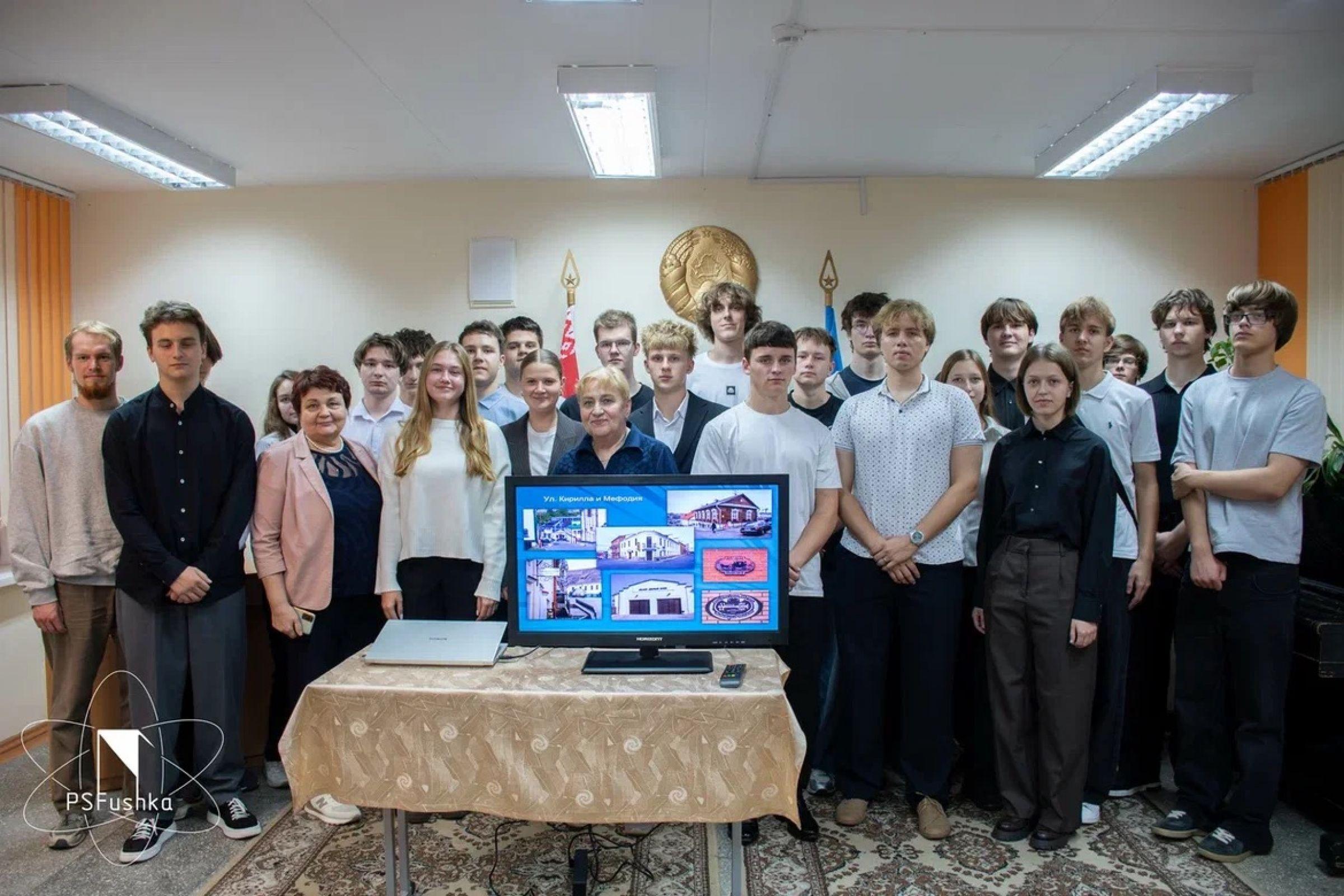
On September 17, a meeting with a representative of the BNTU Scientific Library was held for students of the Instrument-Making Faculty. The event, titled "An Ancient City — A Young City," brought together students eager to learn what Minsk was like centuries ago and how its past lives on in modern streets.
The conversation began with the chronicle mention of Minsk. Listeners learned that ancient narratives wrote about the Yaroslavichi and the Battle on the Nemiga — events that became part of the city's history long before it acquired its present appearance.
Special attention was given to three legends about the origin of the name "Minsk." According to one version, it came from the word "mena" (barter); according to another — from the Menka River; according to a third — from the name of an epic hero. Students were also told where the monument to the hero's mill is located today.
The Menka River is not just a geographical name. It was there that ancient Mensk was located, mentioned in the chronicles. Today, excavations are underway at that site, and ancient Minsk, it turns out, was located not at all where we are used to seeing the historical center. The speaker showed what the hillfort looked like on a map and what the Minsk Castle Site represents today.
Before the students appeared Minsk of the 13th century, and then the Trinity Suburb: what it was like and what it has become now.
The Trinity Suburb is a place steeped in history. Maxim Bogdanovich was born here. The Trinity Monastery, founded in 1603, is also located here. Nearby is the Third House of Soviets. Not far away is the Mariavite Monastery, which was closed after the revolution, and its buildings were transferred to the Suvorov Military School. And on the site of the Trinity Market today stands the Opera and Ballet Theater.
The next stop was Nemiga. Here stands the Cathedral in the Name of the Holy Apostles Peter and Paul. It had two names: the Catherine Church and the Peter and Paul Cathedral. Nearby was the Cold Synagogue — the oldest building in Minsk.
The Rakovskoye Suburb and the Tatar Settlement were not overlooked either — students learned what is located in their place today.
The Upper City opened up to the listeners from a new side. They learned what was located here during Soviet times, when the Town Hall was built, and what the city's coat of arms looked like. Today, ceremonial events are held in the Town Hall. Nearby is the Gostiny Dvor, whose history and modern appearance were also presented. The Bernardine Monastery, the "Vilenchuki" shopping rows, the complex of Basilian Monasteries, and the Cathedral of the Virgin Mary (formerly a Jesuit monastery) were also recalled.
Revolutionary Street was another page of the walk. Students learned what was located here before and what is here now.
The route ended at the "Europe" Hotel, the Dominican Monastery, the House of Libraries, and the Masonic House.
— It was especially interesting to learn that ancient Minsk was located not at all where we are used to seeing the historical center. It makes you look at familiar streets in a new way, — one of the listeners shared her impressions.
The meeting allowed students to see Minsk not just as a modern city, but as a living organism in which past and present are intertwined in every street, every building, and every stone.
"An Ancient City — A Young City" is not just a title, but an accurate description of what Minsk remains for those who are ready to look closely into its history.