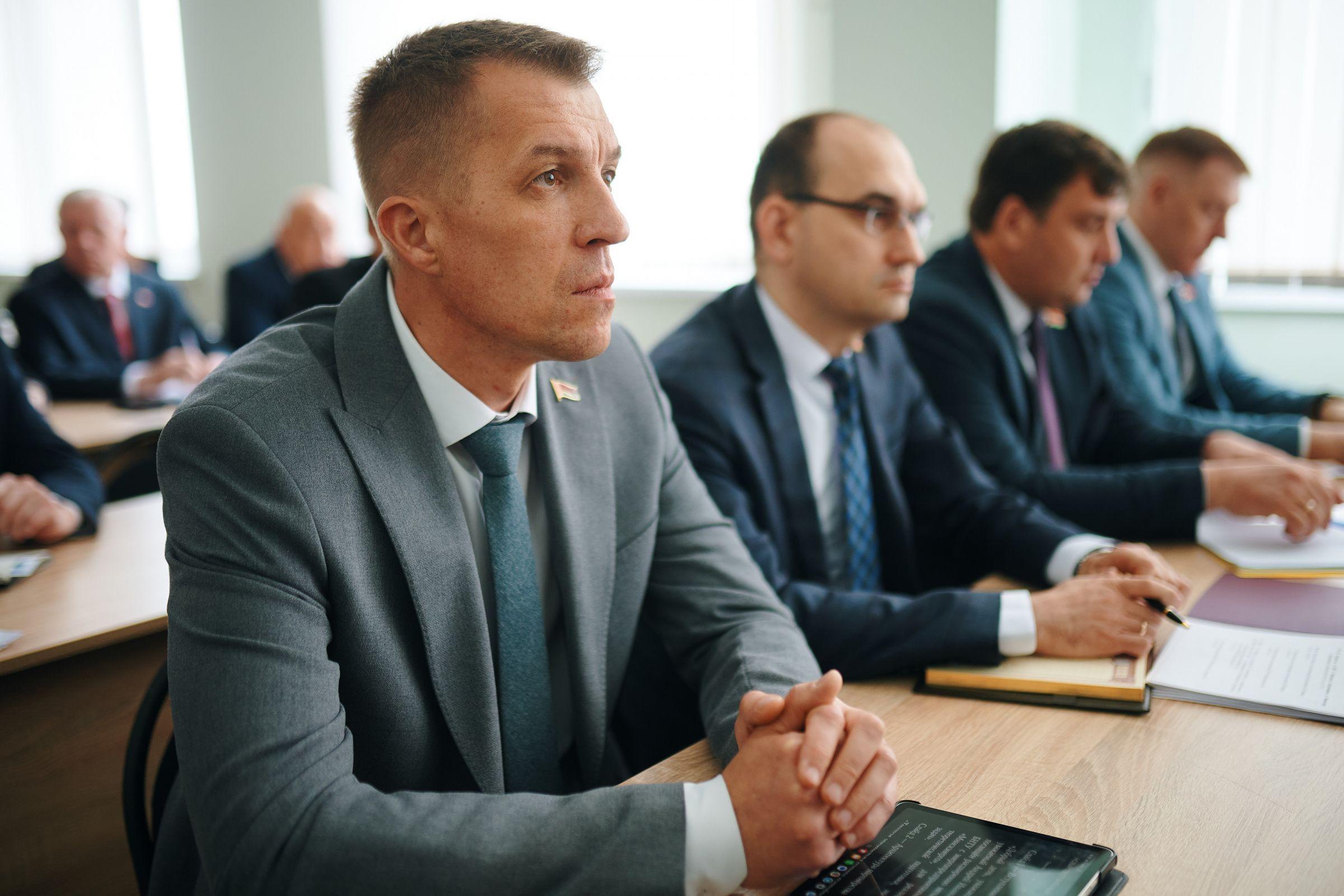
Today, July 7, a working meeting was held in the new educational and laboratory building of the Faculty of Energy of the Belarusian National Technical University on the collaboration between energy industry organizations and higher education institutions in improving the quality of training for energy specialists.
Education Minister Andrei Ivanets, Energy Minister Denis Moroz, and representatives of energy industry organizations arrived at the country's leading engineering powerhouse. A BNTU delegation, led by Rector Sergei Kharitonchik, greeted the guests in the new building, where university staff presented the university's cutting-edge developments and research projects in the energy sector.
Opening the official meeting, Sergei Kharitonchik thanked everyone who helped complete the construction of the new building and noted that, according to student feedback, the learning conditions here are significantly better than before. However, as the rector emphasized, life does not stand still:
"We are always faced with new challenges: further improving the quality of education and training competitive specialists capable of solving complex production problems. We greatly appreciate the attention and support of our ministers – they constantly keep their finger on the pulse and help us move forward. The better we train our personnel, the more effectively they work in the real sector. This is what makes life and work worth living – this is our main goal."
In turn, Andrey Ivanets outlined the key challenges facing the industry in terms of staffing and emphasized the need to further develop the faculty's resources:
"The plans and objectives we set are being realized. Despite this, we all understand perfectly well that without the support of regional universities, it will be extremely difficult for us to staff the entire energy sector."
A distinctive feature of the energy sector is the long service life of equipment. Therefore, personnel training must be focused on real-world production challenges.
"The Ministry of Energy and all energy and gas supply organizations share one unique characteristic: our equipment has a fairly long service life—5-10 years or more. This is why we pay such close attention to collaboration with higher education institutions and specialized secondary schools. We need to clearly understand the level and qualifications of specialists coming to the energy sector to work on the equipment we are already using and implementing in our energy system," Denis Moroz emphasized.
Dean of the Faculty of Energy, Evgeny Ponomarenko, reported on the progress of the cooperation roadmap with the Belenergo State Production Association. He also shared information on the growth in contractual work, the increase in the number of targeted students, paid internships at energy system facilities, and the strengthening of the infrastructure. Furthermore, attention was paid to engineering classes in schools and the active participation of faculty in research in priority areas of the industry.
Deepening practical interactions, systematic internships for faculty at energy system facilities, expanding laboratory facilities, and integrating corporate training at BNTU were the topics addressed in his report by Pavel Gorudko, Director General of RUE Minskenergo. He placed particular emphasis on the need to provide students with vocational training as part of their educational process.
Meeting participants discussed the implementation of the protocol of ministry instructions, reviewed the plan for equipping the BNTU Faculty of Energy, and exchanged views on current issues in engineering training. Following the meeting, further steps were outlined to strengthen cooperation between universities and energy industry organizations.
