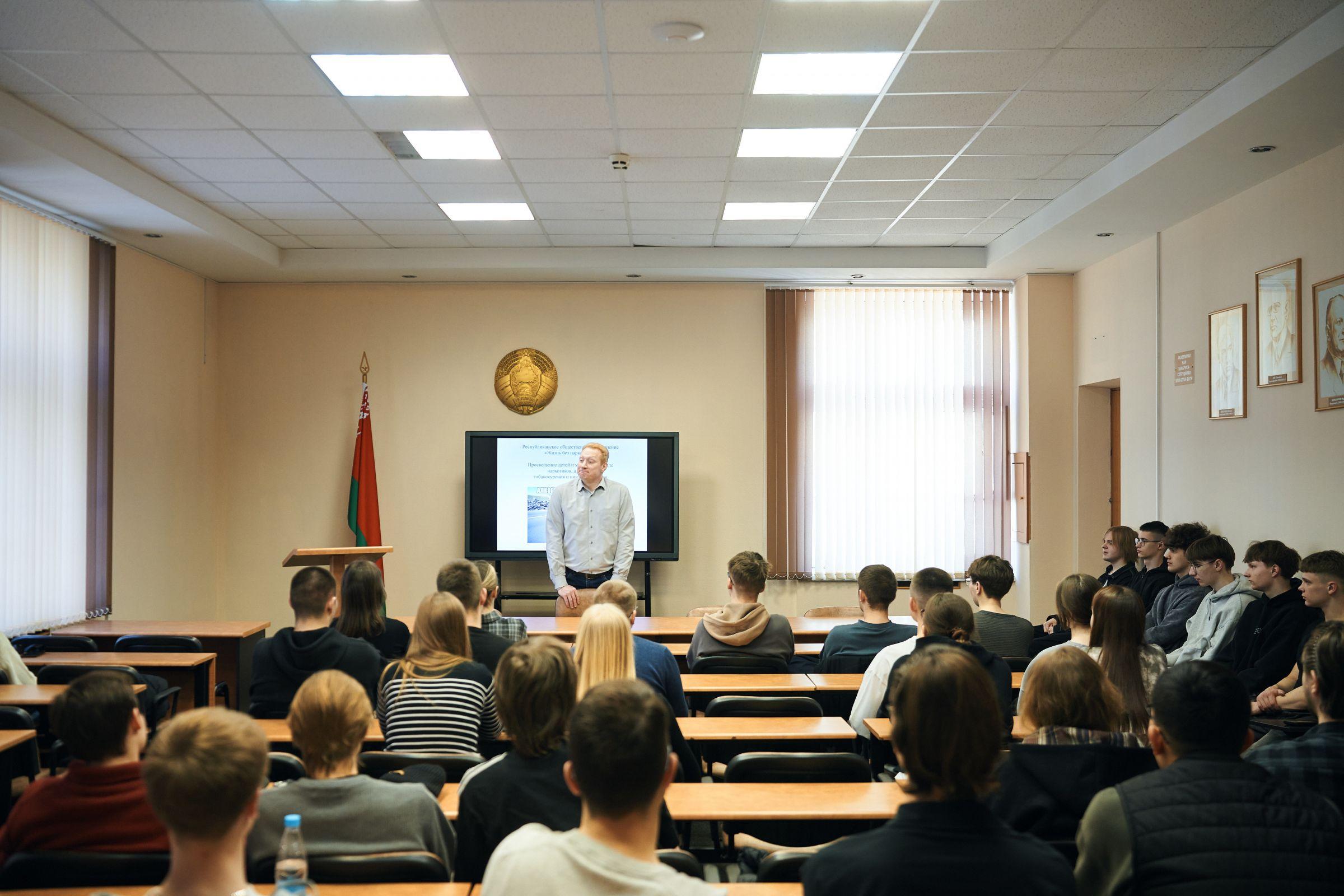
From March 3rd to March 19th, the Belarusian National Technical University hosted a series of meetings titled "Artificial Happiness," dedicated to the International Day Against Drug Abuse and Illicit Trafficking. The speakers at the events were representatives of the Republican Public Association "Life Without Drugs," Vyacheslav Filipenko and Evgeny Dovzhenko. A total of 5 discussions took place in the dormitories and the main academic building, organized by the Socio-Pedagogical and Psychological Service of the Center for Ideological Work and Youth Affairs.
A central element of the discussions was explaining the mechanism of action of any psychoactive substances. The speakers invited students to define drugs themselves. The students actively engaged in the dialogue, offering options such as: "substances that befuddle the mind," "means that alter consciousness," and "psychotropics."
— A drug (including nicotine and alcohol) is a substance that is not naturally present in our body. It causes three effects: it alters consciousness, creates addiction, and destroys the body, — explained Vyacheslav Alekseevich.
The audience showed particular interest in the Ron Hubbard Tone Scale demonstrated by the speakers, which arranges human emotional states in ascending order, from apathy and grief to joy and enthusiasm.
During the dialogue, the students also learned about why people start using narcotic substances and how the "pendulum" of addiction works.
— A person has a smoke, gets a dose of nicotine, and rises to a feeling of joy for an hour and a half. After this time, the drug's effect wears off, thoughts become confused, hands shake, and they need to find a new dose of illusory satisfaction. Gradually, a person loses the previous feeling from a single dose, and therefore the addiction becomes more severe. All this can lead to irreversible consequences – death, — emphasized Vyacheslav Filipenko.
The speakers also touched upon the topic of energy drinks and coffee. They advised against overusing these beverages and recommended avoiding them before exams.
The open dialogues between Vyacheslav Filipenko, Evgeny Dovzhenko, and the students about how drugs destroy the body and only create an illusion of satisfaction helped the students formulate the main idea: a conscious choice for life and a clear mind are the foundation for a full and happy life.
