1. Spark-resistant boron-containing thermo-diffusion layers on carbon structural steels.
The development belongs to the field of metallurgy, specifically to the creation of high-spark-resistant alloys and coatings, and can be used for strengthening steel parts and ensuring increased spark resistance in conditions of frictional contact.
Compositions of saturating media have been developed, and saturation conditions have been determined to ensure high wear resistance in conditions of sliding friction and spark resistance of diffusion-type coatings on steels obtained during complex treatment in a boron-containing environment.
Samples have been tested under conditions of spark formation on a specially designed module with a maximum friction interaction speed of up to 80 m/s.
As a result of the tests, photographs of spark formation on samples made of steel without coating (Figure a) and with boron-containing coating (Figure b) are presented, under identical test conditions. The presented results confirm the effectiveness of the proposed treatment, providing a low level of spark formation under conditions of frictional contact. Multicomponent saturation, saturation in a boron-based system, is an effective technological solution for creating spark-resistant layers on carbon steels such as Steel 40, Steel 45, etc.
|
a) |
b) |
|
A) Steel 45 without coating; B) Steel 45 after surface saturation with a boron-containing complex Figure - Spark formation on the investigated samples. |
|
2. Complex wear-resistant boron-containing thermo-diffusion layers with reduced brittleness.
The development belongs to the field of metallurgy, specifically to chemical-thermal processing, and can be used for the production of diffusion-hardened steel parts with increased durability under conditions of mechanical wear with moderate impact loads.
The method of thermo-chemical boriding is well known and effective for many engineering, agricultural, and construction products. However, a limiting factor for the active implementation of this technology in many areas is the increased brittleness of the layers and the inability to withstand impact conditions, which cause chipping of the formed layer. This development, through original compositions of mixtures, control of temperature-time parameters, and preliminary surface preparation, allows obtaining a special morphology of the layer that compensates for elastic interactions between structural components and provides increased layer ductility. As a result, resistance under moderate impact loads is increased, and accordingly, the range of hardened products is expanded.
The microstructure of the modified boride layer on the steel is shown in the figure, demonstrating partial fragmentation of the needle-like structure due to the composition of the mixture, pre-treatment conditions, and temperature-time saturation conditions.
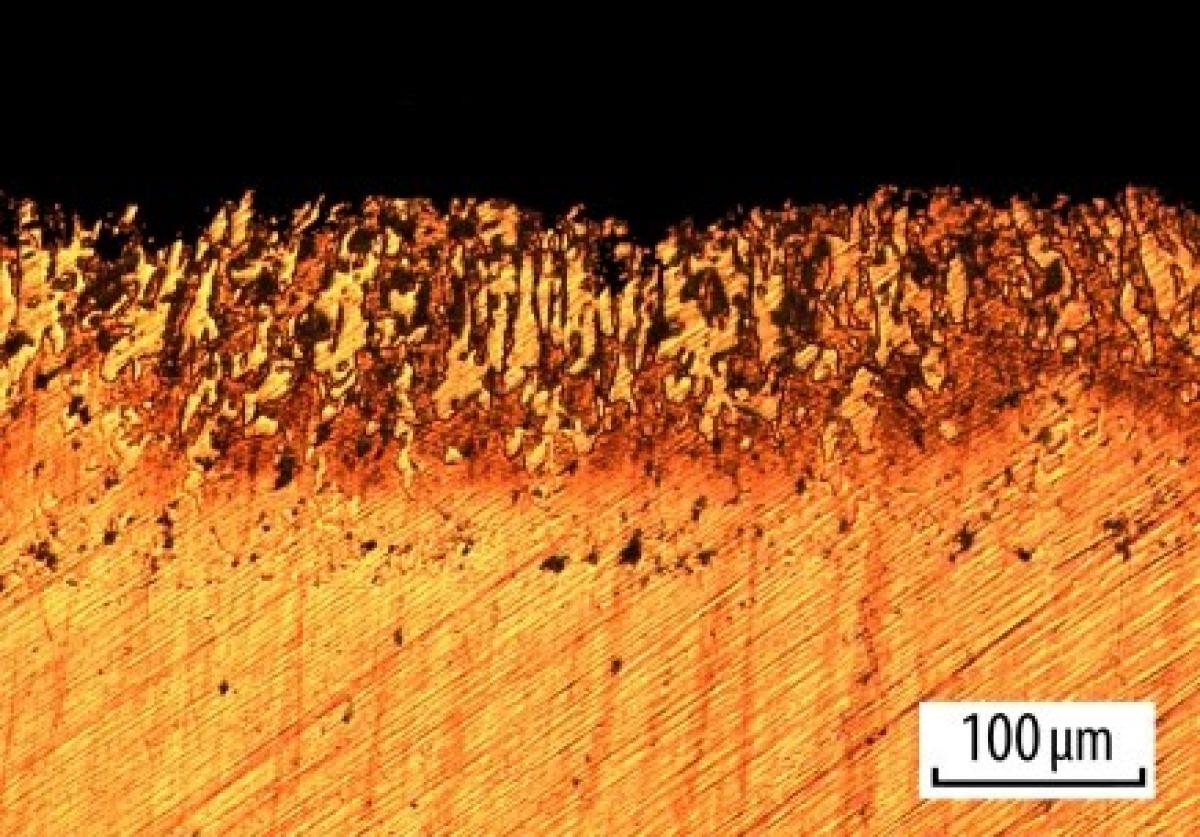
Figure - Microstructures of modified boride layer on steel
The maximum microhardness value of these layers on steels is achieved at the surface of the sample and can reach 18 GPa, corresponding to the microhardness of the FeB phase.
The considered complex coatings have reduced brittleness, determined by the spalling stress, which is 1.5 to 1.8 times less than traditional boriding. Functionally, such layers, due to reduced brittleness, demonstrate high wear resistance in conditions of tests with moderate impact loads.
3. Wear and corrosion-resistant nitrogen-, carbon-, boron-containing composite coatings on tool steels, obtained by thermo-diffusion saturation and vacuum deposition.
A range of composite coatings based on TiN, TiAlN, and others has been developed using strengthening technology, which includes pre-chemical-thermal treatment of the substrate and subsequent application of a vacuum coating. As a result of the combined use of chemical-thermal and vacuum ion-plasma treatment on the surface of a steel product through thermochemical exposure and vacuum deposition, a layer of a new material with a different composition and properties is formed - a composite coating "thermo-diffusion layer - ion-plasma coating."
The microhardness and wear resistance of composite coatings "thermo-diffusion layer - TiAlN coating," obtained as a result of various types of thermochemical treatment (TCT), are presented in the table below.
Table - Properties of steels with diffusion layers and TiAlN coating.
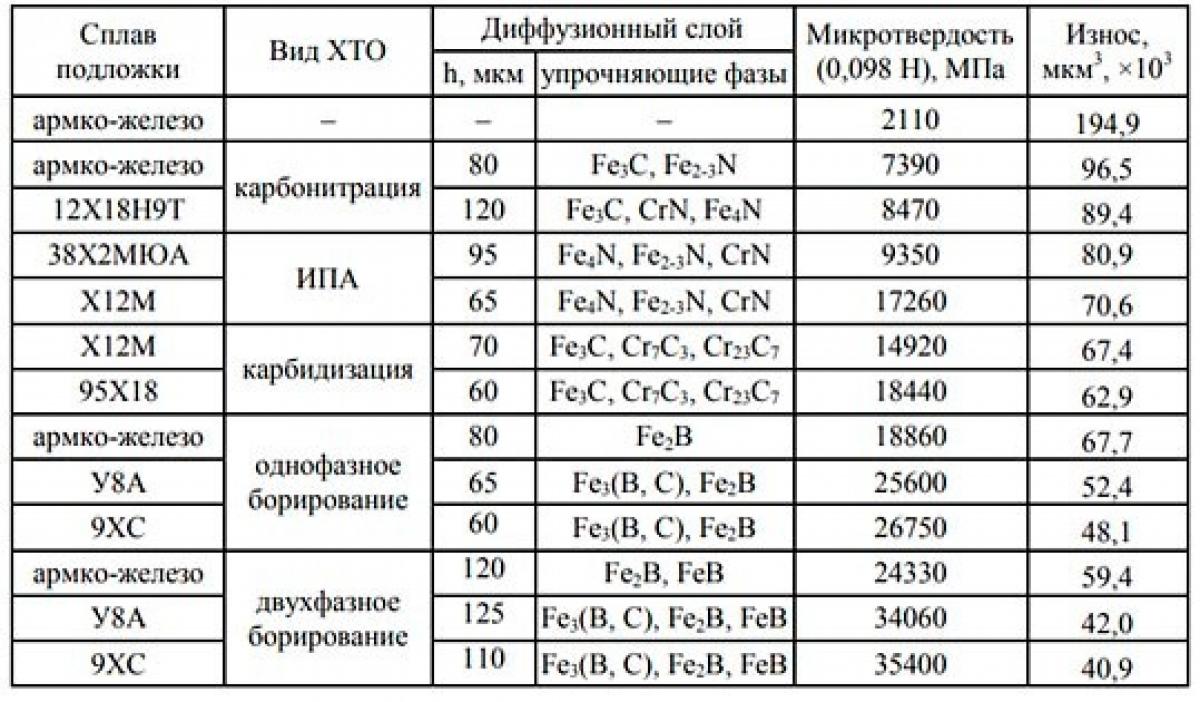
For the considered coatings, a non-additive increase in surface microhardness and wear resistance of the steel is noted as a result of carburizing and the application of TiN coating. The increase in microhardness and wear resistance from the complex treatment by more than 3.0...6.2 and 2.4...10.8 times, respectively, exceeds the cumulative increase in these properties from carburizing and the application of TiN coating separately. The presence of a carburizing layer on the steel substrate enhances the adhesion of TiN and TiAlN coatings and contributes to their cohesive failure. This is due to the formation of a transitional diffusion layer between the thermo-diffusion layer and the vacuum coating and secondary structure formation processes.
4. Build-up materials and thermal spray materials obtained by thermo-diffusion alloying.
The essence of the development lies in the use of surface-alloyed discrete material in the form of powder or shot as a build-up alloy. Additionally, effective is the use of wire, which, after saturation, can be used for build-up and thermal spraying processes (metalizing). In general, the following directions for synthesizing new materials for build-up and thermal spraying can be distinguished:
- Surface alloying with fluxing-strengthening elements of cast iron powders, including cast iron chips (chips of cast irons: ICH28N2, SC20);
- Surface alloying with fluxing-strengthening elements of steel powders (powders: PR-steel 45, PR-10P6M5, PR-X18H9);
- Surface alloying with fluxing-strengthening elements of steel wires (wires: U7, steel 08).
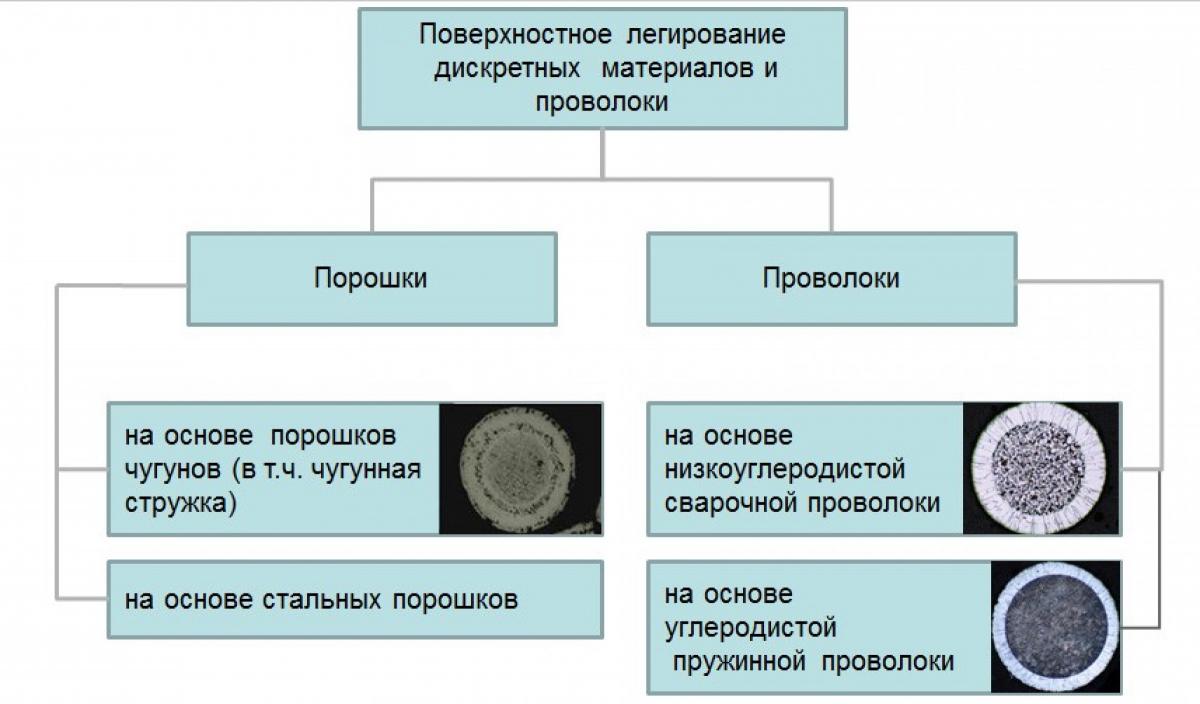
Figure - Diffusion-alloyed powder materials for build-up and thermal spraying
A distinctive feature is the use of production waste as the starting component in the form of chips or shot. This results in a sharp reduction in costs for build-up material. Such material is typically used for induction build-up. The powder mixture is applied to the surface to be treated with a layer of the specified thickness, then the surface of the part is heated by an inductor and powder. An abrasion-resistant build-up of about 1.0 - 2 mm thick is formed. The porosity of the obtained layers is about 3 - 5%. When using cast iron shot, the structure of the deposited layer has regions of hypoeutectic, eutectic, and hypereutectic structure, with a hardness of the deposited layers up to 60 HRC.
5. Highly efficient technology of thermo-diffusion zinc coating of steel products.
The essence of the development is the formation of a protective layer through thermo-diffusion treatment in powder media based on waste from hot-dip galvanizing.
As a result, high economic efficiency of thermo-diffusion zinc coating is ensured due to the use of synthetic media based on waste from hot-dip galvanizing; as well as energy resource savings through the elimination of final heat treatment operations for products, combining the application of a protective layer and the formation of the required operational properties of the products into a single technological operation.
The technology provides processing of products with surfaces of any complexity. The coating is uniform and accurately reproduces the surface profile. In addition, excellent adhesion is formed with paint coatings without the use of primers. Practically all types of industrial paints adhere well to this coating, which practically eliminates blistering and paint peeling from the surface.
The structure and phase composition of the layer formed ensure increased resistance to corrosion damage and mechanical impacts (maximum integral microhardness among all known zinc coatings, up to 4500 MPa). The thermo-diffusion zinc coating process is environmentally safe as the process takes place in tightly closed containers.
Figure - Fasteners after thermo-diffusion zinc coating
