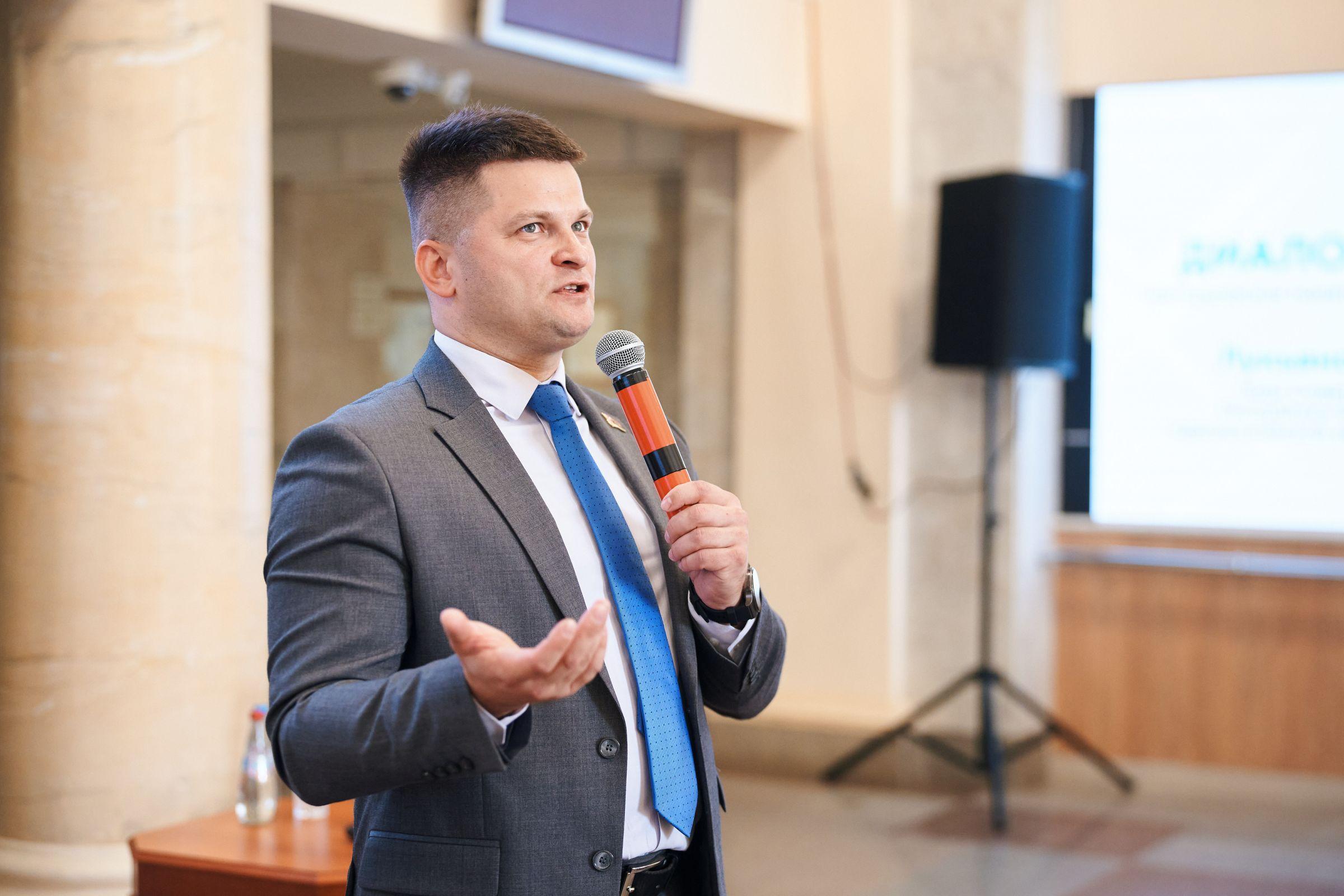
Today, September 15, the Belarusian National Technical University (BNTU) hosted a dialogue session titled "Historical Memory and Patriotism: The Foundation of National Unity" as part of the "Student Knowledge" information and outreach project.
The speaker was Alexander Lukyanov, a member of the Standing Commission on International Affairs and National Security of the Council of the Republic of the National Assembly of the Republic of Belarus and Head of the Main Directorate for Ideological Work and Youth Affairs of the Minsk City Executive Committee. Active students from all faculties gathered for the event to discuss—in an open dialogue format—the preservation of historical truth and the role of youth in the state's development.
As the meeting was held during the "Unified Information Day," the upcoming National Unity Day was a key topic of discussion. Alexander Lukyanov elaborated on the events of 1939, emphasizing that for the Belarusian people, this represented a crucial act of restoring justice. From 1921 onwards, a harsh policy aimed at suppressing national identity was enforced in Western Belarus; Belarusian schools were closed, and people were forbidden from speaking their native language. The darkest symbol of that era was the Bereza-Kartuzskaya concentration camp—a site of severe hardship for many Belarusians. The speaker noted that this tragic chapter of history must not be forgotten.
"It was a genuine ethnocide against the Belarusian people, where individuals were persecuted and killed simply for wishing to speak their native language and freely practice their faith. The culmination of this brutal policy was the Bereza-Kartuzskaya concentration camp, established specifically to suppress any form of dissent." Up to 10,000 of our compatriots endured torture, harrowing ordeals, and death there. A memorial complex now stands on the site, and I strongly urge each of you to visit it to grasp the magnitude of those events and pay your respects.
The conversation shifted from the lessons of the past to the challenges of the present. The guest highlighted the issue of information security, noting that the modern media landscape often features biased and distorted assessments of the situation in our country—frequently from people with no real understanding of life in Belarus. That is precisely why it is more important than ever for young people—who will soon be starting families and building careers in their homeland—to possess critical thinking skills and the ability to analyze information.
Following the presentation, the audience asked numerous questions covering a wide range of topics. For instance, when asked to give one key piece of advice to a young Belarusian turning eighteen, Alexander Lukyanov gave a simple answer: "You need to take action and not be afraid of making mistakes; it is far more regrettable to miss an opportunity, hesitate to ask a question, or fail to show initiative."
When asked to describe modern patriotism using three verbs, the speaker chose "believe," "act," and "unite." He explained that belief in one's cause eliminates doubt, constant development turns ideas into reality, and teamwork helps overcome any obstacle.
In his concluding remarks, Alexander Lukyanov noted that the open forum at BNTU serves as a model for other educational institutions:
"The 'Student Knowledge' project at BNTU sets an example for many universities, not just in Minsk but across the entire country. Here, within the walls of the historic first building, we discussed vital topics. I even noticed students stopping—young people who were simply passing by or rushing between lectures. That is the true value of an informal approach." The theme of the Unified Information Day was "National Unity Day as a Source of National Pride." It is crucial for every student to understand that the goal today is not merely to acquire a basic minimum of knowledge, pass exams, and obtain a diploma. One must recognize the immense historical foundation upon which our country’s education, science, and industrial sectors are built. It is particularly important to emphasize this here, at an alma mater that has launched the careers of so many engineers, designers, and even government ministers. Through such forums for dialogue, the university leadership brilliantly succeeds in uniting student potential and expert insights with a vision for our country's future unity.
We thank Alexander Lukyanov for his engaging presentation and for providing comprehensive answers to students' questions. Held in the run-up to National Unity Day, this open dialogue served as an excellent reminder of the importance of cherishing our history and building the future together.
